

Is the soap you bought to "protect" your ceramic coating actually the primary cause of its failure? Many owners believe that "ceramic-infused" products are the superior choice, yet these formulas often leave behind surfactant films that clog the coating's surface and kill its natural hydrophobicity. To maintain a professional-grade finish, you need a lubricant-heavy surfactant that prioritizes surface decontamination over temporary wax fillers. Selecting the best soap for ceramic coated cars requires understanding the chemical balance between cleaning power and coating safety.
It's frustrating to watch a high-gloss finish lose its water-beading performance due to simple maintenance errors. This article explains the scientific criteria for choosing a maintenance soap that preserves the integrity of your Ceramic Graphene Shield. You'll learn how pH-neutral, pure formulations prevent "clogging" and extend the life of a professional coating to its maximum 7-year rating. We'll examine the technical differences between reactive shampoos and pure surfactants to help you achieve measurable efficiency and professional results with SKY MAXPRO engineering.
Key Takeaways
- Learn why high-lubricity surfactants are essential for maintaining surface tension and preventing the "clogging" phenomenon that masks hydrophobic performance.
- Identify the chemical advantages of pH-neutral 7.0 formulations, which qualify as the best soap for ceramic coated cars by cleaning without compromising the bond of your graphene or ceramic layer.
- Compare the long-term effects of pure maintenance soaps versus SiO2-infused shampoos to determine which engineering approach best preserves your coating’s 7-year rating.
- Implement a professional-grade wash protocol using foam cannon emulsification and the two-bucket method to eliminate mechanical abrasion during decontamination.
- Explore how aerospace-grade standards drive the development of biodegradable, high-lubricity maintenance solutions designed specifically for Ceramic Graphene Shield technology.
Why Your Coating Demands Specialized Surfactant Engineering
Maintaining a vehicle protected by a Ceramic Graphene Shield requires a shift from traditional cleaning mindsets to precise chemical engineering. A ceramic coating is a semi-permanent nanotechnology layer that bonds to the substrate at a molecular level. Unlike factory clear coats, these surfaces are engineered for extremely low surface energy. This specific property is what creates the "self-cleaning" effect. However, using a generic detergent can compromise this architecture within a single wash cycle. The best soap for ceramic coated cars is defined as a high-lubricity, residue-free surfactant system that prioritizes the complete emulsification of contaminants without leaving a secondary film behind.
SKY MAXPRO applies aerospace-grade standards to automotive maintenance, treating every surface with the same precision required for industrial monitoring or thermal diagnostics. In the professional sector, efficiency is measured by the longevity of the solution. If a soap leaves a residue, it isn't cleaning; it's contaminating. While modern car wash techniques have evolved significantly, many consumer-grade products still rely on outdated chemical structures. These formulas fail to rinse clean from the dense, non-porous structure of a graphene or ceramic lattice, leading to a dull finish and reduced performance.
The Problem with Traditional "Wash and Wax" Products
Generic "wash and wax" soaps are fundamentally incompatible with ceramic technology. These products utilize carnauba wax or synthetic gloss enhancers designed to fill the pores of a standard clear coat. When these organic wax particles encounter an inorganic ceramic layer, they can't bond correctly. Instead, they sit on top of the coating, creating a sticky, high-energy surface. This layer acts as a magnet for industrial fallout and dust, effectively burying the coating’s performance under a film of cheap oils. Gloss enhancers in these soaps are temporary masks that provide a false sense of shine while actively degrading the surface's ability to shed water.
Protecting the Hydrophobic Architecture
The primary goal of maintenance is to preserve the contact angle of water droplets. A high contact angle ensures that water beads and rolls off, carrying dirt with it. When you use the wrong soap, you lower this angle and destroy the surface's tension. Hydrophobic clogging is the accumulation of surfactant residues, environmental pollutants, or organic waxes that physically mask the nanotechnology peaks of a coating, resulting in a total loss of water-repellent performance. To prevent this, the best soap for ceramic coated cars must be chemically "pure." It should break the bond between road grime and the ceramic layer, then rinse away completely to reveal the untouched hydrophobic peaks of the original coating.
The Science of pH-Neutrality and Residue-Free Formulations
The core of maintenance engineering lies in the logarithmic pH scale. While aggressive cleaners use alkaline or acidic ranges to strip organic matter, a maintenance wash must remain at a precise 7.0. This neutrality ensures the surfactant system interacts with surface contaminants without compromising the covalent bond of the coating. Using the best soap for ceramic coated cars isn't just about safety; it's about chemical stability. High-performance coatings are sensitive to ionic residues that can alter surface energy, making rinse-ability a critical engineering requirement. A soap that fails to rinse clean leaves a microscopic film that acts as a bridge for environmental pollutants.
pH-Neutral vs. pH-Balanced: The Professional Distinction
Professional detailers often distinguish between products that are merely "pH-balanced" and those that are truly "pH-neutral." A balanced soap might start as a harsh alkaline that manufacturers "correct" using acidic buffering agents. While the final reading is 7.0, these reactive chemicals can leave a microscopic film or degrade the coating’s longevity over repeated applications. SKY MAXPRO prioritizes biodegradable, VOC-free formulations that are neutral by design, not by correction. This approach maintains the structural integrity of the Ceramic Graphene Shield while ensuring the surface remains free of chemical stress.
Surfactant Technology: Lifting Without Stripping
Surfactants function through a process known as molecular encapsulation. Instead of using chemical heat to dissolve dirt, these molecules surround grit particles in a lubricated envelope. This prevents the dirt from making contact with the paint as it's moved across the surface. Many consumers mistakenly equate high foam with cleaning power. In reality, excessive suds often indicate a high-surfactant load that requires more water to rinse, which increases the risk of hard water spots. High-foaming soaps can be counterproductive if the rinse phase isn't executed with extreme precision.
The engineering focus should remain on lubricity, which is the "slip" between the wash mitt and the paint. A high-lubricity formula allows for mechanical decontamination with zero abrasion. Achieving this balance is a core component of the Professional Auto Detailing Master Checklist, which outlines the necessity of residue-free cleaning for aerospace-grade results. Selecting the best soap for ceramic coated cars means choosing a product that leaves zero ionic residue, ensuring the coating’s hydrophobic peaks remain fully exposed to repel water and pollutants efficiently.
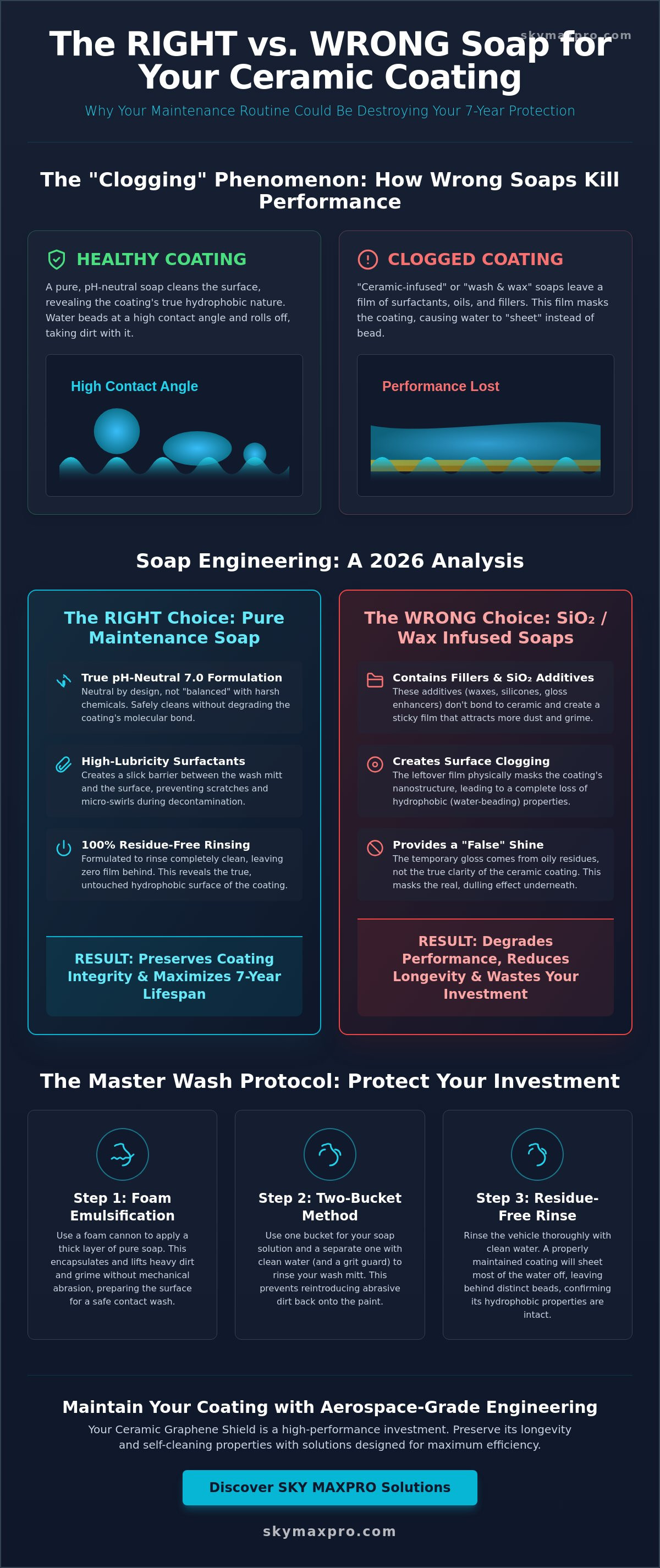
Ceramic-Infused Shampoos vs. Pure Maintenance Soaps: A 2026 Analysis
The detailing market in 2026 is divided between two primary philosophies: "wash and protect" versus "clean and maintain." For owners of high-performance vehicles, selecting the best soap for ceramic coated cars requires a strategic choice between SiO2-infused formulas and pure surfactants. While infused products promise to "recharge" a coating, they introduce chemical variables that can interfere with the native performance of advanced nanotechnology shields. A professional-grade maintenance routine prioritizes the removal of contaminants without altering the surface chemistry of the existing protection.
Evaluating SiO2-Infused "Ceramic Washes"
SiO2-infused shampoos contain silicon dioxide polymers that deposit a temporary hydrophobic layer during the wash process. These products provide a measurable boost in water beading for vehicles with neglected or aging coatings. They act as a stop-gap measure, restoring surface tension when the base layer begins to fail. However, these benefits come with technical trade-offs. On a high-quality, healthy coating, the additional polymers can cause streaking or uneven buildup. This "masking" effect often hides the actual condition of the base coating, making it difficult to determine when a true decontamination or professional "reset" is required.
Why Professionals Prefer "Pure" Maintenance Shampoos
Precision detailing relies on total control over the surface environment. Pure maintenance shampoos are engineered without waxes, silicones, or gloss enhancers. Their sole function is to emulsify road film and rinse away completely. This ensures that the base coating, such as a Ceramic Graphene Shield, performs exactly as the manufacturer intended. Pure soaps are universally compatible with various protection types, including ceramic, graphene, and Paint Protection Film (PPF). The Pure Soap Standard is the benchmark for 2026 detailing excellence, ensuring that no secondary films interfere with the coating's hydrophobic architecture.
Graphene coatings, in particular, demand even higher levels of rinse-ability than standard SiO2 layers. Graphene’s unique molecular lattice provides superior heat dissipation and reduced water spotting, but these benefits are easily neutralized by the surfactant residues found in cheaper, "infused" soaps. To maintain the integrity of a graphene-enhanced surface, the surfactant must leave the surface atomically clean. If you need to enhance gloss or hydrophobicity, professionals recommend using a dedicated "topper" like a Ceramic Spray Coating after the wash, rather than relying on a soap to do two jobs at once. This strategic framework allows for targeted maintenance: the soap cleans the surface, while the spray provides the sacrificial protection. This separation of tasks ensures maximum efficiency and prevents the chemical "clogging" that leads to premature coating failure.
The Master Wash Protocol: Protecting Your Surface Investment
Applying a high-performance coating is only the first stage of surface engineering. The secondary, and arguably more critical, phase is the execution of a consistent maintenance protocol. Even the most advanced graphene lattice can be compromised by mechanical abrasion or chemical mismanagement. A professional wash cycle isn't merely about aesthetics; it's a controlled decontamination process designed to remove abrasive particulates while maintaining the structural integrity of the coating. To achieve this, you must integrate the best soap for ceramic coated cars into a system that eliminates unnecessary physical contact with the paintwork.
The pre-wash phase is the foundation of this protocol. Utilizing a foam cannon to apply a thick layer of surfactant allows for the emulsification of surface grit without manual agitation. This non-contact stage utilizes chemical energy to lift heavy soil, reducing the risk of swirl marks during the subsequent contact wash. When the soap dwells on the surface, it encapsulates contaminants, allowing them to be rinsed away safely. High-efficiency surfactants ensure that the bond between road film and the ceramic layer is broken before a wash mitt ever touches the vehicle.
Step-by-Step: The Professional 2026 Wash Cycle
- Thermal Regulation: Pre-rinse the vehicle with cool water to lower the surface temperature of the panels. This prevents the soap from drying prematurely and causing surfactant spotting.
- Foam Encapsulation: Apply a dense foam layer using a pure maintenance soap. Allow it to dwell for 3 to 5 minutes to maximize emulsification.
- Two-Bucket Execution: Use the two-bucket method with grit guards. This is a non-negotiable standard for scratch-free maintenance. Agitate the surface with a dedicated microfiber mitt, ensuring you rinse and inspect the mitt after every single panel.
- Deionized Rinse: Perform a final rinse using a deionized water source. Managing water quality is vital, as high TDS (Total Dissolved Solids) levels in hard water can lead to mineral etching on the ceramic surface.
The drying phase is where most coating damage occurs. Traditional leather chamois or low-quality towels create friction that can mar the finish. Professionals utilize forced air or high-GSM (grams per square meter) microfiber drying towels to lift water away without dragging contaminants across the substrate. This ensures the surface remains atomically clean and free of microscopic scratches that dull the gloss over time.
Post-Wash Maintenance: The Final Touch
Once the drying is complete, inspect the surface for any remaining mineral deposits or "clogging." If water beading appears sluggish in specific areas, it often indicates bonded contaminants that the wash didn't fully remove. Utilizing a ceramic-compatible quick detailer can safely neutralize these deposits and restore the high-gloss finish. For a deeper understanding of which chemicals best support your coating, consult the Professional Car Detailing Products Guide. This engineering-focused resource details how to select the best soap for ceramic coated cars and secondary protection layers. To maintain aerospace-grade precision for your vehicle, upgrade your maintenance kit with SkyMax Pro engineering today.
SKY MAXPRO Solutions: Aerospace-Grade Maintenance for Ceramic & Graphene
SkyMax Pro approaches automotive surface care through the lens of industrial engineering. Our maintenance lineup isn't merely a collection of cleaning agents; it's a suite of chemical solutions engineered to support the Ceramic Graphene Shield ecosystem. By applying the same rigorous standards used in aerospace diagnostics and precision monitoring, we ensure that every surfactant provides a safety margin far exceeding standard consumer requirements. The best soap for ceramic coated cars must offer more than simple decontamination; it must preserve the molecular lattice of the coating against UV degradation and industrial fallout.
Our "no-compromise" formulation strategy prioritizes three technical pillars: biodegradability, precise pH-balance, and high-lubricity. These aerospace-approved formulas are designed to be chemically inert regarding the coating while remaining aggressive toward road film and organic contaminants. This balance is critical for maintaining the 5 to 7-year performance rating of professional-grade graphene installations. By utilizing high-lubricity surfactants, we reduce the coefficient of friction during the wash, effectively eliminating the primary cause of microscopic marring on the substrate.
The Ceramic Waterless Wash Alternative
In scenarios involving light dust or environmental fallout where a traditional hose-and-bucket setup is impractical, the SKY MAXPRO Ceramic Waterless Car Wash serves as a high-efficiency alternative. This solution utilizes polymer encapsulation science to isolate grit particles within a lubricated barrier. This process transforms abrasive contaminants into a non-reactive state, allowing them to be wiped away without compromising the surface. It's the ideal tool for maintaining a "Mirror Shine" between deep decontamination cycles, ensuring the hydrophobic architecture remains unobstructed by light surface soil.
The Professional Detailer’s Choice
Professional detailing shops have increasingly adopted SKY MAXPRO concentrates as their industrial standard for maintenance. The ability to achieve aviation-grade results on daily drivers is no longer reserved for high-end boutique services. Our concentrated formulas allow professionals to customize the surfactant load based on the specific protection level of the vehicle, whether it's a standard ceramic layer or an advanced graphene shield. This data-driven approach to detailing ensures maximum efficiency and cost-optimization for high-volume operations where results must be measurable and repeatable.
Precision maintenance is the final step in protecting your technological investment. Don't settle for retail-grade detergents that mask performance and clog your coating. Upgrade your maintenance routine with SKY MAXPRO professional soaps to ensure your surface protection performs at its peak engineering specification for years to come.
Advancing Your Surface Maintenance Strategy
Maintaining a high-performance finish requires shifting from generic cleaning to a systematic decontamination approach. We've established that the best soap for ceramic coated cars must prioritize residue-free surfactants over temporary wax fillers to avoid the clogging that destroys hydrophobicity. By adhering to the 7.0 pH-neutral standard and utilizing high-lubricity formulas, you ensure the Ceramic Graphene Shield remains functional for its full 7-year rating. Precision in the wash phase is the only way to guarantee long-term surface efficiency.
SkyMax Pro delivers this through aerospace-approved nanotechnology that is VOC-free and biodegradable. Our solutions are manufactured locally in the United States to meet the highest industrial safety and performance standards. This engineering precision provides a safety margin that retail-grade detergents simply can't match. It's time to treat your vehicle with the same accuracy required for industrial monitoring and thermal diagnostics.
Ready to optimize your detailing workflow? Explore the SKY MAXPRO Collection of Professional Detailing Supplies and secure your surface investment today. Achieve professional-grade results with the confidence of aerospace engineering.
Frequently Asked Questions
Can I use Dawn dish soap on a ceramic coated car?
No, you should never use dish soap for routine maintenance. While it's effective at stripping grease, its high alkalinity can prematurely degrade the coating's surface tension and structural integrity. Using a dedicated pH-neutral surfactant is the only way to ensure you aren't chemically attacking the nanotechnology layer you've invested in.
How often should I wash my ceramic coated car in 2026?
Maintain a wash frequency of every 7 to 14 days to prevent contaminant bonding. Even with a high-performance graphene shield, environmental fallout and industrial dust can accumulate and mask the coating’s properties. Regular cleaning ensures these particulates don't have time to bake into the surface under UV exposure.
Is it safe to go through an automatic car wash with a ceramic coating?
Avoid automatic washes that utilize rotating brushes or curtains. These systems cause mechanical marring and swirl marks that even a 10H hardness rating can't fully prevent. If a hand wash isn't possible, a touchless system is a safer alternative, though the aggressive chemicals in touchless washes can still shorten the coating's lifespan.
What happens if I use a soap with wax on my ceramic coating?
Soaps containing waxes or gloss enhancers will clog the coating’s hydrophobic peaks. This creates a secondary, low-quality film that kills water beading and attracts more dust. You'll lose the self-cleaning effect of your ceramic layer until this organic wax residue is completely stripped away with a pure surfactant.
Do I need a special soap for graphene coatings specifically?
Graphene coatings don't require a unique chemical class, but they demand superior rinse-ability. The best soap for ceramic coated cars with graphene is a pure maintenance shampoo that leaves zero ionic residue. This ensures the graphene lattice remains exposed to provide its signature heat dissipation and water-spot resistance without interference.
Can I use a foam cannon with any ceramic-safe soap?
Yes, provided the soap is engineered with high lubricity and the correct surfactant load. Most professional-grade maintenance soaps are designed to be diluted for foam cannon use. This pre-wash stage is vital for emulsifying surface grit and reducing the risk of scratches during the mechanical agitation phase.
What is the best way to dry a ceramic coated car to avoid water spots?
Forced air is the professional standard for drying coated surfaces. By using a high-velocity blower, you remove water from crevices and panels without making physical contact. If air drying isn't an option, use a high-GSM microfiber towel to blot the surface rather than dragging it across the paintwork.
Does a ceramic coating make the car "scratch-proof" during washing?
No coating is completely scratch-proof; they are scratch-resistant. While a Ceramic Graphene Shield provides a significant sacrificial barrier against minor abrasions, poor wash techniques will still cause damage. You must still use the two-bucket method and high-lubricity soaps to maintain a swirl-free finish over the years.