

Most drivers accept visual distortion and sun-glare streaks as an unavoidable reality of automotive maintenance, but true optical clarity is actually a measurable engineering outcome. You've likely spent hours scrubbing your windshield only to have a blinding web of residue appear the moment you drive into direct sunlight. Identifying the best car window cleaner isn't just about removing surface dirt; it's about addressing the molecular bonds of interior plastic off-gassing and environmental contaminants that standard retail soaps leave behind.
Achieving a factory-fresh view requires moving beyond basic detergents toward aerospace-grade formulations that protect your expensive window tints and delicate interior surfaces. We'll show you how to utilize professional-grade science to achieve an "invisible" glass finish that remains clear even in the harshest lighting conditions. This guide explores the technical advantages of Window Crystal Multi Cleaner and other VOC-free solutions. You'll learn how to implement a high-precision cleaning regimen that ensures a safe, non-toxic environment while providing the high-definition visibility required for modern driving standards.
Key Takeaways
- Understand how interior plastic off-gassing and environmental grime create visual hazards that require molecular-level cleaning rather than simple surface wiping.
- Learn why the best car window cleaner utilizes nanotechnology to actively break down contaminants instead of relying on traditional, residue-heavy surfactants.
- Identify the four technical pillars of professional glass maintenance: tint safety, VOC-free chemistry, precise evaporation rates, and streak resistance.
- Master the "Two-Towel Method" and specific environmental preparation steps to ensure an optical-grade finish without the interference of direct sunlight.
- Discover the performance advantages of aerospace-grade formulations that provide long-lasting protection and high-definition clarity for modern automotive glass.
Beyond Visibility: Why Selecting the Best Car Window Cleaner is a Safety Priority
Automotive maintenance often focuses on mechanical reliability, yet the optical clarity of the vehicle's glass is a primary safety parameter. Achieving the standard of the best car window cleaner involves more than just removing visible dust. It requires the elimination of light-diffracting films that compromise a driver's reaction time. While standard Windshield washer fluid handles surface debris during transit, it cannot address the complex layers of road grime and chemical residues that accumulate over time. These layers act as a filter, reducing the transmission of light and increasing the intensity of glare from external sources.
Road grime consists of oily hydrocarbons and metallic particles that bond to the exterior surface. Simultaneously, the interior glass surface accumulates a hazy film caused by plastic off-gassing. This occurs when interior polymers release plasticizers, creating a greasy layer that scatters light. There is a technical distinction between "clean" glass and "optically clear" glass. Optically clear glass ensures that light passes through the medium without refraction or scattering; this is critical for the performance of modern Advanced Driver Assistance Systems (ADAS). If the glass is clouded by residue, the cameras and sensors responsible for lane-keep assist and emergency braking may receive degraded data, leading to system failure or inaccurate detection.
The Danger of Household Cleaners on Automotive Surfaces
Ammonia-based household sprays are structurally incompatible with automotive glass requirements. Ammonia acts as a solvent that aggressively degrades aftermarket window tints, causing them to peel or turn purple over time. These cleaners also interact negatively with automotive sealants, leaving behind a surfactant residue. This residue causes "ghosting," where headlights from oncoming traffic appear as multiple smeared images. Identifying the best car window cleaner means choosing a formula specifically engineered to evaporate without leaving these light-catching solids behind, ensuring the structural integrity of your vehicle's interior finishes remains intact.
The Impact of Interior Cabin Air Quality
The chemical composition of cleaning agents directly impacts the cabin environment. Many generic cleaners contain high levels of Volatile Organic Compounds (VOCs), which can linger in the enclosed space of a vehicle long after the cleaning process is complete. Professional-grade, VOC-free formulas are necessary to maintain a safe respiratory environment for passengers. As detailed in our guide on Engineering the Perfect Shine, using high-performance, non-toxic solutions is a cornerstone of professional vehicle detailing. This approach ensures that the pursuit of visual clarity doesn't compromise the health of the vehicle's occupants or the longevity of the interior materials.
The Engineering of Clarity: Nanotechnology vs. Traditional Surfactants
Understanding the transition from basic soaps to advanced glass maintenance requires a look at The Chemistry of Cleaning. Traditional surfactants work by reducing the surface tension of water, allowing it to surround and lift oils or proteins from the glass surface. While effective for general debris, these surfactants often leave behind microscopic solids that result in streaks or a secondary film. To identify the best car window cleaner for modern high-performance vehicles, we must look toward nanotechnology. Rather than simply lifting dirt, nano-engineered formulas break down contaminants at a molecular level; this ensures that no residue remains to scatter light or attract new dust particles.
High-performance automotive glass demands a residue-free environment. Many consumer-grade products rely on heavy solvents that evaporate quickly but leave behind chemical "ghosting" under direct sunlight. In contrast, water-based, high-lubricity formulations prioritize the suspension of particles. This prevents the abrasive action that often occurs when wiping away dry contaminants. By utilizing molecular-level cleaning agents, these professional solutions ensure that the glass surface is truly bare. This provides the optical clarity required for both human vision and the accuracy of sensitive camera sensors.
Breaking Down the "Film" on Interior Glass
Interior windshield haze is primarily the result of outgassing. This technical process involves the release of volatile vapors from the polymers, vinyls, and adhesives used in your car's dashboard and upholstery. These vapors condense on the glass, creating a greasy layer that is notoriously difficult to remove with standard cleaners. Specialized formulas neutralize these vapors through molecular bonding, which prevents the immediate re-accumulation of film. Using a dedicated professional solution like Window Crystal Multi Cleaner allows you to strip these plasticizers without damaging the surrounding trim or compromising cabin air quality.
Exterior Contaminants: From Bug Splatter to Industrial Fallout
Exterior surfaces face a different set of challenges, ranging from acidic bug splatter to calcified water spots. Removing these requires a cleaner with high lubricity to act as a barrier between the glass and the contaminant during the wiping process. This prevents the micro-scratching that eventually dulls the glass finish. For vehicles with light surface dust, integrating a ceramic waterless car wash into your routine can maintain the hydrophobic properties of the glass while removing light grit safely. However, for a true optical-grade finish, the best car window cleaner must be capable of dissolving organic matter and industrial fallout without the use of harsh acids that can etch the glass surface over time.
Key Criteria for Professional-Grade Auto Glass Cleaners
The evaluation of the best car window cleaner requires a focus on four technical pillars: tint safety, volatile organic compound (VOC) levels, controlled evaporation rates, and streak resistance. Professional-grade cleaners must maintain a balanced evaporation rate. If a formula dries too quickly, it leaves behind "drying streaks" before the technician can effectively buff the surface. Conversely, slow-evaporating solvents often leave a lingering residue that attracts dust. Achieving this equilibrium is essential for ensuring that the glass surface remains chemically neutral and optically clear.
Professional detailers prioritize high-yield, concentrated formulas because they offer consistent performance across varying humidity levels. A "no-residue" guarantee is not merely a marketing claim but a safety requirement. At night, even microscopic residues scatter light from oncoming traffic, creating a visual halo effect that obscures road hazards. Eliminating this scattering is the primary objective of any professional glass maintenance regimen.
Tint-Safe Formulations: Non-Negotiable Protection
Maintaining the integrity of aftermarket window films is a primary concern. Ammonia-based products are easily identified by their sharp, pungent scent; they represent a significant risk to polyester-based tint layers. Over time, ammonia breaks down the adhesives and the film itself, leading to bubbling and discoloration. Window Crystal Multi Cleaner is specifically engineered with an ammonia-free profile, ensuring it's safe for all glass types, including factory and aftermarket tints. This chemical stability preserves the polyester layers, extending the lifespan of the film while providing the necessary clarity.
Eco-Friendly and VOC-Free Standards
Modern detailing standards emphasize both environmental impact and technician safety. High VOC levels in confined cabin spaces can lead to respiratory irritation and long-term health risks. Reviewing a Glass Cleaner Safety Data Sheet reveals the potential hazards of traditional solvent-based cleaners. Utilizing VOC-free, biodegradable ingredients ensures a safer working environment without sacrificing cleaning power. For more technical insights into sustainable surface care, refer to our Professional Car Detailing Products guide. These standards reflect a commitment to operational efficiency and health-conscious engineering, making them a requirement for any product claiming to be the best car window cleaner in the current market.
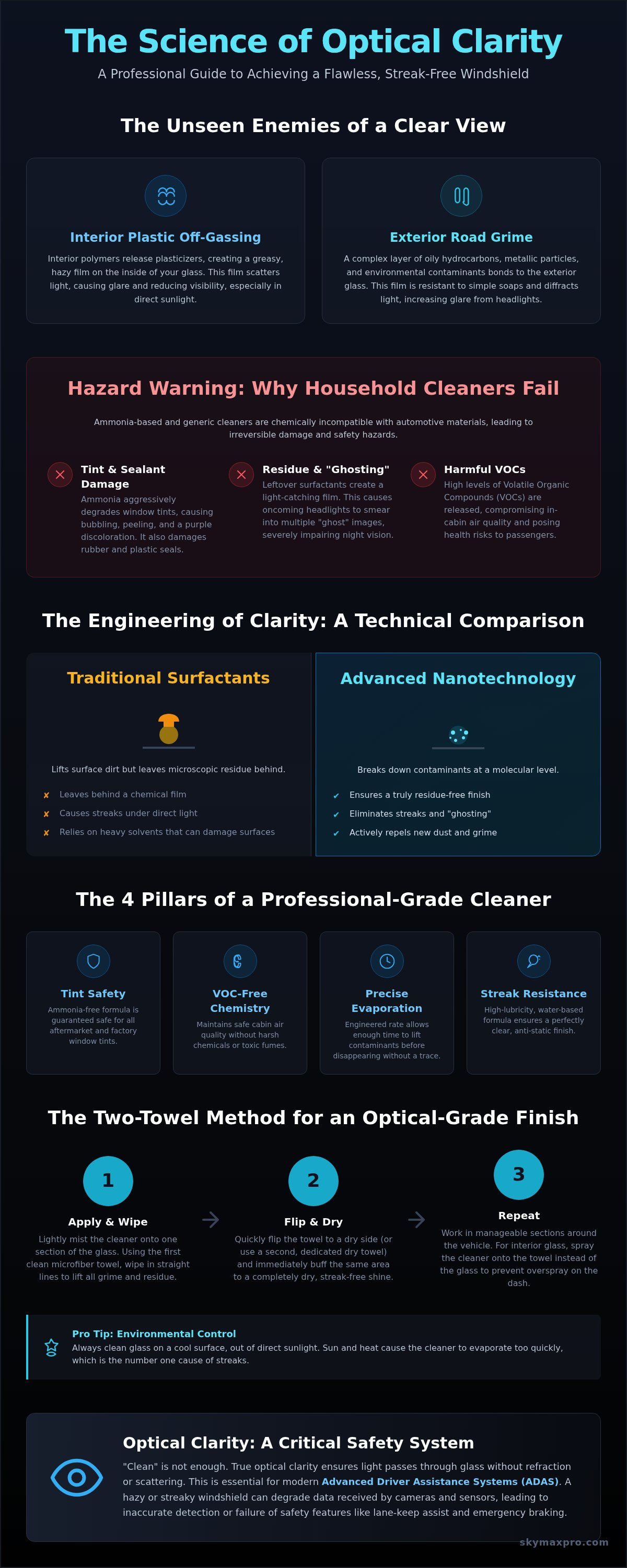
Step-by-Step Guide: Achieving an Optical-Grade, Streak-Free Finish
The technical success of glass maintenance depends as much on environmental control as it does on the chemical composition of the cleaner. You should never perform glass cleaning in direct sunlight or on a surface that hasn't reached thermal equilibrium. High glass temperatures cause rapid solvent evaporation. This leads to the premature drying of surfactants, creating the very streaks you're trying to eliminate. For the best car window cleaner performance, work in a shaded, climate-controlled environment where the glass is cool to the touch. This allows the formula enough "dwell time" to encapsulate contaminants before you begin the mechanical removal process.
Professional results require the "Two-Towel Method," a protocol that prevents cross-contamination. Use the first microfiber towel to distribute the cleaner and agitate the surface debris. Immediately follow with a second, dry, high-density microfiber towel to buff the surface to a final finish. This second towel acts as a mechanical absorbent for any remaining microscopic carrier fluid. Avoid the common mistake of using old newspapers; the petroleum-based inks can leach into modern glass coatings and leave a greasy residue that's difficult to strip. Precision is also key during application. Spray the cleaner directly onto your towel rather than the glass when working near the dashboard to avoid overspray on sensitive polymers and electronic displays.
The Internal Windshield Challenge
The acute angles of modern windshields make edge-to-edge coverage difficult. To avoid leaving gaps or oily handprints, use a dedicated glass cleaning tool with a pivoting head. This ensures even pressure across the entire surface. One of the most frequently ignored steps is cleaning the top edge of roll-down windows. Lower the window slightly to expose the grime trapped in the weatherstripping. Cleaning this edge prevents the transfer of dirt back onto the glass every time the window is operated. A final inspection using a high-lumen light source from multiple angles will verify that you've achieved true molecular clarity.
Advanced Protection: Anti-Fog and Ceramic Treatments
In high-humidity environments, visual clarity is often compromised by condensation. Applying an Anti-Fog Spray Ceramic Protection creates a microscopic barrier that prevents water droplets from bonding to the surface. These ceramic-infused treatments do more than just stop fogging; they improve the efficiency of your wiper blades and enhance water shedding during heavy rain. Regular maintenance with a high-lubricity cleaner ensures these protective layers remain intact for longer periods. To ensure your vehicle maintains this level of visual precision, you can upgrade your detailing kit with professional-grade glass solutions designed for long-term protection.
SKY MAXPRO Window Crystal: The Aerospace Solution for Automotive Glass
The Window Crystal Multi Cleaner represents the technical intersection of aerospace engineering and automotive maintenance. Unlike retail options that rely on high water content and chemical thickeners, this high-concentration formula is engineered to meet the stringent optical requirements of aviation instrumentation. By applying aerospace-grade nanotechnology, the solution ensures that no microscopic residue remains on the surface after evaporation. This level of precision is why it's frequently categorized as the best car window cleaner for professionals who demand "invisible" glass. Its versatility extends far beyond the windshield; the formula is chemically stable enough for use on side mirrors, rear-view mirrors, and even the sensitive high-definition LCD touchscreens that define modern vehicle cabins.
SKY MAXPRO functions as a bridge between industrial performance and consumer ease-of-use. We've taken the complex chemical bonding agents used in specialized sectors and refined them for the daily driver. This ensures that you don't need a professional laboratory setup to achieve world-class results. The focus remains on measurable efficiency: reducing the time spent on glass maintenance while increasing the longevity of the results. By utilizing molecular-level cleaning, Window Crystal Multi Cleaner removes the "haze" that other products simply smear across the surface, providing the high-definition visibility required for modern driving standards.
Why Detailers Choose Window Crystal
Operational efficiency is a critical metric for professional detailing businesses. Window Crystal Multi Cleaner allows for a "one-pass" cleaning process, which significantly reduces labor time per vehicle. The formula's high lubricity ensures that it doesn't just clean but also protects. It's safe for use near delicate plastic, vinyl, and high-gloss interior trim, eliminating the risk of chemical staining or etching that often occurs with cheaper, solvent-heavy alternatives. For those seeking a complete maintenance solution, integrating this cleaner with our Interior Cleaning Kit provides the necessary tools to maintain a factory-level environment across all cabin surfaces. This systematic approach ensures that every surface, from the glass to the upholstery, meets a uniform standard of excellence.
Engineered in the USA
Quality control is maintained through local manufacturing in the United States. This allows us to oversee every stage of the production process, ensuring that every bottle of the best car window cleaner adheres to strict aerospace-approved formulations. Nanotechnology is the foundation of sustainable car care, as it requires fewer chemical applications to achieve superior results compared to traditional surfactants. By moving away from harsh solvents and toward molecular-level cleaning, we provide a product that is both environmentally responsible and technically superior. If you're ready to transition from basic visibility to aerospace-level clarity, upgrade your view with the Window Crystal Multi Cleaner today.
Engineering a Future of Absolute Clarity
Maintaining automotive glass is a technical necessity that directly impacts operational safety and vehicle longevity. We've explored how moving beyond traditional surfactants toward aerospace-grade nanotechnology allows for the total elimination of light-scattering residues. By prioritizing 100% tint-safe and VOC-free formulations, you ensure a chemically stable interior environment while protecting the sensitive polymers of your cabin. The transition to the best car window cleaner represents a shift from simple surface wiping to high-precision molecular maintenance that satisfies industrial standards.
Professional detailers approve of these advanced methods because they deliver measurable results under the most challenging high-glare conditions. Whether you're neutralizing interior plastic outgassing or removing aggressive exterior road grime, the right chemical approach provides the optical-grade finish required for modern ADAS performance. It's a matter of applying engineering principles to your maintenance routine to ensure a safe, "invisible" view every time you drive. You can now achieve this level of technical excellence without specialized laboratory equipment.
Shop Window Crystal Multi Cleaner for Optical Clarity and experience the difference that aerospace-grade science makes for your vehicle. Elevate your maintenance standards today.
Frequently Asked Questions
Is it safe to use household glass cleaner on my car windows?
Household glass cleaners are generally unsuitable for automotive applications because they frequently contain ammonia. This chemical compound aggressively degrades the polyester layers of aftermarket window tints and can cause the premature drying of rubber weatherstripping. To maintain the structural integrity of your vehicle's components, you should utilize an ammonia-free formula specifically engineered for automotive glass and trim surfaces.
How do I get rid of the hazy film on the inside of my windshield?
Eliminating interior haze requires a high-concentration cleaner capable of neutralizing plasticizer outgassing. This greasy film is a byproduct of interior polymers and cannot be removed by standard water-based detergents alone. Applying a professional-grade solution with a clean microfiber towel will break the molecular bond of the film, ensuring the glass remains optically clear and free of sun-glare distortion.
What is the best way to clean tinted car windows without damaging them?
The best car window cleaner for tinted surfaces is a pH-balanced, ammonia-free solution paired with a high-density microfiber towel. You must avoid abrasive materials like paper towels or sponges, which can create micro-scratches in the delicate tint film. This professional approach ensures the tint remains intact and prevents the purple discoloration or bubbling often caused by harsh industrial solvents.
Why do my car windows always have streaks after I clean them?
Streaking is typically the result of surfactant residue or the use of a saturated cleaning towel that can no longer absorb contaminants. When identifying the best car window cleaner, professionals prioritize formulas with balanced evaporation rates that don't dry prematurely. If the glass surface is too hot, the cleaner dries before it can be buffed, leaving behind visible chemical solids that scatter light.
Can I use Window Crystal Multi Cleaner on my car’s infotainment screen?
Yes, Window Crystal Multi Cleaner is safe for use on automotive infotainment screens and high-definition electronic displays. Its residue-free formulation ensures that it won't interfere with touch sensitivity or degrade sensitive anti-reflective coatings. You should always spray the solution onto a microfiber towel first rather than directly onto the screen to prevent moisture from entering the electronic housing or surrounding buttons.
What is the "Two-Towel Method" for glass cleaning?
The "Two-Towel Method" is a professional protocol designed to prevent the re-deposition of contaminants during the cleaning process. You use the first towel to distribute the cleaner and agitate the surface grime. A second, completely dry towel is then used to buff the glass to its final finish, ensuring that any remaining carrier fluid is mechanically absorbed before it can evaporate into streaks.
How often should I clean my car windows for optimal safety?
You should clean your car windows every two weeks to maintain optimal visual clarity and ensure the accuracy of ADAS sensors. Environmental factors like industrial fallout or high-heat outgassing can accelerate film accumulation on both exterior and interior surfaces. Regular maintenance prevents the build-up of thick, light-diffracting layers that compromise your reaction time during night driving or in heavy rain conditions.
Does anti-fog spray really work on car windows?
Anti-fog sprays are effective because they create a microscopic hydrophilic layer on the glass surface. This layer reduces the surface tension of moisture, causing it to spread into a thin, transparent film rather than forming light-scattering droplets. It's a critical safety addition for high-humidity environments where temperature differentials between the cabin and exterior are significant, preventing the sudden loss of visibility.