

The microscopic porosity of a matte finish makes it a high-performance magnet for metallic debris, turning a standard wash into a complex chemical engineering challenge. If you've ever hesitated before applying a cleaner, fearing that one wrong move could permanently stain an expensive rim, you understand the technical volatility of these surfaces. Mastering the process of cleaning brake dust from matte wheels requires more than just soap; it demands a precise understanding of pH-neutral decontamination and surface safety.
We recognize that the 2026 trend toward an "OEM+ aesthetic" prioritizes a factory-perfect satin sheen over artificial gloss, yet standard chemicals often leave behind white streaks or ghosting that ruins the look. This guide outlines the professional protocols for removing aggressive, pitted particles without compromising the original flat finish. You'll learn how to implement a systematic decontamination workflow and utilize advanced shielding technologies to ensure that your wheels remain protected and easier to maintain in the long term.
Key Takeaways
- Analyze the microscopic structural differences between matte and gloss finishes to understand why metallic particles bond more aggressively to porous surfaces.
- Identify the chemical requirements for cleaning brake dust from matte wheels, specifically the necessity of pH-neutral gel formulas that provide extended dwell time without surface staining.
- Master the professional decontamination protocol, starting with thermal stabilization to prevent chemical flash-drying on sensitive wheel surfaces.
- Avoid critical maintenance failures by eliminating gloss-enhancing surfactants and mechanical clay bars that can permanently alter the original flat sheen.
- Implement long-term surface preservation using ceramic graphene technology to create a heat-resistant, hydrophobic barrier against future metallic contamination.
The Engineering Challenge: Why Matte Wheels Trap Brake Dust
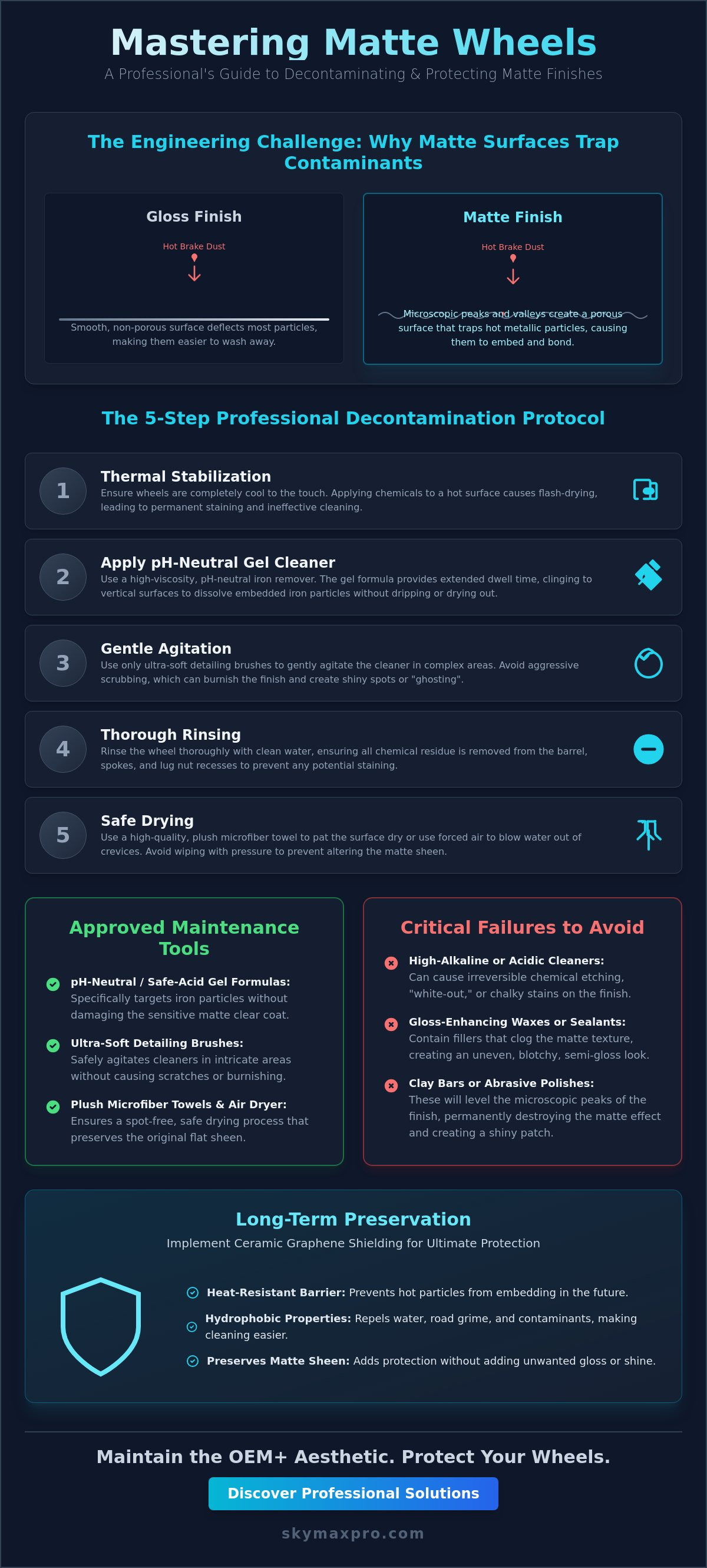
Matte wheels represent a specific engineering paradox. While they provide a sophisticated, future-oriented aesthetic, their surface geometry is fundamentally designed to trap contaminants. Unlike a glossy clear coat, which is chemically leveled to create a mirror-like finish, a matte finish is purposefully engineered with microscopic irregularities. These peaks and valleys are what diffuse light to create a flat sheen; however, they also serve as high-friction collection points for industrial debris.
The primary source of contamination stems from the fundamental physics of deceleration. During the operation of disc brake mechanics, intense friction between the brake pads and rotors generates incandescent metallic shards. These iron particles often reach temperatures exceeding 400 degrees Celsius. When these hot shards impact a matte surface, they don't simply sit on top. They melt into the porous structure of the clear coat, creating a mechanical bond that standard detergents cannot break.
As the wheel cools, the clear coat contracts around these particles, effectively anchoring them within the finish. This heat-cycling makes cleaning brake dust from matte wheels a task that requires chemical intelligence rather than brute force. Traditional mechanical polishing is not an option here. Because polishing is the process of leveling a surface to make it smooth, any attempt to "buff out" a stain on a matte wheel will permanently destroy the finish by creating an irregular, shiny patch. Once the microscopic peaks are leveled, the matte effect is gone forever.
Porosity and Surface Tension in Matte Finishes
The "peaks and valleys" of a matte surface increase the overall surface area compared to a gloss finish. This increased area leads to higher surface tension, which holds onto oils, road film, and metallic debris with greater tenacity. These valleys act as physical anchors for hot metallic particles, shielding them from the reach of basic wash mitts. If you apply too much friction or use an aggressive brush, you risk burnishing the peaks of the finish. This results in "ghosting," a permanent alteration where the wheel looks stained or unevenly glossy.
The Chemical Reaction of Brake Dust Oxidation
Once iron particles are embedded in the finish, they begin a process of rapid oxidation when exposed to moisture and oxygen. As iron turns into iron oxide (rust), the particle expands in volume. This expansion exerts outward pressure on the surrounding clear coat, leading to microscopic pitting and permanent structural damage to the finish. The chemical bond between brake dust and matte paint is a complex interaction of thermal embedding and subsequent metallic oxidation. To preserve the finish, you must use specialized chemistry to neutralize these iron particles before they can expand. Failing to address this decontamination early makes cleaning brake dust from matte wheels nearly impossible without risking the integrity of the specialized clear coat.
Selecting Engineering-Grade Supplies for Matte Maintenance
Selecting the correct chemical profile is the most critical decision in the decontamination workflow. Because matte finishes lack the protective leveling of a traditional gloss clear coat, they're highly susceptible to chemical etching. Many off-the-shelf cleaners rely on high-alkaline surfactants to break down road film, but these high-pH formulas often react with the specific flatting agents used in matte paint. This reaction leads to irreversible "white-out" or chalky staining that ruins the uniform appearance of the rim.
The Role of pH Balance in Matte Surface Preservation
Effective cleaning brake dust from matte wheels requires a shift from aggressive alkalinity to targeted, pH-balanced acidity. While the term "acid" often suggests corrosion, engineering-grade "Safe ACID" formulations are designed for specific molecular targeting. These agents focus exclusively on the iron oxide bonds of the brake dust without attacking the polymer structure of the matte finish. This is particularly relevant as regulatory bodies emphasize the environmental impact of non-exhaust emissions, including particulate matter and microplastic pollution from automotive braking systems. Using a controlled gel, such as the PRO Safe ACID Gel Wheel & Rim Cleaner, ensures the chemical stays in contact with the metallic shards long enough to dissolve them without drying on the sensitive surface.
Essential Tools for Non-Abrasive Cleaning
The physical application of these chemicals must follow a strict "no-scrub" philosophy. Since you can't polish out scratches on a matte surface, the tools you choose must be strictly non-abrasive. Soft boar hair brushes are the industry standard for this application. Unlike synthetic nylon bristles, which can be too rigid and cause micro-marring, boar hair provides enough structural integrity to agitate the gel into lug nut pockets while remaining gentle on the finish.
Microfiber selection is equally vital. Only premium-grade, high-GSM (grams per square meter) towels should touch the wheel. Lower-quality towels often contain polyester blends that can "burnish" the matte peaks through friction, creating unwanted shiny spots. When cleaning brake dust from matte wheels, your goal is to let the chemistry do 90% of the work. If the contamination is severe, we recommend using the PRO Safe ACID Gel Wheel & Rim Cleaner to safely emulsify the debris before a low-pressure rinse, ensuring the structural integrity of the finish remains intact.
The Professional Decontamination Protocol for Matte Wheels
High-performance detailing requires a standardized operating procedure to ensure repeatable, damage-free results. When cleaning brake dust from matte wheels, the sequence of operations is as critical as the chemistry itself. A haphazard approach often leads to uneven cleaning or, worse, chemical staining that requires professional refinishing. Following a structured engineering protocol ensures that every metallic particle is neutralized while the delicate matte clear coat remains uncompromised.
Pre-Wash and Temperature Control
Thermal stabilization is the absolute prerequisite for chemical safety. Spraying cold fluids onto hot brake rotors or wheels can cause immediate thermal shock, potentially leading to rotor warpage or micro-cracking in the wheel's finish. Beyond mechanical damage, heat accelerates chemical evaporation. If a cleaner dries on a matte surface, it can leave "ghosting" marks that are nearly impossible to remove without polishing. To ensure a safe decontamination environment, the wheel surface and braking components must be below 38°C (100°F) before any liquid application. This temperature threshold prevents the premature "flashing" of the cleaning agents and allows the surfactants to work at their designed efficiency.
Once the wheels reach a safe temperature, a thorough pre-rinse is mandatory. This step utilizes high-pressure water to remove loose particulate matter and road grit. By clearing these larger contaminants first, you reduce the risk of dragging abrasive debris across the finish during the agitation phase. It's a foundational step in preventing micro-marring on the sensitive "peaks" of the matte texture.
Agitation and Rinsing Techniques
The core of cleaning brake dust from matte wheels lies in managing the chemical dwell time without allowing the solution to reach its evaporation point. Apply your gel-based cleaner systematically, starting from the bottom and working upward to ensure total coverage. You'll observe a color-changing reaction as the specialized agents bond with iron particles. This visual indicator confirms the chemical is actively dissolving the metallic bonds. We recommend a dwell time of three to five minutes, depending on ambient humidity, but you must never let the product dry completely.
- Least Aggressive Agitation: Use a soft boar hair brush to gently disturb the gel in high-collection areas like lug nut pockets and spoke intersections.
- Single-Wheel Focus: Always process one wheel at a time to maintain total control over dwell times and prevent chemical drying.
- High-Pressure Evacuation: Use a concentrated water stream to flush the "valleys" of the matte finish, ensuring all emulsified brake dust is removed from the pores.
- Forced Air Drying: Avoid contact drying with towels if possible. Using a high-velocity air blower removes water from crevices and prevents the formation of calcium deposits or water spots that stand out on dark matte finishes.
By treating the decontamination as a technical workflow, you eliminate the variables that lead to finish failure. This protocol ensures that the original satin sheen is preserved while achieving a level of cleanliness that standard wash methods can't match.
Avoiding Common Failures in Matte Wheel Detailing
The margin for error when maintaining matte finishes is non-existent. While a glossy clear coat allows for corrective measures like compounding and polishing, a matte surface is a "one-way" finish. Any mistake made during the process of cleaning brake dust from matte wheels, whether it's a chemical mismatch or a mechanical overreach, results in permanent structural damage. Understanding these common failure points is essential for preserving the refractive properties that give matte wheels their distinct, non-reflective appearance.
Gloss-enhancing soaps and "wash and wax" products represent a significant risk to surface integrity. These formulas are engineered to fill microscopic surface imperfections with wax or silicone to create a smooth, reflective plane. On a matte wheel, these agents settle into the peaks and valleys discussed earlier, creating blotchy, irregular shine patches that destroy the original satin sheen. Similarly, mechanical clay bars must be strictly avoided. The abrasive nature of claying, which is designed to shear off contaminants, will simultaneously shear off the microscopic peaks of the matte texture, leading to permanent "bright spots" or localized glossing.
The Myth of "All-Purpose" Cleaners
Many operators rely on high-alkaline degreasers or consumer-grade glass cleaners for wheel maintenance, assuming their "all-purpose" label implies safety. This is a technical fallacy. Aggressive degreasers can strip the essential oils from matte powder coatings, leading to surface dehydration and eventual micro-cracking. In addition, glass cleaners often contain surfactants that leave behind a hazy residue, which is highlighted by the dark, flat nature of matte rims. To ensure your entire workflow meets industrial standards, consult our Professional Auto Detailing: The 2026 Master Checklist for a comprehensive breakdown of aerospace-grade protocols.
Mechanical Damage: The Irreversibility of Friction
Friction is the enemy of the matte finish. Because you cannot "buff out" a scratch, every physical contact must be calculated during the process of cleaning brake dust from matte wheels. Using stiff nylon brushes or applying excessive pressure with a wash mitt can burnish the finish. This burnishing effect is a mechanical alteration of the surface texture, turning a flat area into a semi-glossy one. This is often referred to as "ghosting," and once it occurs, the only solution is a complete wheel strip and recoat. If you are looking for similar high-end spray results for your property, visit SKR Specialists to explore professional respray services for residential and commercial sites.
Environmental factors like hard water spots also present a significant risk. In national environments with high mineral content, water droplets that dry on the surface leave behind calcium and magnesium deposits. These minerals bond to the porous matte structure and are significantly harder to remove than brake dust. If you encounter persistent mineral scaling, don't attempt to scrub it off. Instead, utilize a specialized Water Spot Remover designed to chemically dissolve mineral bonds without the need for abrasive friction, ensuring your matte wheels retain their engineered finish.
Long-Term Protection: Ceramic Graphene Shielding
The final phase of professional wheel maintenance isn't the rinse; it's the implementation of a semi-permanent sacrificial barrier. While the decontamination protocols discussed previously effectively remove contaminants, they leave the porous matte surface exposed to immediate re-soiling. By utilizing nanotechnology, we can alter the surface energy of the rim to repel metallic debris. This shift from reactive cleaning to proactive shielding is what separates standard detailing from engineering-grade surface management. Integrating a high-performance barrier like the Ceramic Graphene Shield Coating ensures that the microscopic valleys of the matte finish are protected without the introduction of unwanted gloss.
The Science of Graphene on High-Heat Surfaces
Graphene represents a significant technological leap over traditional polymer sealants or waxes. Traditional waxes have low thermal stability; they begin to soften and become "sticky" at temperatures common to wheel surfaces during braking. This tackiness actually causes brake dust to bond more aggressively. Graphene, a single layer of carbon atoms arranged in a hexagonal lattice, possesses extraordinary thermal conductivity and heat resistance. It dissipates the heat generated by disc brake mechanics across the wheel surface, preventing the localized "burning in" of hot metallic shards.
The molecular structure of a graphene-based coating is small enough to fill the microscopic pores of the matte clear coat. It creates a hydrophobic and oleophobic surface that prevents water and oils from anchoring. Because the coating is optically clear and extremely thin, it preserves the original light-diffusing properties of the matte finish. This creates a "self-cleaning" effect where light rain or a low-pressure rinse can remove a significant portion of road film. Professional data suggests that this level of protection simplifies the process of cleaning brake dust from matte wheels so effectively that subsequent maintenance times are reduced by up to 70%.
Applying Protection to Matte Wheels
The efficacy of a ceramic graphene barrier depends entirely on the quality of the bond. Before application, the wheel must undergo a "strip wash" to remove any remaining chemical residues or surfactants from the cleaning phase. A final panel wipe with an alcohol-based prep solution ensures the surface is chemically bare. When applying the Ceramic Graphene Shield Coating, work in small sections, ensuring the product is leveled evenly across intricate spoke geometries. For a deeper technical analysis of these molecular bonds, refer to our guide on The Engineering of Ceramic Coating. Once cured, this shield provides a resilient defense against chemical attacks and metallic pitting, maintaining the factory-perfect satin sheen of your wheels through 2026 and beyond.
Precision Maintenance for the Future of Automotive Finishes
Maintaining the integrity of a matte finish requires a shift from traditional detailing to a protocol-driven engineering approach. We've established that the microscopic porosity of these surfaces demands pH-neutral decontamination and strict temperature control. By eliminating abrasive mechanical methods and adopting gel-based chemistry, you prevent the permanent ghosting and burnishing that often ruins high-value rims. Mastering the process of cleaning brake dust from matte wheels is ultimately about managing surface energy through advanced shielding rather than aggressive friction.
Implementing a nanotechnology-based barrier is the final step in ensuring long-term operational efficiency and finish preservation. Our biodegradable and eco-friendly cleaning solutions provide the foundation for this maintenance, while our graphene treatments are formulated with aerospace-approved nanotechnology and engineered for high-heat automotive environments. Upgrade to Aerospace-Grade Protection with the SKY MAXPRO Ceramic Graphene Shield to secure a factory-perfect finish that resists metallic bonding. With the right technical workflow, your wheels will remain a testament to engineering precision and aesthetic excellence.
Frequently Asked Questions
Can I use a clay bar to remove stubborn brake dust from matte wheels?
No, you must avoid mechanical clay bars on matte surfaces. Claying is an abrasive process designed to level surface contaminants, which will simultaneously shear off the microscopic "peaks" of the matte texture. This results in permanent burnishing or shiny spots that cannot be reversed. Chemical decontamination is the only safe method for removing embedded particles without altering the finish.
Will a ceramic coating make my matte wheels look glossy?
A specialized nanotechnology coating will not add artificial gloss if it is engineered for matte surfaces. High-quality barriers, such as a ceramic graphene shield, are designed to be optically clear and thin enough to fill microscopic pores while preserving the light-diffusing properties of the original finish. It enhances the depth of the color without creating a reflective shine.
How often should I clean brake dust from high-performance matte wheels?
We recommend a thorough decontamination every 2 to 4 weeks, depending on your driving volume and brake pad compound. High-performance braking systems generate significant heat, which accelerates the bonding of metallic shards to the porous finish. Regular cleaning brake dust from matte wheels prevents iron particles from oxidizing and causing permanent pitting in the clear coat.
Is it safe to use a pressure washer on matte-finished rims?
Yes, pressure washing is a highly effective method for evacuating debris from the "valleys" of a matte finish. You should maintain a nozzle distance of at least 12 inches and ensure the pressure does not exceed 1500 PSI to prevent physical stripping of the coating. High-pressure rinsing is superior to hand-scrubbing as it reduces the risk of micro-marring caused by friction.
What happens if I use a traditional car wax on my matte wheels?
Traditional waxes contain gloss enhancers and carnauba fillers that settle into the matte texture, creating a blotchy and uneven appearance. These products are designed to create a smooth, reflective plane, which is the exact opposite of what a matte finish requires. Once wax is applied, it's difficult to remove from the porous surface without using aggressive solvents that may damage the clear coat.
Why do my matte wheels look white or chalky after cleaning?
A chalky residue is typically the result of using high-alkaline degreasers or allowing chemicals to dry on the surface. These aggressive surfactants react with the flatting agents in the matte paint, leading to chemical staining. Using a pH-neutral gel cleaner and ensuring the wheel is cool to the touch before application prevents this "white-out" effect.
Can I use iron removers on matte powder-coated wheels?
Yes, pH-balanced iron removers are essential for the safe maintenance of powder-coated matte finishes. These chemicals utilize a targeted reaction to dissolve iron oxide bonds, allowing you to rinse away metallic debris without the need for abrasive scrubbing. It is the most technically sound way to handle heavy accumulation on intricate spoke designs.
What is the best way to dry matte wheels to avoid water spots?
Forced air is the industry-standard drying technique for matte finishes. Using a high-velocity air blower removes moisture from every crevice and pore, eliminating the risk of mineral deposits forming water spots. Contact drying with towels, even premium microfibers, carries a higher risk of burnishing the finish if any microscopic grit remains on the surface.