

Why does a factory finish often exhibit the texture of orange peel while a professional show car possesses the optical depth of a pool of liquid glass? If you've spent hours washing your vehicle only to see micro-marring and dullness under direct sunlight, you're battling the physics of light refraction rather than a lack of effort. In 2026, achieving a candy-like gloss on car paint isn't a matter of simple polishing but a result of engineering precision and molecular layering. You likely recognize that standard waxes can't provide the 5 to 7 years of durability now achievable through graphene-infused ceramic technology.
This article provides the technical roadmap to mastering aerospace-grade chemistry and professional application sequences. You'll learn how to transform standard automotive finishes into high-depth surfaces that meet the rigorous standards of the $1.84 billion global detailing market. We'll examine the specific synergy between chemical decontamination and nanotechnology to ensure your finish exceeds the performance of traditional coatings while adhering to the 600 g/L VOC limits established by 40 CFR Part 59. From surface leveling to the final flash of a Ceramic Graphene Shield, we're detailing the exact steps to secure a permanent, mirror-like finish.
Key Takeaways
- Understand the physics of light refraction and how nanotechnology layers manipulate the refractive index, which is essential for achieving a candy-like gloss on car paint.
- Master the professional decontamination protocol to eliminate iron deposits and surfactants, ensuring a perfectly leveled substrate for coating adhesion.
- Leverage the synergistic properties of graphene and ceramic to establish a 9H hardness foundation that maximizes both heat dissipation and optical saturation.
- Implement aerospace-grade maintenance standards, including pH-neutral chemistry and friction-reducing washing techniques, to preserve surface clarity against environmental degradation.
Understanding the Physics of Achieving a Candy-Like Gloss on Car Paint
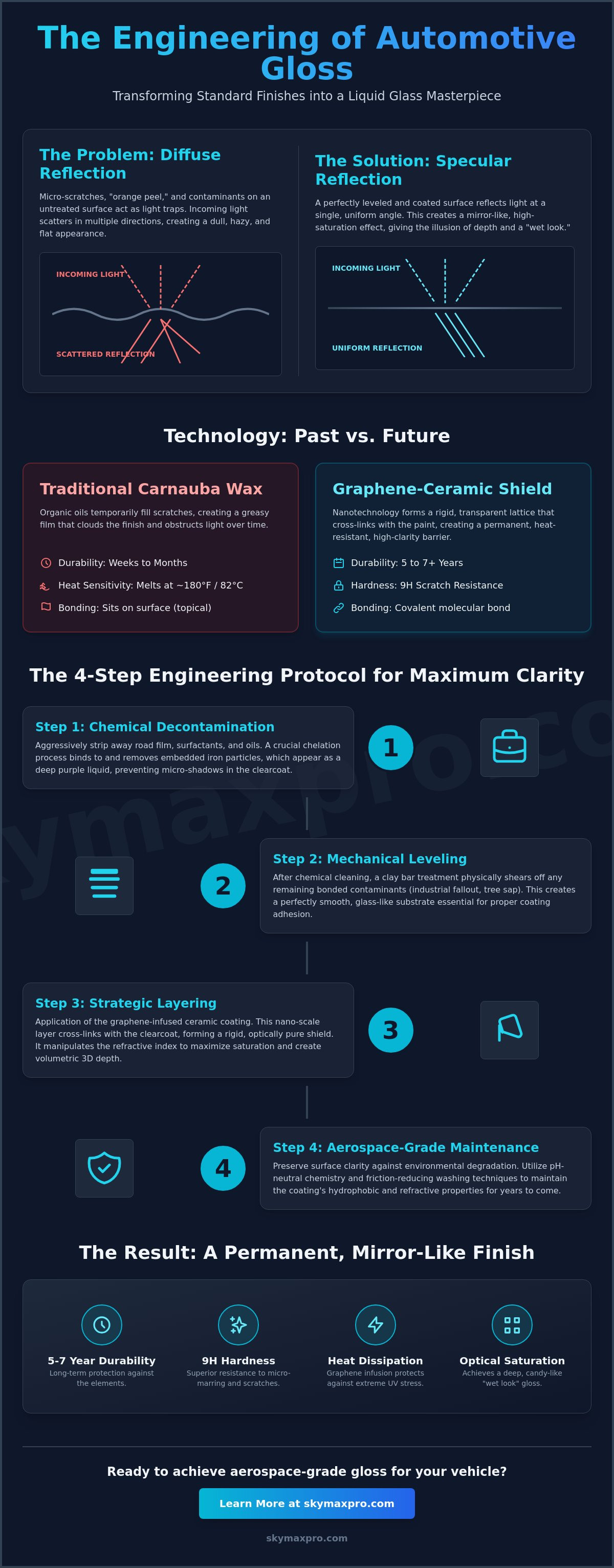
Candy-like gloss isn't a subjective aesthetic; it's a measurable optical phenomenon. In technical terms, this "wet look" occurs when light penetrates a transparent top layer, reflects off the base substrate, and returns to the observer with minimal scattering. This creates a high-saturation effect that gives the illusion of depth, making the paint appear as if it's submerged under an inch of liquid glass. Achieving a candy-like gloss on car paint requires manipulating the refractive index of the surface. By applying nanotechnology layers with high optical density, we can control how light bends as it enters and exits the coating. This engineering approach shifts the visual result from a flat 2D shine to a volumetric 3D depth.
Surface leveling is the critical prerequisite for this effect. While many consumers attempt to "fill" scratches with heavy oils, true depth requires a perfectly flat substrate. Specular reflection, where light reflects at a single, consistent angle, is only possible when the surface peaks and valleys are eliminated. If the surface is uneven at a microscopic level, light undergoes diffuse reflection, scattering in multiple directions and killing the perceived gloss. This is why professional sequences prioritize mechanical leveling over temporary chemical masking.
The Science of Specular Reflection
Micro-scratches act as light traps. When light hits these imperfections, it scatters, which reduces the clarity of the underlying automotive paint and creates a hazy appearance. High-end coatings utilize Total Internal Reflection (TIR) principles to maximize saturation. By engineering the coating to trap and then release light more efficiently, the base color appears darker and more vibrant. Aerospace-grade materials, such as those found in Ceramic Graphene Shield formulations, provide superior optical clarity because they lack the large molecular structures found in organic waxes. These nano-scale bonds create a tighter, more uniform lattice that allows light to pass through with zero distortion.
Why Traditional Waxes Often Fail to Deliver Depth
Natural Carnauba waxes have significant thermal limitations. Most organic waxes begin to soften or "melt" at approximately 180°F (82°C). On a summer day in 2026, dark car panels can easily exceed these temperatures, causing the wax to migrate and lose its structural integrity. As these organic oils decompose, they "cloud" the finish, creating a greasy film that actually obstructs light rather than enhancing it. Transitioning from these temporary, heat-sensitive fillers to permanent nanostructure bonds is essential for long-term clarity. Ceramic and graphene layers don't just sit on top of the paint; they cross-link with the surface to form a rigid, heat-resistant barrier that maintains its refractive properties even under extreme UV stress.
The 4-Step Engineering Protocol for Maximum Surface Clarity
Achieving a candy-like gloss on car paint is impossible without a standardized engineering protocol. Surface defects as small as 0.5 microns can disrupt light refraction, turning a potentially deep finish into a dull, hazy reflection. To prevent this, technicians follow a rigorous sequence designed to strip away environmental interference and level the substrate to a mirror-smooth standard. This process ensures that subsequent protective layers bond at a molecular level rather than merely sitting on top of surface contaminants. Proper execution of this protocol is the only way to transition from a simple shine to a volumetric, show-car finish.
Decontamination: The Foundation of Gloss
The first stage involves aggressive chemical decontamination. Using Heavy Duty Red Power Degreaser allows for the removal of accumulated road film, old surfactants, and organic oils that mask the paint's true texture. This is followed by a dedicated iron removal step. The chemical reaction of iron removers involves a chelation process where the active ingredient binds to embedded metallic particles, converting them into a water-soluble complex that typically turns deep purple upon contact. Removing these ferrous deposits is critical for the "candy" sparkle in metallic finishes, as even microscopic iron specs can create shadows within the clearcoat.
Clay Bar Mastery for Surface Leveling
Once chemical cleaning is complete, mechanical leveling is required to address bonded contaminants like industrial fallout or tree sap. Utilizing Final Touch I PRO Detailing Clay provides the necessary shearing force to lift these particles without marring the clearcoat. To verify results, technicians use the plastic bag method: place your hand inside a thin polyethylene bag and slide it over the panel. This amplifies tactile feedback, allowing you to feel imperfections that are invisible to the naked eye. A perfectly leveled surface is the only foundation capable of supporting high-refraction coatings.
The third stage is abrasive correction, which refines the clearcoat to remove the microscopic "haze" caused by car wash brushes or improper drying. By optimizing the surface chemistry of automotive clearcoats, we eliminate the light-scattering peaks and valleys that kill depth. Finally, the paint must be made chemically naked. Any residual polishing oils or lubricants will act as a barrier, preventing the coating from forming a permanent cross-linked bond. A dedicated surface prep wipe ensures 100% substrate exposure for the nanotechnology to follow. For those looking to streamline this process, the Exterior Detailing Kit from SKY MAXPRO contains the essential tools required to execute this engineering protocol with professional precision.
Strategic Layering: Synergizing Graphene and Ceramic for Depth
While traditional body shops argue that depth is solely a product of spray-booth clear coat thickness, modern nanotechnology allows for the manipulation of light at the molecular level. Achieving a candy-like gloss on car paint in 2026 relies on a strategic layering process known as refractive stacking. This involves establishing a high-density foundation and finishing with a sacrificial layer that acts as an optical lens. By stacking materials with different refractive properties, you create the 3D "pool of ink" effect that defines a professional show-car finish.
Graphene oxide is the primary driver of this modern depth. Its unique honeycomb lattice structure doesn't just provide 9H hardness; it enhances the saturation of the underlying pigment by reducing light diffraction. Because graphene is highly efficient at heat dissipation, it prevents the microscopic surface expansion that can cause traditional coatings to appear "soft" or hazy under intense sunlight. This thermal stability ensures the mirror-like clarity remains consistent regardless of ambient temperatures.
Applying the Ceramic Graphene Shield
The foundation of this system is the Ceramic Graphene Shield Coating. Application requires a precise cross-hatch technique to ensure a uniform film thickness across the substrate. Technicians must monitor flash times closely; the moment the coating "sweats" or exhibits a rainbow-like interference pattern, it must be leveled with a high-GSM microfiber towel. Failing to manage these flash times results in "high spots" that disrupt the specular reflection required for a candy finish. When cured correctly, this layer provides a 5-year durability promise that meets aerospace-grade standards for environmental resistance.
The "Candy" Topper: Ceramic Deep Wet Mirror Shine
To achieve the final volumetric depth, a sacrificial refractive layer is applied over the cured base. The Ceramic Deep Wet Mirror Shine Wax Sealant acts as a secondary lens, further bending light as it passes through to the graphene-reinforced clearcoat. This sequence is vital: the graphene provides the structural clarity and protection, while the sealant provides the "wet" visual characteristics. For optimal results, this topper should be refreshed every 4 to 6 months to maintain the high-saturation look. This dual-layer approach ensures that the vehicle maintains its showroom appearance without the need for a costly custom repaint, effectively bridging the gap between detailing and industrial coating technology.
Engineering these layers requires patience. Molecular cross-linking typically takes 12 to 24 hours to reach initial stability. During this window, the vehicle must remain in a controlled environment to prevent moisture from interrupting the chemical bond. Once the cross-linking process is complete, the surface reaches its peak optical density, securing the candy-like gloss against the elements.
Maintaining the Refractive Finish Against Environmental Degradation
Establishing a mirror-like surface is only half of the engineering challenge. Maintaining the optical clarity required for achieving a candy-like gloss on car paint involves a systematic approach to friction reduction and chemical balance. Once the graphene and ceramic layers have cross-linked, the surface becomes a high-energy substrate that repels water but remains vulnerable to mechanical abrasion and mineral accumulation. Failure to follow a precise maintenance protocol results in micro-marring, which scatters light and effectively kills the 3D depth achieved during the correction phase.
Friction is the primary catalyst for surface degradation. The two-bucket engineering method is mandatory for preserving specular reflection. By utilizing separate wash and rinse buckets equipped with grit guards, you ensure that abrasive particulates are sequestered at the bottom of the vessel. This prevents the reintroduction of contaminants to the wash mitt. Additionally, the chemistry of your cleaning agents must remain pH-neutral. Harsh, highly alkaline detergents with a pH of 10 or higher can strip the sacrificial topper layers and eventually degrade the ceramic matrix, leading to a loss of that signature wet appearance.
Waterless Washing for Gloss Preservation
For vehicles that aren't heavily soiled, utilizing Ceramic Waterless Car Wash is the most efficient way to clean without introducing swirl marks. This formulation uses encapsulated surfactants to lift dirt away from the surface, surrounding each particle in a lubricating polymer. When paired with high-GSM microfiber towels, the risk of dragging contaminants across the clearcoat is virtually eliminated. Daily driven vehicles in 2026 require this level of maintenance every 7 to 10 days to prevent environmental fallout from bonding to the coating.
Addressing Hard Water and Contaminants
Mineral deposits from hard water act as microscopic lenses that focus UV radiation, leading to localized etching. Utilizing Water Spot Remover allows you to chemically dissolve calcium and magnesium bonds before they penetrate the protective clear layer. This preservation of optical clarity is vital for achieving a candy-like gloss on car paint over the long term. You should also address bird droppings and tree sap immediately, as their acidic nature can compromise even 9H-rated coatings within hours of exposure. For a comprehensive look at long-term surface management, consult the Professional Auto Detailing Checklist. To ensure your maintenance kit meets these rigorous standards, explore the full range of SKY MAXPRO exterior solutions to protect your investment.
Why Aerospace-Grade Standards Matter for Automotive Gloss
Aerospace-grade standards represent the ceiling of surface protection technology. Achieving a candy-like gloss on car paint in 2026 requires more than just high-solids content; it requires molecular stability under conditions that would degrade standard consumer products. SKY MAXPRO formulations are rooted in aerospace engineering, where coatings must withstand extreme atmospheric pressure shifts and intense UV exposure at 30,000 feet. By bringing this level of rigor to the automotive sector, we ensure that the high-depth finish achieved through the 4-step protocol doesn't succumb to the oxidation that typically clouds factory clearcoats within 24 months of exposure.
Environmental regulations in 2026 have significantly tightened, with the South Coast Air Quality Management District (SCAQMD) Rule 1151 amendments taking effect on May 1, 2025. SKY MAXPRO has engineered its nanotechnology to exceed these stringent VOC requirements, focusing on biodegradable, high-performance chemistry. This precision ensures that the nanostructure bonds are tighter and more uniform than those found in traditional detailing products. When you use the same car detailing products developed for industrial applications, you're benefiting from a 99% UV rejection rate and a 9H hardness rating that prevents the micro-marring identified earlier as a gloss killer.
The SKY MAXPRO Engineering Advantage
The core of the SKY MAXPRO advantage is visible in the consistency of the molecular lattice. Unlike organic waxes that suffer from irregular molecular weights and low melting points, our coatings form a perfectly even refractive layer. This consistency is the final requirement for achieving a candy-like gloss on car paint, as it allows light to pass through the coating without the distortion caused by uneven curing. These formulations have been tested against the same thermal expansion cycles used for aircraft components, ensuring the wet look remains locked in regardless of climate.
Thermal stability is a critical factor often overlooked in traditional detailing. Standard clearcoats and waxes expand and contract at different rates, creating microscopic surface tension that disrupts light refraction. Because our graphene-infused matrices are tested against the extreme temperature deltas found in aerospace environments, they maintain their structural integrity from -60°F to over 400°F. This resilience prevents the visual softening of the gloss, ensuring the mirror-like finish remains as sharp at noon as it did in the garage. To secure this level of professional protection for your vehicle, Explore the Full SKY MAXPRO Collection and experience the peak of automotive surface engineering.
Mastering the Future of Automotive Surface Engineering
Transitioning from standard maintenance to professional-grade surface engineering requires a shift from temporary fillers to permanent nanotechnology. You've now mastered the technical requirements for refractive stacking and the precise decontamination protocols necessary for a mirror-smooth substrate. By utilizing the synergistic relationship between graphene lattices and ceramic foundations, you can ensure your finish maintains its optical density against UV degradation and environmental friction. Achieving a candy-like gloss on car paint is no longer a trade secret of high-end spray booths; it's a repeatable engineering result.
SkyMax Pro provides the industrial-grade tools required to execute these sequences with precision. Our products are proudly manufactured in the USA and utilize aerospace-grade formulations to guarantee long-term stability. The Graphene Shield provides a 5-year protection guarantee, ensuring your investment remains secure against the elements. Achieve the Ultimate Mirror Finish with the SkyMax Pro Ceramic Graphene Kit. Your vehicle is now ready to exhibit a level of depth and clarity that defines the 2026 standard for automotive excellence.
Frequently Asked Questions
How do I achieve a candy-like gloss on my car paint at home?
Achieving a candy-like gloss on car paint at home requires a standardized sequence of chemical decontamination and molecular layering. You must first strip road film using a degreaser and level the surface with detailing clay to ensure a smooth substrate. Applying a graphene-infused ceramic coating creates the necessary refractive stacking that simulates the depth of a multi-stage custom paint job without an industrial spray booth.
Can I get a candy finish on a black car without repainting?
You can achieve a deep candy finish on black paint through mechanical correction and refractive stacking. Black surfaces are highly sensitive to light scattering, so removing 100% of micro-marring is essential. Once the surface is leveled, applying a high-solids ceramic foundation followed by a graphene topper creates the volumetric depth associated with high-end show cars by maximizing specular reflection.
What is the difference between shine and depth in car detailing?
Shine refers to the intensity of light reflecting directly off the surface, whereas depth involves the saturation of color beneath a transparent layer. Achieving a candy-like gloss on car paint requires balancing both phenomena. We use nanotechnology to manipulate the refractive index, allowing light to travel through the coating and reflect off the base paint with minimal loss of saturation or clarity.
Does graphene coating make paint look wetter than ceramic?
Graphene-infused coatings generally provide a higher perceived depth than traditional ceramics because the honeycomb lattice structure reduces light diffraction. In the 2026 detailing market, valued at $1.84 billion, graphene is preferred for its ability to dissipate heat. This thermal management ensures the "wet" appearance remains consistent even when panel temperatures rise during peak solar exposure, preventing the visual softening common in older formulas.
How long does a professional candy-like gloss last?
A professional-grade candy finish achieved through nanocoatings can last between 5 and 7 years. This is a significant improvement over traditional Carnauba waxes, which typically degrade within 60 to 90 days when exposed to temperatures exceeding 180°F. The 5-year protection guarantee on SkyMax Pro Graphene Shield reflects the durability of aerospace-grade bonds that resist UV oxidation and the 600 g/L VOC-compliant chemical stressors.
Will a ceramic coating hide existing scratches in my paint?
Ceramic coatings are designed to protect and enhance, not to fill or hide defects. Any scratches or swirl marks left on the paint will be locked under the coating and may become more visible due to the increased optical clarity. You must perform a full abrasive correction to remove these imperfections before establishing the permanent nanostructure bond to ensure the finish remains mirror-smooth.
What is the best way to maintain a high-gloss finish on a daily driver?
Maintenance for a daily driver should focus on minimizing friction and chemical stress. The two-bucket method with grit guards is the industry standard for preventing new scratches during the wash process. Using a Ceramic Waterless Car Wash every 7 to 10 days is also effective for removing light dust while refreshing the sacrificial refractive layer that maintains the high-gloss effect.
Is it safe to layer different types of car wax and ceramic coatings?
Layering is safe and effective only when using chemically compatible products. We recommend establishing a 9H ceramic foundation and then adding a graphene-infused spray as a topper to increase the wet look. However, applying organic waxes over a ceramic coating is counterproductive. The wax won't bond properly to the hydrophobic surface and will eventually cloud the optical clarity of the underlying coating.