

Most vehicle owners treat interior maintenance as a simple cosmetic task, yet the reality of polymer degradation means that deep cleaning car interior plastics is actually a high-stakes engineering challenge. The chemistry of restoration is exact. You've likely struggled with the sticky, dust-attracting residue left by cheap silicone dressings or noticed door panel scuffs that refuse to budge with standard soap and water. It's frustrating to watch a dashboard lose its structural integrity and color depth due to cumulative UV damage and outdated chemical treatments. This guide provides a professional framework to master the restoration process using aerospace-grade decontamination protocols and advanced ceramic technology.
We'll move beyond surface-level wiping to explore a rigorous two-phase system of molecular cleaning and surface stabilization. You'll learn how to achieve a perfectly matte, scent-free finish that actively rejects contaminants while providing long-term UV protection. By following this technical breakdown, you'll implement 2026-compliant chemical solutions designed for maximum efficiency and a non-greasy, factory-fresh result that meets industrial standards. Our objective is to transition your maintenance routine from basic cleaning to a precise restoration of the vehicle's original material properties.
Key Takeaways
- Identify the technical causes of polymer degradation and outgassing to effectively eliminate the oily film often found on interior glass and surfaces.
- Master the selection of pH-balanced chemistry for deep cleaning car interior plastics while protecting integrated vehicle electronics and sensitive trim.
- Apply professional-grade decontamination techniques that ensure even product distribution and prevent the common issue of chemical overspray.
- Replace obsolete silicone dressings with ceramic-infused technology to provide superior UV resistance and a factory-fresh matte appearance.
- Implement a data-driven maintenance routine using anti-static agents to maintain a dust-free environment and extend the life of restoration treatments.
Understanding the Degradation of Automotive Interior Plastics
Automotive interior components are engineered from advanced polymers designed for durability; however, these materials aren't immune to environmental decay. Effective deep cleaning car interior plastics requires a fundamental understanding of how these surfaces fail at a molecular level. Most visible deterioration results from Polymer degradation processes, where long-chain molecules break down under constant thermal and oxidative stress. This structural compromise manifests as a change in color, texture, and physical integrity over the vehicle's lifespan.
One of the most persistent issues encountered by detailers is "outgassing." This phenomenon occurs when plasticizers, the chemical agents that keep plastics flexible, migrate to the surface and evaporate. Inside a sealed vehicle, these vapors condense on the coolest available surface, usually the windshield, creating a stubborn oily film that obscures vision. This isn't just a cleaning nuisance; it's a measurable indicator that the interior materials are losing their essential chemical balance and structural stability.
Three primary contaminants dictate the restoration strategy: human skin oils, atmospheric dust, and residual silicone-based dressings. Standard household cleaners usually fail in this environment because they lack the specialized surfactants needed to penetrate the micro-textured surfaces found on modern dashboards and door panels. These surfaces are often designed to mimic leather or fabric, creating deep pores that trap contaminants well beyond the reach of basic detergents.
The Impact of UV Radiation and Heat
The greenhouse effect within a vehicle cabin can raise temperatures to levels that significantly accelerate plastic embrittlement. Dashboards are the most vulnerable components because they absorb direct solar energy for extended periods. As heat increases, the rate of molecular vibration rises, leading to chain scission. Visual indicators of this damage include whitening, severe fading, and a noticeable loss of structural elasticity. Without intervention, the plastic eventually becomes brittle and prone to stress cracking under normal use.
Chemical Contamination and Biofilms
Human interaction introduces sweat and sebaceous oils that bond with environmental particulates to form a resilient "biofilm." This layer fills the plastic's pores, creating a dull, tacky surface that traditional wiping cannot resolve. Polymer degradation is a chemical process influenced by environmental catalysts. When owners apply cheap silicone-based dressings, they often worsen the problem. These greasy films act as magnets for dust and grit, creating an abrasive paste that accelerates physical wear every time the surface is touched. True deep cleaning car interior plastics involves stripping these biofilms and residues to reach the original, uncontaminated substrate.
Selecting the Right Detailing Chemistry for Deep Cleaning
Engineering a factory-fresh finish requires more than mechanical agitation; it demands precise chemical compatibility. When deep cleaning car interior plastics, selecting a pH-balanced agent is critical for preserving the integrity of modern sensitive trims and integrated electronics. Standard alkaline cleaners can cause immediate discoloration or long-term stress cracking. Scientific data from Chemical resistance testing of plastics confirms that aggressive chemical formulations often lead to premature material failure. Using a neutral surfactant-based cleaner ensures that contaminants are emulsified and lifted without compromising the polymer’s surface energy.
The distinction between daily maintenance and heavy-duty restoration is a matter of chemical concentration and molecular weight. Maintenance cleaners are designed for low-surface-tension soil, while restoration agents must break down the resilient biofilms discussed in the previous section. Safety remains a priority in 2026. New regulations, such as the New Jersey VOC limits effective August 18, 2026, mandate that non-aerosol vinyl and plastic cleaners contain no more than 15% VOCs by weight. Adhering to these standards ensures a non-toxic cabin environment while maintaining high-performance results. Advanced surfactants play a key role here, acting as bridges between water and oils to pull deep-seated grime from the micro-pores of textured surfaces.
Deep Clean Interior Cleaner vs. Heavy Duty Degreasers
Standard soil levels, such as dust and light oils, require the precision of a dedicated Deep Clean Interior Cleaner. This formulation is engineered to penetrate textured surfaces without leaving the sticky residues characteristic of inferior products. However, extreme cases involving heavy grease on kick plates or pedals require a more aggressive approach. In these scenarios, a diluted Heavy Duty Red Power Degreaser provides the necessary chemical force to strip industrial-grade grime. It's essential to follow strict safety protocols, including spot testing and immediate neutralization, to prevent staining on sensitive interior substrates.
The SKY MAXPRO Engineering Advantage
Our formulations utilize aerospace-approved chemistry to provide a level of safety and efficiency that exceeds standard automotive grades. These professional solutions are biodegradable and eco-friendly, aligning with the industry shift toward sustainable detailing practices. Utilizing a cohesive system, such as the Interior Cleaning Kit, eliminates the risk of chemical cross-contamination. This integrated approach ensures that each step of the deep cleaning car interior plastics process works in synergy to achieve a uniform, matte finish. For those seeking maximum efficiency, investing in a complete detailing solution is the most reliable way to guarantee professional results.
The Step-by-Step Interior Plastic Deep Cleaning Protocol
Executing a professional protocol for deep cleaning car interior plastics requires a systematic shift from superficial wiping to a rigorous decontamination sequence. The objective is to achieve a "naked" substrate, a surface entirely free of previous dressings, oils, and biofilms. This state is essential for the subsequent bonding of ceramic protection. Before introducing any liquid chemistry, you must isolate sensitive components. Cover infotainment screens, instrument clusters, and speaker grilles with low-tack tape or clean microfiber towels to prevent accidental ingress of moisture or chemical vapors.
Application technique determines the uniformity of the result. For large panels like door cards, mist the surface lightly to ensure full coverage. However, when working near the headliner or electronic interfaces, always spray the chemical directly into your applicator. This precision prevents overspray, which can leave stubborn spots on glass or damage internal circuitry. Professional restoration is a controlled process where chemistry and mechanical action work in a calculated tandem.
Dry Decontamination and Vacuuming
Starting with a dry phase is a mandatory engineering step. If you apply liquid cleaners to a dusty surface, you create a slurry that pushes fine particulates deeper into the plastic's grain. Use a soft-bristle detailing brush to agitate vents, seams, and tight gaps while simultaneously using a vacuum with a brush attachment to extract the loosened debris. This ensures that the subsequent wet cleaning phase focuses on bonded contaminants rather than loose surface dust. High-quality boar's hair brushes are recommended for this stage to avoid micro-scratching softer synthetic finishes.
Active Emulsification and Agitation
Once the surface is dry-prepped, apply your chosen cleaner and utilize the cross-hatch agitation technique. This involves moving your brush in overlapping vertical and horizontal strokes to ensure the chemistry reaches every angle of the plastic's texture. Managing dwell time is vital; the cleaner must stay wet long enough to break down oils but shouldn't be allowed to dry, as this can lead to chemical staining. For high-gloss "piano black" trim, skip the brushes and use a clean, dampened microfiber to avoid the swirling and marring common with these sensitive finishes.
Extraction is the final mechanical step. Use a high-GSM (grams per square meter) microfiber towel to lift the emulsified suspension from the surface. Don't scrub; instead, use firm, single-direction wipes and flip the towel frequently to expose a clean side. Verification occurs once the panel is dry. A properly decontaminated surface will appear perfectly matte and feel slightly "grippy" to the touch. If any sections appear shiny or slick, residual oils remain, and the deep cleaning car interior plastics process must be repeated in those specific areas until the substrate is uniform.
Restoring and Protecting: The Ceramic Advantage
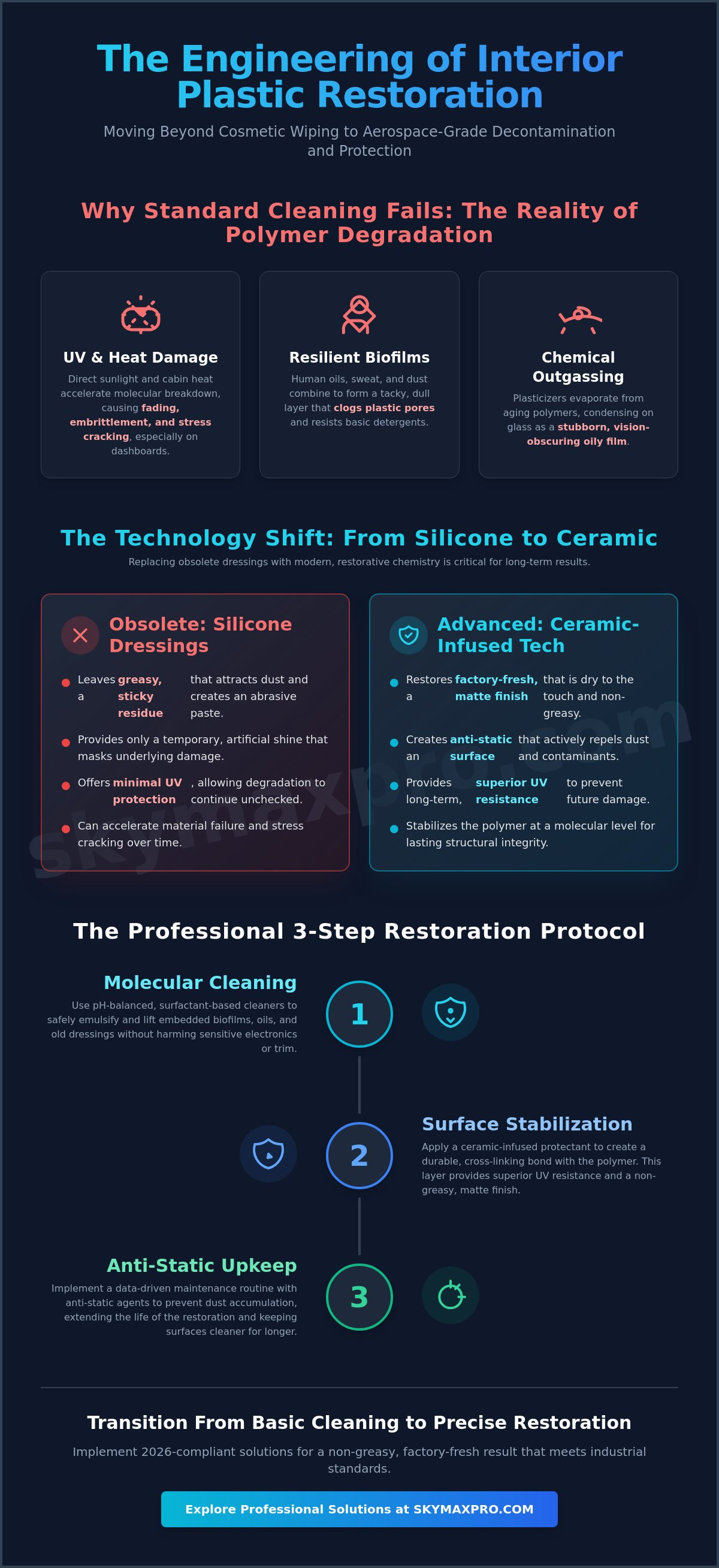
Once you've achieved a decontaminated substrate through the process of deep cleaning car interior plastics, the next engineering requirement is surface stabilization. Traditional silicone-based dressings are no longer viable for modern automotive interiors. These legacy products rely on heavy oils that sit on the surface without bonding, creating a dust-attracting film that eventually evaporates and contributes to the outgassing film on your windshield. Ceramic technology has replaced these temporary fixes as the gold standard for preservation. By utilizing silicon dioxide (SiO2) or graphene-infused formulations, you create a semi-permanent bond with the plastic polymer, resulting in a finish that is functional rather than just aesthetic.
The professional preference for a matte or satin finish isn't merely a matter of taste; it's a safety and maintenance specification. High-gloss surfaces reflect sunlight into the driver's eyes and onto the windshield, significantly reducing visibility. A ceramic-treated surface provides a deep, factory-fresh appearance that remains non-reflective. Because these coatings are anti-static, they actively repel atmospheric dust. This keeps the cabin cleaner for longer periods compared to untreated or silicone-treated surfaces, which naturally attract particulates through static charge.
Ceramic Vinyl, Rubber & Plastic New Look Coating
The Ceramic Vinyl, Rubber & Plastic New Look Coating operates through a molecular bonding process that penetrates the pores of the material. To achieve a streak-free result, apply a small amount to a foam applicator and work it into the plastic using light, even pressure. Unlike dressings that last days, this ceramic barrier provides months of protection against UV-induced cracking and fading. It's engineered to be non-greasy to the touch, ensuring that your interior remains functional and comfortable without the oily residue found in consumer-grade alternatives. This technological shift ensures that deep cleaning car interior plastics leads to a durable, resilient result.
Advanced Trim Restoration for Faded Surfaces
In cases where the plastic has already suffered significant photo-degradation, a standard protectant is insufficient. Utilizing the Ceramic Trim Plastic Restorer allows for the chemical replenishment of lost pigment while sealing the surface against further decay. There's a fundamental technical difference between a dressing and a semi-permanent restorer; the latter integrates with the substrate to provide a durable shield. Ceramic protection is not a cosmetic layer but a functional surface shield. For those ready to upgrade their interior preservation, you can browse our full range of ceramic coating solutions to secure your vehicle's long-term value.
Maintenance Strategies for a Lasting Professional Finish
Maintenance represents the final phase of the restoration lifecycle. While deep cleaning car interior plastics effectively removes years of neglect, a bi-weekly maintenance routine ensures that aggressive chemical intervention isn't required in the future. This proactive approach focuses on removing light atmospheric dust and human oils before they can bond with the substrate or form the resilient biofilms identified earlier in this guide. Anti-static properties are a critical component of this phase. They reduce the surface's electrical charge, which prevents particulates from settling on the dashboard and center console between cleaning cycles.
When handling localized spills, such as beverages or food residues, the objective is to lift the contaminant without compromising the established ceramic protection layer. You should use a clean, damp microfiber to blot the area rather than scrub it. Aggressive friction can create unnecessary mechanical wear on the coating. A final inspection involves checking for surface uniformity under high-intensity LED lighting. You must ensure no residue remains on primary touchpoints like the steering wheel, gear shifter, and door handles, as these areas are most susceptible to tactile degradation and transfer.
Using Quick Detailers for Interior Maintenance
For light dusting and fingerprint removal, a Quick Detailer Spray with Ceramic High Gloss Finish provides the most efficient solution. This formulation acts as a sacrificial layer, reinforcing the base ceramic coating and extending its hydrophobic properties. Proper microfiber selection is essential during this stage. Use a low-pile, high-quality towel for maintenance wipes to ensure you don't leave lint behind or create static charge through excessive friction. This keeps the surface "naked" and clean without the need for water-based rinsing.
Professional Detailing Kits for the Home User
Utilizing a comprehensive Interior Cleaning Kit is the most reliable way to maintain a 2026 vehicle's cabin to professional standards. These kits are engineered to provide chemical synergy, ensuring that maintenance cleaners don't react negatively with restoration agents. For a complete operational overview, detailers should follow the Professional Auto Detailing Checklist, which outlines the master sequence for achieving aerospace-grade results. Following these engineering protocols guarantees that your interior remains in a factory-fresh state for the duration of your ownership.
Upgrade your interior detailing game with SKY MAXPRO professional supplies.
Implementing the Future of Interior Surface Management
Transitioning from basic maintenance to a professional restoration protocol ensures that your vehicle's interior remains a high-performance environment. We've established that effective deep cleaning car interior plastics requires a two-phase approach: precision decontamination to remove biofilms and outgassing residues, followed by ceramic stabilization to block UV-induced degradation. By shifting away from obsolete silicone dressings and adopting anti-static maintenance strategies, you preserve both the aesthetic value and the structural integrity of your cabin's polymers.
The engineering behind these results depends on the quality of your chemical toolkit. Our solutions are manufactured in the USA and utilize aerospace-approved nanotechnology formulations to provide measurable efficiency without compromising safety. These VOC-free and eco-friendly cleaning solutions meet the most stringent 2026 regulatory standards, ensuring a safe, non-toxic environment for all occupants. Consistency in your application and maintenance will yield a factory-fresh, matte finish that lasts for months.
Frequently Asked Questions
Can I use a magic eraser to clean car interior plastics?
Avoid using melamine foam, commonly known as magic erasers, on automotive plastics. These tools act as high-grit abrasives that physically sand away the factory-applied clear coat or texture. While they effectively remove surface stains, they often leave permanent dull patches or "burn" marks that require professional refinishing to repair. Stick to chemical decontamination and soft-bristle brushes for deep cleaning car interior plastics without risking irreversible surface damage.
How do I remove sticky residue from my car dashboard?
Removing sticky residue requires a pH-balanced degreaser or an adhesive-specific emulsifier. Avoid using aggressive household solvents which can melt polymer bonds. Apply the cleaner to a microfiber towel and allow it to dwell on the residue for sixty seconds to break down the chemical bond. Gently lift the residue using a clean section of the towel; ensure you neutralize the area with a damp cloth afterward to prevent any chemical lingering.
Is it safe to use a steam cleaner on car interior plastic?
Steam cleaning is an effective mechanical decontamination method when used with technical precision. You must avoid direct, prolonged contact with the plastic substrate to prevent thermal warping or adhesive failure. Use a microfiber-wrapped steam nozzle to provide indirect heat, which opens the plastic's pores and lifts deep-seated grime. This method is particularly efficient for sanitizing textured surfaces where manual agitation might be insufficient to reach every recessed area.
What is the best way to clean textured plastic vs. smooth plastic?
Textured plastics require mechanical agitation with soft-bristle brushes to reach contaminants trapped within the grain. Conversely, smooth or high-gloss plastics should only be treated with high-GSM microfiber towels to prevent surface marring. Using the same technique on both surfaces often leads to sub-optimal results; brushes can scratch smooth surfaces, while towels alone fail to extract dirt from the deep pores of textured dashboards and door panels.
How often should I deep clean my car interior plastics?
A comprehensive deep clean should be performed every six to twelve months, depending on vehicle usage and environmental exposure. This interval ensures that you remove accumulated biofilms and outgassing residues before they cause permanent polymer degradation. Between these sessions, implement a bi-weekly maintenance routine using anti-static detailers. This frequency maintains the integrity of any applied ceramic coatings and significantly reduces the labor required during your next deep restoration session.
Will ceramic coatings make my dashboard too shiny or reflective?
Professional ceramic coatings are specifically engineered to provide a matte or satin finish rather than a high-gloss shine. These formulations enhance the color depth of the plastic without increasing its reflectivity, which is critical for maintaining dashboard safety and visibility. Unlike traditional silicone dressings that create an oily, reflective layer, ceramic technology bonds with the surface to provide a "new look" that remains non-greasy and visually neutral.
How do I remove scuff marks from plastic door panels?
Scuff marks are often material transfers from shoes or cargo and can be removed with a dedicated interior cleaner and a soft brush. If the scuff has physically gouged the plastic, it cannot be cleaned away and may require a specialized texture repair kit; to explore options for professional restoration, you can discover The Solution. For surface-level transfers, apply a specialized cleaner to emulsify the foreign material, then use a cross-hatch agitation motion to lift the mark from the plastic's grain without abrading the substrate.
Can I use these cleaners on my car’s infotainment screen?
Most interior plastic cleaners are too aggressive for the sensitive anti-reflective coatings found on infotainment screens. These displays require dedicated electronic cleaners or a slightly dampened, ultra-soft microfiber towel. Using standard plastic cleaners can cause delamination or permanent clouding of the screen's surface. Always verify the chemical compatibility of your product before application, as the engineering requirements for optical displays differ significantly from structural interior polymers.