

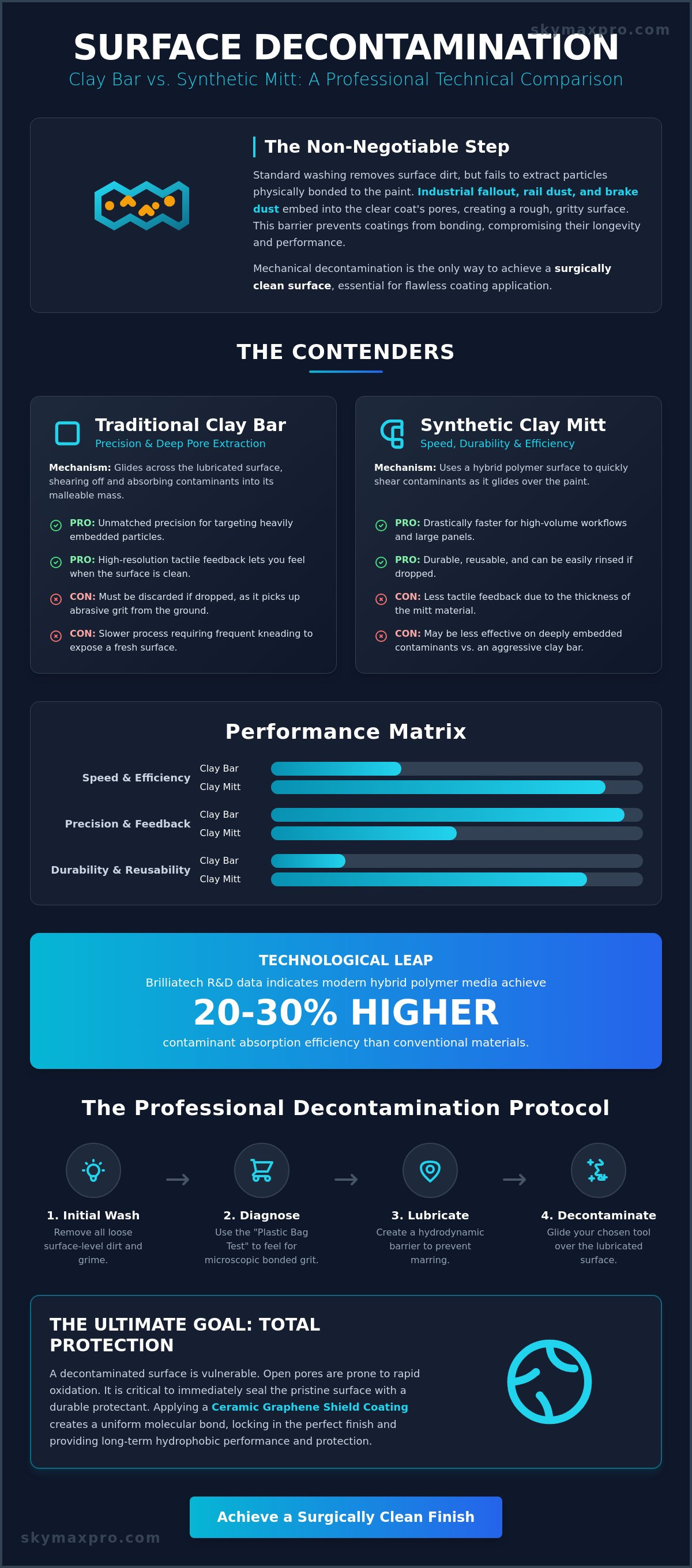
Brilliatech R&D Center data from November 2025 indicates that hybrid polymer clay bars now achieve 20 to 30 percent higher contaminant absorption efficiency than conventional materials. For professionals managing high-volume workflows, this technical shift necessitates a re-evaluation of standard decontamination protocols. You understand that the margin for error is non-existent when preparing a surface for a Ceramic Graphene Shield Coating. The fear of marring a delicate clear coat or the operational inefficiency of discarding expensive clay after a single drop are variables that modern engineering can now mitigate.
This article provides an objective, data-driven comparison to settle the clay bar vs clay mitt which is better debate for the 2026 market. We'll show you how to optimize your surface preparation to achieve a surgically clean finish while minimizing the risk of paint damage. We will analyze the mechanical friction profiles of traditional media like our Final Touch I PRO Detailing Clay against synthetic alternatives; this ensures you select the precise tool for your specific contamination profile and subsequent ceramic coating application.
Key Takeaways
- Identify the engineering principles of mechanical decontamination to effectively remove embedded industrial fallout from clear coat pores.
- Evaluate the precision and deep-pore extraction capabilities of traditional media like Final Touch I PRO Detailing Clay for sensitive surfaces.
- Analyze mechanical friction and durability to determine clay bar vs clay mitt which is better for optimizing high-volume workflows.
- Apply a professional decision matrix to select the optimal tool based on vehicle age, contamination profile, and cost-per-use efficiency.
- Learn why immediate application of a Ceramic Graphene Shield Coating is critical to protecting a surgically clean surface from rapid oxidation.
The Engineering of Mechanical Decontamination: Why Claying Matters
Mechanical decontamination represents the precise removal of non-soluble particulates from a vehicle's clear coat. While standard chemical washing effectively dissolves surface-level dirt and grime, it lacks the mechanical energy to address particles that have achieved a physical bond with the substrate. Industrial fallout, rail dust, and ferrous brake dust particles don't simply sit on the surface. Instead, they embed themselves into the microscopic pores of the clear coat through a combination of thermal expansion and kinetic impact. Once these particles cool, the paint effectively "locks" them in place. These microscopic jagged edges act as anchors. Standard surfactants and wash mitts cannot dislodge them; they require the controlled shearing force provided by professional-grade decontamination media.
Professional detailers frequently weigh the technical advantages of clay bar vs clay mitt which is better when managing different paint hardness levels and contamination densities. The primary tool, detailing clay, is a specialized synthetic variant of industrial plasticine. It works by grabbing the protruding tip of a contaminant and pulling it from the pore or shearing it flat. If these contaminants are not addressed, they scatter incoming light, which significantly degrades the specular reflection and "wet look" of the finish. Critically, these particles create a physical barrier. This barrier prevents advanced coatings, such as a Ceramic Graphene Shield Coating, from achieving a uniform molecular bond with the clear coat. Without a surgically clean surface, the coating's longevity and hydrophobic performance are compromised.
Identifying Bonded Contaminants
Visual inspection is often insufficient for diagnosing surface contamination. Professionals utilize the "plastic bag test" to amplify tactile feedback. By placing a thin plastic film between the hand and the paint, you can detect the presence of microscopic grit that would otherwise be invisible. These bonded contaminants create a textured surface that increases drag and reduces the efficacy of any subsequent wax or sealant application. Visual indicators, such as orange specks of oxidized iron on light-colored vehicles, further confirm the need for mechanical intervention.
The Role of Lubrication in Paint Safety
Mechanical decontamination is inherently risky without a proper interface. Lubrication provides hydrodynamic lift, creating a microscopic barrier that allows the media to glide over the surface. This fluid layer prevents abrasive particles from being dragged across the clear coat, which would cause significant marring. When evaluating clay bar vs clay mitt which is better, the decision often depends on how effectively the specific lubricant maintains this hydrodynamic barrier under varying pressure levels. Specialized lubricants are engineered with specific viscosity to encapsulate sheared particles, ensuring they don't re-embed during the process.
The Traditional Clay Bar: Precision and Deep Pore Extraction
The traditional clay bar operates through a mechanism of particulate entrapment. As the resin glides across the lubricated clear coat, it shears off bonded contaminants and pulls them into its malleable mass. Unlike synthetic surfaces that merely scrape, the clay bar absorbs. This makes it an aggressive yet controlled tool for extracting particles that have deeply embedded into the paint's microscopic pores. Professionals often rely on the Final Touch I PRO Detailing Clay because it maintains a consistent tacky resin profile that maximizes contaminant capture. When evaluating clay bar vs clay mitt which is better, the bar's ability to provide high-resolution tactile feedback is a primary factor. You can feel the exact moment the surface transitions from gritty to smooth through your fingertips, a sensation often dampened by the thickness of synthetic mitts.
Kneading is the essential maintenance step for this tool. By folding the clay, you encapsulate the captured grit and expose a fresh, clean surface. This self-cleaning cycle ensures that you aren't dragging previously extracted industrial fallout across the panel. It's a manual, detail-oriented process that prioritizes surface safety over raw speed. In 2026, while synthetic materials have advanced, the mechanical purity of a high-grade clay bar remains the gold standard for high-stakes paint correction projects.
When to Reach for a Clay Bar
- Heavy Restoration: Use a bar for severe industrial fallout or heavy paint overspray where high shearing force is required.
- Intricate Geometries: The ability to mold the clay into custom shapes makes it indispensable for emblems, door handles, and complex body lines.
- Pre-Polishing Purity: When preparing for multi-stage correction, the bar ensures that no microscopic anchors remain to interfere with the polishing pads.
The Limitations of Natural Clay
Precision comes with operational risks, most notably the "one-drop" rule. Because the resin is designed to trap everything it touches, a clay bar that hits the floor immediately absorbs abrasive floor grit. It cannot be cleaned; it must be discarded to prevent catastrophic paint marring. This makes the process risky in fast-paced environments. Additionally, traditional clay is highly sensitive to temperature. In colder climates, the resin becomes rigid and difficult to knead, requiring constant warming to remain effective. For high-volume shops, these time-consumption factors often outweigh the precision benefits for routine maintenance tasks.
The Synthetic Clay Mitt: Speed, Durability, and Efficiency
The synthetic clay mitt represents a significant evolution in polymer science applied to automotive surface preparation. While traditional resin-based clay relies on an internal entrapment mechanism, synthetic mitts utilize a specialized rubberized polymer coating bonded to a microfiber substrate. This surface is engineered to provide high-frequency shearing of bonded contaminants without the need for constant kneading. When analyzing clay bar vs clay mitt which is better for high-volume service centers, the primary metric shifts toward throughput and operational durability. The larger surface area of a mitt allows for simultaneous decontamination across broader sections, effectively reducing the time spent on large horizontal panels like hoods and roofs.
Unlike the porous nature of traditional clay, the polymer surface on a mitt is non-absorbent. This design choice prioritizes speed and reusability over deep-pore extraction. For maintenance detailing where contamination levels are moderate, the mitt provides a measurable increase in efficiency. It integrates seamlessly into the decontamination wash phase, allowing professionals to use pH-neutral shampoos as a lubricant during the final rinse. This workflow optimization is a key driver for shops looking to reduce labor hours without sacrificing the baseline cleanliness required for sealants or waxes.
Operational Advantages of the Mitt
- Resilience to Contamination: If a synthetic mitt is dropped, the non-porous polymer can be rinsed clean with water. This eliminates the financial waste associated with discarding traditional clay bars after a single accidental drop.
- Labor Optimization: The ergonomic design reduces hand fatigue during extended sessions. By covering more square centimeters per stroke, a technician can complete a full vehicle decontamination in a fraction of the time required for manual claying.
- Extended Service Life: A single high-quality synthetic mitt can typically process dozens of vehicles before the polymer degrades, offering a superior cost-per-use ratio compared to consumable clay bars.
The Trade-off: Precision vs. Speed
Despite the efficiency gains, synthetic tools introduce specific technical challenges. Because the polymer doesn't absorb contaminants, any particles sheared from the paint stay on the surface of the tool until rinsed. This increases the risk of "marring" or fine surface scratching, particularly on soft Japanese or European clear coats. In scenarios involving heavy paint overspray or severe industrial fallout, the shearing force of a mitt may prove insufficient compared to the aggressive "pulling" action of a bar. Maintenance is also critical; the polymer surface can become tacky or melt if stored in high-temperature environments or exposed to petroleum-based chemicals. Professionals must weigh these factors against the speed requirements of the specific project.
Clay Bar vs. Clay Mitt: The Professional Evaluation Framework
A professional evaluation framework moves beyond subjective preference, focusing instead on measurable outcomes and operational costs. When deciding clay bar vs clay mitt which is better, technicians must assess the specific contamination profile against the paint system's hardness. A traditional bar offers a high-resolution tactile interface, allowing for the detection of microscopic resistance that synthetic polymers often mask. However, the economic reality of high-volume detailing favors the mitt's durability. While a standard clay bar is typically a single-use consumable for heavily contaminated vehicles, a synthetic mitt can maintain operational integrity for over 40 vehicles if properly maintained.
The subsequent polishing phase is directly impacted by the tool choice. A clay bar's ability to pull contaminants into its mass often results in a cleaner surface that requires less aggressive pad cleaning during correction. Conversely, a mitt's speed allows for a faster transition to machine work, provided the technician has accounted for the increased risk of surface marring. Ultimately, the question of clay bar vs clay mitt which is better is answered by the technician's ability to balance throughput with surface integrity.
The Efficiency Matrix
- Time Comparison: Decontaminating a standard full-size SUV typically requires 45 to 60 minutes with a bar, whereas a mitt can achieve similar results in approximately 15 to 20 minutes.
- Durability Ratings: Traditional clay is often discarded after one heavy use or any ground contact. Synthetic mitts are rated for 40 or more applications with standard rinsing.
- The operational break-even point for a professional shop occurs within the first five vehicles after switching to synthetic mitts, primarily due to significant labor hour reductions.
Surface Safety and Marring Risks
Surface safety is the primary variable in any decontamination protocol. Soft European or "sticky" clear coats are highly susceptible to marring from the concentrated friction generated by a mitt's polymer surface. In these specific scenarios, the choice of lubrication becomes the deciding factor for safety. Referencing a professional car detailing products guide ensures that the lubricant's chemical composition provides the necessary hydrodynamic lift for the chosen tool. Improper technique with a mitt often leaves a distinct tick or haze pattern; this requires more aggressive polishing to correct, which can negate the time saved during the decontamination phase.
For those seeking the highest level of surface preparation, our Exterior Detailing Kit provides the professional-grade tools required for a surgically clean finish.
Post-Decontamination: Engineering the Ultimate Shield
Once mechanical decontamination is complete, the clear coat exists in its most vulnerable state. The removal of bonded contaminants leaves microscopic voids in the paint's surface, effectively increasing the surface area exposed to oxygen and environmental pollutants. This "naked" state facilitates rapid oxidation if left untreated. When determining clay bar vs clay mitt which is better, the ultimate objective remains the same: preparing the substrate for a permanent chemical bond. The surgically clean finish achieved by either method is the prerequisite for applying a Ceramic Graphene Shield Coating. This advanced nanotechnology requires direct contact with the clear coat's molecular structure to ensure maximum durability and performance.
A standardized 3-step workflow ensures long-term surface integrity and professional-grade results:
- Decontaminate: Utilize the appropriate mechanical tool (bar or mitt) to extract embedded particulates and clear the paint's pores.
- Prep: Use a panel wipe or specialized degreaser to remove any residual lubricants, silicones, or oils left behind during the claying phase.
- Shield: Apply a graphene-infused coating to seal the pores and create a high-strength sacrificial barrier against the elements.
Maximizing Adhesion with Graphene
The integration of graphene into the ceramic matrix represents a significant advancement in material science for 2026. Graphene's hexagonal carbon lattice provides exceptional tensile strength and thermal conductivity, which helps dissipate heat on the vehicle's surface. These lattices anchor themselves into the microscopic irregularities of the clear coat. If the decontamination phase is bypassed, these anchors attach to the contaminants rather than the paint. This results in premature coating failure, often manifesting as a loss of hydrophobicity within months. For a deeper technical analysis of these molecular interactions, consult our guide on the engineering of ceramic coating.
The Final Result: Aerospace-Grade Protection
The synergy between professional decontamination and graphene technology produces an aerospace-grade shield. This barrier significantly reduces the surface energy of the vehicle, causing water and contaminants to bead and roll off before they can achieve a physical bond. Maintaining this finish requires minimal effort; routine washes with a pH-neutral solution will sustain the slickness and gloss. Whether your evaluation of clay bar vs clay mitt which is better led you to the precision of a bar or the efficiency of a mitt, the result is a vehicle protected against the harsh environmental variables of the modern landscape. Upgrade your detailing arsenal with SKY MAXPRO today and ensure every surface you prep is engineered for endurance.
Advancing Surface Integrity through Engineering Precision
The objective data for 2026 confirms that the decision regarding clay bar vs clay mitt which is better is dictated by your specific operational requirements. High-precision tasks involving heavy industrial fallout or intricate body lines still require the tactile feedback and absorbent resin of professional-grade media like our Final Touch I PRO Detailing Clay. Conversely, high-volume maintenance workflows benefit from the durability and speed of synthetic polymer mitts. Both tools serve as the critical mechanical foundation for aerospace-approved formulations. Skipping this step compromises the molecular bond of advanced coatings, which leads to premature failure.
By selecting the right tool for the substrate's contamination profile, you ensure a surgically clean surface ready for a Ceramic Graphene Shield Coating. Our products are manufactured in the USA to meet the most rigorous industrial standards, providing the reliability required for professional-grade results. Integrating these technical solutions into your workflow optimizes both efficiency and surface longevity.
Shop Aerospace-Grade Decontamination Tools & Coatings
Achieve the ultimate finish with technical confidence.
Frequently Asked Questions
Is a clay mitt safer than a clay bar for beginners?
A clay mitt is technically safer for beginners because its ergonomic design significantly reduces the risk of accidental drops. While a traditional bar is a consumable that you must discard if it contacts floor grit, the non-porous polymer of a mitt can be rinsed clean. This resilience prevents the beginner from unknowingly dragging abrasive debris across the clear coat during the decontamination process.
Can I reuse a clay bar if I drop it on the ground?
You cannot reuse a clay bar once it has been dropped on the ground. The resin is engineered to be tacky and will immediately absorb sand, dirt, and microscopic stones from the floor. Attempting to knead or wash the bar will not remove these embedded abrasives; using it afterward will cause severe surface marring and deep scratches that require aggressive machine polishing to rectify.
Do I need to polish my car after using a clay mitt?
Polishing is typically required after using a clay mitt to correct minor surface marring. The synthetic polymer surface generates significant mechanical friction, which can leave a light haze or tick marks on soft clear coats. In the context of clay bar vs clay mitt which is better, the bar often leaves a cleaner finish on sensitive paint, whereas the mitt is optimized for speed before a machine correction stage.
What is the best lubricant to use with a clay bar vs a clay mitt?
The most effective lubricant is a dedicated clay lubricant engineered to provide high hydrodynamic lift and surface slickness. For synthetic mitts, a high-lubricity, pH-neutral solution like our Ceramic Waterless Car Wash can be used during the wash phase to streamline the workflow. You must avoid using plain water, as it lacks the viscosity required to prevent the media from grabbing the paint and causing surface damage.
How often should I clay my car if it has a ceramic coating?
Mechanical decontamination should only be performed on a ceramic-coated vehicle when chemical decontamination fails to restore surface smoothness. Excessive claying will eventually degrade the coating's sacrificial layer and hydrophobic properties. If the plastic bag test confirms bonded contaminants, use a fine-grade media no more than once or twice per year to maintain the coating's performance without compromising its integrity.
Can a clay mitt remove paint overspray as well as a clay bar?
A clay mitt is generally less effective than a traditional clay bar for removing heavy paint overspray. The malleability of a bar allows for concentrated pressure on specific spots, providing the shearing force needed to dislodge dried paint droplets from the pores. When evaluating clay bar vs clay mitt which is better for restoration, the traditional bar remains the professional choice for severe industrial fallout and overspray removal.
How do I clean and store a clay mitt after use?
Clean your clay mitt by rinsing the polymer surface thoroughly with fresh water after every panel to remove dislodged debris. After the full process, wash it with a mild detergent, rinse, and allow it to air dry with the polymer side facing up. You must store it in a cool, dry environment away from direct sunlight to prevent the polymer from becoming tacky or melting over time.
Will claying my car remove the existing wax or sealant?
Claying will remove the majority of existing waxes and polymer sealants from the paint's surface. The mechanical action is designed to strip bonded contaminants, which simultaneously abrades the thin layer of traditional protection. This is why professionals use mechanical decontamination as a mandatory preparation step before applying a high-durability Ceramic Graphene Shield Coating to ensure maximum molecular adhesion.