

More than 1,000 vehicles per day are damaged by paint overspray in the United States, leading to over half a billion dollars in damages and insurance claims annually. If you've recently discovered hardened yellow or white stripes bonded to your fenders, you're likely facing the frustration of a surface that feels like sandpaper. You already know that standard car soaps can't break these industrial bonds. Identifying the best products for removing road paint from car exteriors requires an understanding of chemical solvency and clear coat safety to avoid permanent damage.
We recognize the anxiety surrounding potential body shop bills and the fear of ruining your finish. This guide promises to provide the professional-grade chemistry and technical methods required to safely extract road paint without compromising your vehicle's protective layers. We'll preview the most effective specialty removers, the role of professional detailing clay, and the engineering behind surface restoration. By the end, you'll have the knowledge to restore a factory gloss and implement barriers that prevent future paint adhesion.
Key Takeaways
- Analyze the chemical composition of thermoplastic road markings to understand why standard washing fails to break industrial resin bonds.
- Select the best products for removing road paint from car finishes, focusing on high-performance degreasers and specialized removers that preserve clear coat integrity.
- Execute a multi-phase extraction process utilizing high-pressure kinetic energy followed by targeted chemical softening to minimize surface friction.
- Utilize professional-grade detailing clay to remove embedded resins and eliminate "ghosting" textures after the initial chemical extraction.
- Transition from reactive cleaning to proactive protection by applying graphene or ceramic shields that create a chemically resistant, non-stick surface.
Understanding Road Paint Chemistry and Surface Adhesion
Road striping paint represents a pinnacle of industrial durability, engineered to withstand thousands of tons of traffic and extreme weather cycles. These coatings aren't standard decorative paints; they're high-performance resins often loaded with reflective glass beads to ensure night-time visibility. When your tires kick these materials onto your vehicle, the resulting bond is more than a simple physical layer. It's a chemical adhesion where the fast-curing resins begin to cross-link with the organic molecules of your clear coat. Understanding Road Paint Chemistry is essential because it reveals why common cleaning methods fail to restore the surface. Identifying the best products for removing road paint from car panels starts with acknowledging that you're fighting an industrial-grade resin bond.
The Difference Between Water-Based and Thermoplastic Contaminants
Most modern departments of transportation utilize two primary types of marking materials. Acrylic water-based paints are increasingly common due to environmental regulations. These are generally easier to swell and emulsify if you act quickly. In contrast, thermoplastic resins are applied as a hot-melt liquid that solidifies into a plastic-like state within seconds. Yellow paint often signals a more durable epoxy or thermoplastic base, while white markings might be a standard acrylic. Both types become significantly more difficult to remove as they cure and "bake" into the paint's pores under the heat of the sun or the friction of highway driving. This thermal exposure accelerates the cross-linking process, making the best products for removing road paint from car surfaces a necessity for safe extraction.
Why Traditional Car Wash Soaps Fail
Standard automotive shampoos are formulated as mild surfactants designed to encapsulate loose dirt and road film. They lack the aggressive solvency required to disrupt the molecular structure of industrial resins. Attempting to remove road paint with a sponge and soap often results in localized clear coat damage. The mechanical friction needed to scrape away hardened resin creates micro-scratches, or "swirl marks," long before the paint itself detaches. Professional extraction requires aerospace-grade chemical engineering. Industrial-strength solutions like a Heavy Duty Red Power Degreaser are designed to penetrate the resin's matrix, softening the bond so it can be safely lifted without the need for abrasive scrubbing. Immediate intervention is vital. The longer the paint remains, the deeper the chemical bond penetrates the clear coat, leading to permanent "ghosting" textures that require mechanical polishing to correct.
The Best Professional Products for Road Paint Removal
Selecting the best products for removing road paint from car surfaces requires a shift from standard maintenance chemicals to industrial-grade solvents. While enthusiasts often suggest household alternatives like WD-40 or gasoline, these substances introduce secondary risks. Petroleum-based lubricants leave oily residues that penetrate rubber seals and complicate the bonding of future protective coatings. A professional engineering approach utilizes chemicals designed to disrupt thermoplastic resins without altering the clear coat's molecular structure.
Aerospace-Grade Degreasers for Industrial Contamination
The first line of defense involves high-concentration alkaline or solvent-based degreasers. Products such as the Heavy Duty Red Power Degreaser are formulated to penetrate the hard shell of road markings. The effectiveness of these formulas relies on "dwell time." This is the period where the chemistry actively breaks down the resin matrix before the product evaporates. For optimal results, apply the degreaser to a cool surface and allow it to sit for three to five minutes. This allows the surfactants to swell the paint, making it pliable for removal. This method is safe for high-impact areas like wheel wells and rocker panels where road paint accumulation is most dense.
Solvent Safety and Clear Coat Integrity
Maintaining the integrity of the factory finish is the primary constraint of any extraction process. Professionals prioritize VOC-free and biodegradable formulas to ensure long-term paint health. It's vital to differentiate between types of cleaners; for example, you should avoid using the PRO Safe ACID Gel Wheel & Rim Cleaner on painted body panels for road paint removal. While effective for metallic brake dust, acid-based cleaners can etch clear coats if misused. Always perform a compatibility test on an inconspicuous area, such as the lower door sill, to verify that the solvent doesn't dull the gloss.
Once the chemical phase is complete, mechanical decontamination is required to pull remaining resins from the paint's microscopic pores. This is where the Final Touch I PRO Detailing Clay becomes essential. It shears off the softened paint fragments that a pressure wash cannot reach. Using a high-lubricity spray during this phase prevents friction-induced marring. If you are looking for professional-grade supplies to handle this process, you can explore the full range of exterior detailing solutions designed for high-efficiency decontamination. By combining chemical solvency with mechanical extraction, you ensure a surface that is not only clean but restored to its original smoothness.
The Engineering Process: Safe Road Paint Extraction
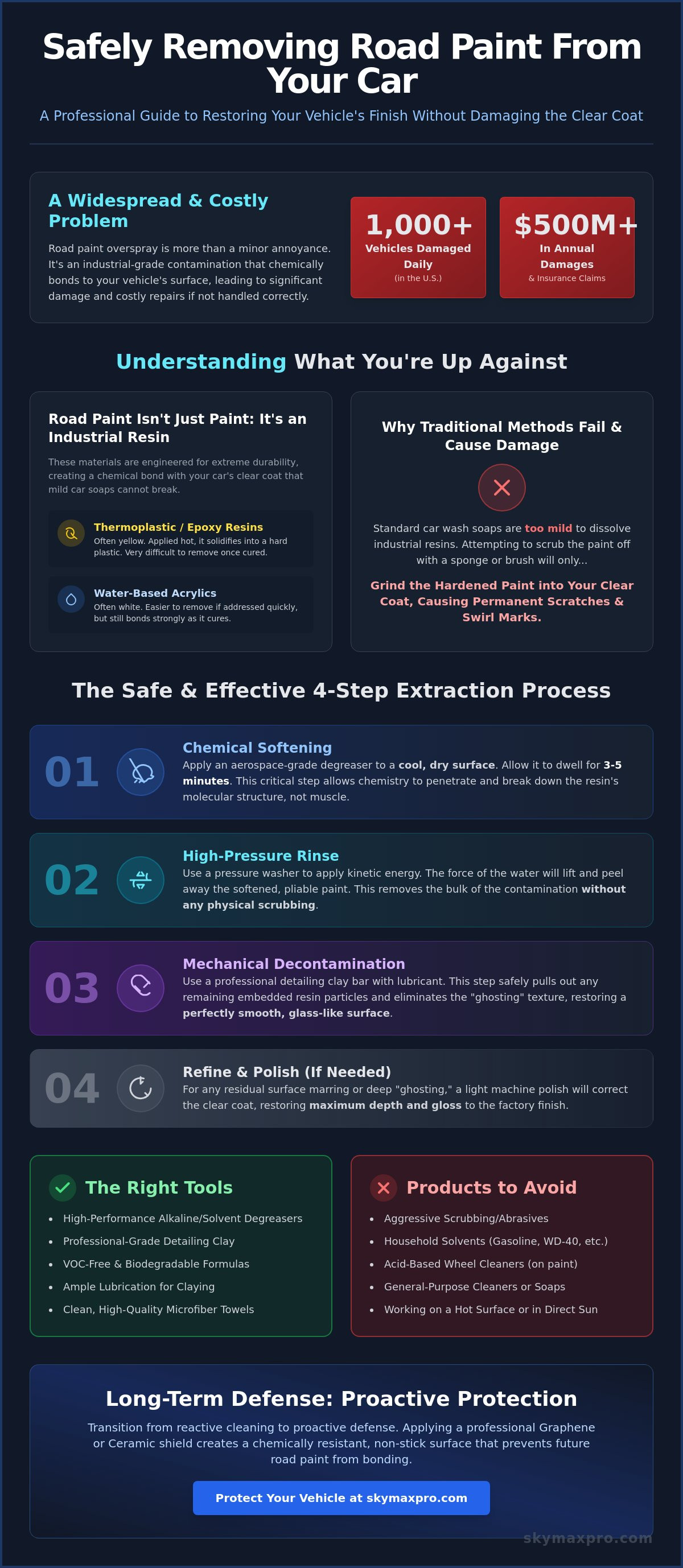
Safely extracting road paint is a procedural discipline that prioritizes the structural integrity of the automotive finish over rapid, aggressive results. Brute force methods, such as utilizing metal scrapers or high-grit abrasives, often lead to irreversible clear coat failure. A professional engineering process follows a four-phase protocol: kinetic debris removal, chemical saturation, controlled mechanical agitation, and final surface neutralization. By adhering to this sequence, you ensure that the best products for removing road paint from car exteriors operate at peak chemical efficiency without introducing physical defects.
Step 1: The Pre-Wash and Surface Prep
Before addressing the bonded resin, you must eliminate loose environmental contaminants that could cause secondary scratching. A high-pressure rinse or the application of a Ceramic Waterless Car wash serves as the primary tool for removing glass beads and abrasive road grit. Focus these efforts on high-density areas like wheel wells and lower rocker panels where the accumulation is thickest. It's essential to dry the surface thoroughly after this initial rinse. Residual water on the paint creates a barrier that dilutes the removal chemistry, which significantly reduces the effectiveness of your targeted degreaser.
Step 2: Chemical Softening and Agitation
Once the surface is dry, apply a specialized solvent or the Heavy Duty Red Power Degreaser directly to the paint splatter. A dwell time of three to five minutes is necessary to allow the surfactants to penetrate the thermoplastic matrix and swell the resin. For thick accumulations or "globs," you may use a plastic razor blade or the edge of a credit card to gently lift the softened material. You should never apply this edge directly to the clear coat with force. Once the bond is disrupted, wipe the residue away using a high-quality microfiber towel. This mechanical action must remain light. If the paint does not lift easily, repeat the chemical application rather than increasing manual pressure.
The final phase of the extraction process involves neutralizing the active chemicals to prevent long-term etching. Rinse the treated area with a pH-balanced solution to ensure no solvent residue remains trapped in the paint pores. This systematic approach ensures the surface is chemically stable before moving toward mechanical decontamination. By following these engineering phases, you eliminate the risks associated with traditional scrapers and ensure a safe, professional-grade restoration of the vehicle's exterior.
Post-Removal: Mechanical Decontamination and Polishing
Removing the bulk visible mass of road paint is only the initial phase of surface restoration. Even after chemical extraction, a "ghosting" effect often remains—a visible silhouette or tactile roughness where the resin once sat. This occurs because industrial resins are engineered for deep penetration into microscopic surface pores. Achieving a factory-smooth finish requires a transition from chemical solvency to mechanical decontamination. Selecting the best products for removing road paint from car finishes must include professional-grade tools designed to pull these embedded residues without compromising the clear coat's structural integrity.
The Role of Final Touch I PRO Detailing Clay
Standard washing cannot reach contaminants trapped within the paint's topography. The Final Touch I PRO Detailing Clay serves as a specialized instrument that shears off these microscopic resins. For effective use, you must maintain a high level of lubrication to allow the clay to glide. This prevents the clay from sticking and causing friction-induced marring. Use the "folding technique" religiously; after every few passes, fold the clay to expose a fresh, uncontaminated surface. You can verify the success of this phase using the "plastic bag test." Place your hand inside a thin sandwich bag and slide it over the surface. The increased sensitivity will reveal even the smallest remaining paint particles that the naked eye might miss.
Polishing and Surface Refinement
Chemical solvents and mechanical agitation can sometimes leave a slight haze or dullness on the finish. This is a common side effect of disrupting the clear coat's surface tension. Refinement involves using a fine finishing polish to restore the original optical clarity and gloss. If the road paint affected non-painted surfaces, such as exhaust tips or chrome bumpers, a specialized Chrome & Metal Polish is required to remove oxidation and resin shadows. This step is vital for ensuring the surface is chemically receptive to new protective layers. Before applying any sealant, ensure you perform a final neutralization rinse. Solvent residues can hide in trim gaps and weatherstripping, where they may slowly degrade rubber components over time.
Once the surface is smooth and the gloss is restored, the vehicle is ready for long-term protection. To maintain this level of precision and ensure you have the right tools for the job, you can order professional-grade decontamination kits that include everything needed for post-removal refinement. Completing this mechanical phase ensures that the best products for removing road paint from car exteriors deliver a result that looks like the damage never occurred.
Long-Term Defense: Preventing Road Paint Bonding
Transitioning from a reactive restoration to a proactive defense strategy is the final step in professional surface engineering. While the best products for removing road paint from car finishes are effective at extraction, the ultimate goal is to prevent molecular bonding entirely. Traditional carnauba waxes and polymer sealants often fail in this regard. These conventional products have low thermal stability and narrow chemical resistance profiles, meaning they can melt or degrade under the high-friction heat generated by highway driving. When road paint strikes a waxed surface, it often penetrates the soft layer and bonds directly to the clear coat anyway.
Ceramic Graphene Shield Coating as an Industrial Barrier
Modern nanotechnology provides a superior solution through the use of graphene and ceramic matrices. These coatings create a high contact angle on the vehicle's surface, which significantly reduces the "wetting" ability of liquid road paint. If a tire kicks up fresh thermoplastic resin, the paint beads up rather than spreading and anchoring into the clear coat pores. Applying a Ceramic Graphene Shield Coating provides up to 5 years of industrial-grade durability. This sacrificial layer ensures that if contamination does occur, the bond strength is so low that removal often requires nothing more than a high-pressure rinse. This engineering shift moves the vehicle owner away from aggressive solvents and toward simple maintenance protocols.
Spray Coatings for Rapid Maintenance
For vehicles that frequently navigate construction zones or industrial environments, a multi-layered approach is recommended. Utilizing a PRO Ceramic Graphene Spray Coating as a maintenance booster after every wash reinforces the primary shield. You should target high-risk zones specifically, including wheel arches, rocker panels, and the lower sections of doors. These areas receive the highest concentration of road debris and require the most robust chemical resistance.
A consistent maintenance routine keeps the protective shield functional and ensures the surface remains "non-stick." Using a Quick Detailer Spray with Ceramic High Gloss Finish between full washes helps maintain the surface tension required to repel contaminants. By implementing these technological barriers, you eliminate the need to search for the best products for removing road paint from car panels in the future. The surface becomes chemically resilient, ensuring that road markings simply cannot find a foothold on your vehicle's exterior. This proactive stance preserves the factory finish, maintains resale value, and eliminates the anxiety of permanent paint damage.
Advancing Your Vehicle Surface Protection Strategy
Achieving a factory-grade restoration after road paint contamination requires a shift from manual effort to chemical precision. You've explored the systematic extraction of thermoplastic resins and the necessity of mechanical decontamination to eliminate tactile residues. By transitioning to proactive nanotechnology, you ensure that future road markings cannot establish a permanent bond with your clear coat. Identifying the best products for removing road paint from car surfaces is the first step in a larger engineering lifecycle that prioritizes surface integrity and long-term resilience.
Our formulations utilize aerospace-approved nanotechnology to deliver measurable efficiency without compromising safety. Every solution is locally manufactured in the USA and features VOC-free, biodegradable chemistry to protect both your vehicle and the environment. Shop SKY MAXPRO Professional Detailing Supplies for Aerospace-Grade Results to implement these professional protocols today. Restoring your vehicle's aesthetic and functional performance is well within reach when you utilize the correct technical tools.
Frequently Asked Questions
Will road paint damage my car's clear coat permanently?
Road paint doesn't immediately dissolve the clear coat, but its industrial resins create a chemical bond that hardens over time. Exposure to UV rays and road heat can "bake" these resins into the paint's pores, leading to permanent texture or "ghosting" if not addressed within a few days. Professional extraction is required to pull these resins out before they fully cross-link with the automotive finish.
Can I use a pressure washer to remove road paint safely?
You can use a pressure washer to remove loose debris and reflective glass beads during the initial prep phase. However, high-pressure water alone is rarely sufficient to break the bond of cured thermoplastic road paint. Excessive pressure applied too closely can actually damage the clear coat or lift the edges of the factory paint, so it must be used with caution.
Is WD-40 safe for removing road paint from my car?
WD-40 is a common household solvent that can soften some paint resins, but it isn't the most efficient tool for the job. It leaves behind a heavy petroleum residue that is difficult to strip and can interfere with the adhesion of waxes or ceramic coatings. Utilizing the best products for removing road paint from car surfaces, such as dedicated degreasers, provides a cleaner extraction without the oily side effects.
How long can I wait before the road paint becomes impossible to remove?
You should ideally address road paint within 24 to 48 hours for the highest success rate. Fresh paint hasn't fully cross-linked and can often be removed with minimal chemical intervention. Once the resin has cured for several weeks, it becomes an industrial-grade plastic bond that may require multiple rounds of chemical softening and mechanical claying to fully extract.
What should I do if the road paint is on my plastic trim instead of the metal?
Road paint on textured plastic trim requires a delicate approach because porous plastics can trap the resin more aggressively than smooth metal. Avoid harsh solvents that can "white out" or dry the plastic. Use a specialized trim cleaner and follow up with a Ceramic Trim Plastic Restorer to replenish lost oils and restore the factory look.
Does a ceramic coating protect against road striping paint?
A professional ceramic or graphene coating provides a significant defensive barrier against road striping paint. These coatings create a hydrophobic, "non-stick" surface with a high contact angle that prevents the liquid resin from wetting and anchoring into the clear coat. While paint may still land on the car, it won't bond as deeply, making removal a much safer process.
Can I use a clay bar on road paint that has already dried?
You can and should use a clay bar on dried road paint, but only after a chemical softening phase. Attempting to clay "dry" or "hard" paint globs can cause heavy marring. Once a degreaser has softened the resin, the Final Touch I PRO Detailing Clay is one of the best products for removing road paint from car residues that remain trapped in the microscopic surface topography.
What is the best household product to use if I don't have professional cleaners?
If professional chemicals aren't available, petroleum jelly or WD-40 are the most common household starting points. These substances can slowly penetrate the resin matrix to soften it over several hours. However, they lack the advanced surfactants found in industrial degreasers and will require a thorough secondary wash to remove the greasy film they leave behind.