

That tacky residue on your dashboard isn't just accumulated grime; it is the visible evidence of a total chemical failure occurring at the molecular level. If you've ever wondered why is my car interior sticky, you are witnessing the physical breakdown of the polymer matrix. It's a frustrating phenomenon where high-quality plastics and vinyls begin to weep their internal plasticizers, leaving your hands dirty and ruining the aesthetic of a premium cabin. You likely worry that using a standard household cleaner might cause permanent damage or accelerate the melting process.
We understand that maintaining the structural integrity of your vehicle's interior requires more than a simple wipe-down. In this guide, you'll discover the technical causes of polymer degradation and learn the professional engineering methods used to stabilize these surfaces. We will examine how the ISO/TS 24110:2026 standards help us analyze material durability under combined UV and mechanical stress. By the end of this technical briefing, you'll have a clear protocol for restoring a clean, non-tacky finish and applying aerospace-grade protection to ensure long-term longevity and resistance to environmental factors.
Key Takeaways
- Identify the molecular causes behind why is my car interior sticky by understanding how polymer degradation and plasticizer migration compromise material integrity.
- Utilize the "Tack Test" methodology to differentiate between simple surface contamination and the irreversible chemical breakdown of soft-touch plastics or vinyl.
- Learn why high-pH household soaps and solvents like rubbing alcohol fail, often leading to permanent surface bleaching or "chalking" of interior components.
- Implement a professional restoration protocol using targeted surfactants and Heavy Duty Red Power Degreaser to safely stabilize the material without damaging the underlying substrate.
- Establish a durable molecular barrier against UV radiation and thermal stress by applying Ceramic Vinyl, Rubber & Plastic New Look Coating for long-term surface protection.
Understanding the Chemical Breakdown: Why Car Interiors Become Sticky
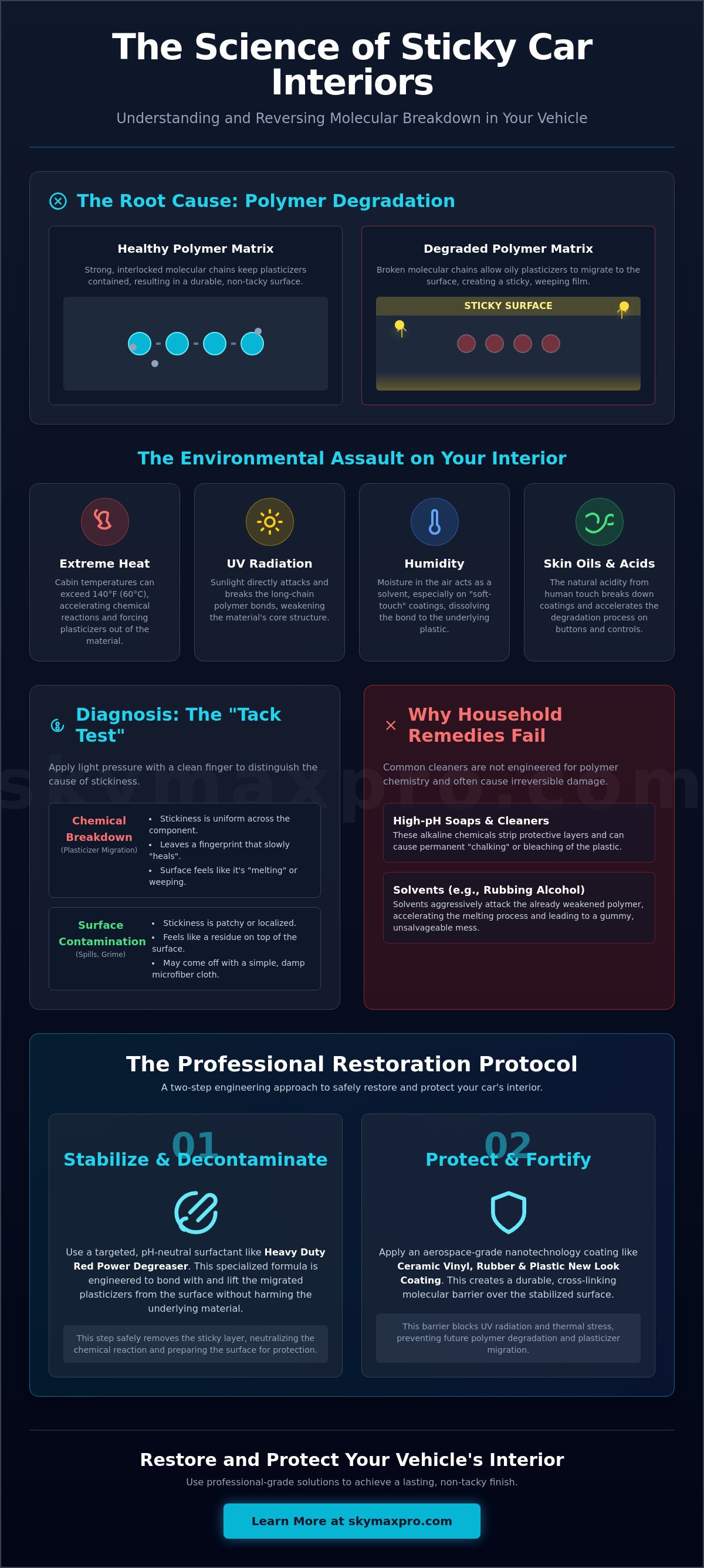
When you touch a button and your finger clings to the surface, you aren't just dealing with accumulated grime. You're observing the final stages of a material's life cycle. If you've been asking why is my car interior sticky, the answer lies in the complex chemistry of automotive manufacturing. Unlike a spilled beverage, this pervasive tackiness is often the result of polymer degradation, where the long-chain molecules in plastics and rubbers lose their structural bond. This is a fundamental chemical breakdown that transforms solid components into a viscous, semi-liquid state.
Manufacturers incorporate plasticizers into polymers to ensure flexibility and a premium hand-feel. Over time, these oily compounds undergo a process known as plasticizer migration. As the polymer matrix weakens, these oils leach from the core of the material to the surface. This creates a persistent, tacky film that traps dust and skin oils. It isn't a simple surface issue; it's a structural leak from within the material itself. Distinguishing between surface contamination from spills and this structural material failure is critical for choosing the correct restoration method.
The "Soft-Touch" Coating Failure
Automakers frequently apply rubberized "soft-touch" coatings to hard plastic substrates to provide a high-end, matte aesthetic. These coatings are specifically engineered for tactile comfort, yet they're highly vulnerable to environmental variables. Humidity and the natural acidity of human skin oils act as solvents, slowly dissolving the chemical bond between the coating and the underlying plastic. Eventually, the coating loses its adhesion, turning into a slurry that feels like melting adhesive. Once this bond fails, the material cannot be "cleaned" in the traditional sense; it must be stabilized or removed through professional degreasing protocols.
Environmental Stressors in the Automotive Cabin
The automotive cabin functions as a high-performance greenhouse. On a 90°F day, interior temperatures can easily exceed 140°F, creating a thermal pressure cooker for interior components. These extreme temperatures trigger rapid chemical reactions and accelerate the off-gassing of Volatile Organic Compounds (VOCs). This off-gassing further destabilizes the remaining polymer structure, leading to a loss of material density. Depolymerization is the reversal of the manufacturing process due to environmental stress. This process effectively unzips the molecular chains, returning the plastic to a state resembling its original chemical precursors. Continuous thermal cycling, the repeated heating and cooling of the cabin, ensures this instability persists until the surface is professionally treated.
Material-Specific Diagnosis: Soft-Touch Plastics vs. Vinyl Surfaces
Identifying the root cause of why is my car interior sticky requires a systematic diagnostic approach. Not all surfaces react to environmental stress in the same way. A tacky steering wheel might be the result of accumulated body oils, while a sticky dashboard usually indicates a more severe chemical failure. You must distinguish between these scenarios to avoid using a treatment that could worsen the material's condition.
The "Tack Test" is your primary diagnostic tool. Apply light pressure with a clean, dry finger to the affected area. If the stickiness is uniform across the entire component and leaves a fingerprint that "heals" or disappears slowly, you're likely dealing with plasticizer migration. If the tackiness feels localized or patchy, it's more likely a result of external contamination. Vinyl surfaces often become "shiny" and tacky as environmental polymer degradation factors like UV exposure break down the PVC top layer. In contrast, thermoplastic door panels and buttons tend to develop a "melting" or "fuzzy" texture as the internal resins lose their stability.
Failed clear coats on "piano black" or wood-look trims present another challenge. These surfaces don't just get dirty; the resin itself begins to delaminate, creating a gummy feel that traps micro-scratches. Leather stickiness differs fundamentally from plastic degradation. While plastics suffer from molecular unzipping, leather typically becomes sticky due to "spew," which is the migration of fatty acids or tanning oils to the surface. Each material requires a specific chemical response to restore its original tactile properties.
Testing for Surface Contamination
Before assuming a total material failure, test for simple contamination. Use a mild pH-neutral cleaner on a small, inconspicuous area. If the residue lifts easily with light agitation, the problem is likely external. Perform the "Microfiber Drag" test by sliding a lint-free towel across the surface. On a simple spill like dried soda, the towel will slide with some resistance. On a degrading polymer, the towel will snag and leave behind tiny fibers, indicating that the material's surface has become porous and adhesive.
Evaluating Structural Integrity
Examine the edges of switches and radio knobs for signs of "melting" or rounding. If the sharp factory edges appear softened, the structural integrity of the component is compromised. Use the fingernail test: press your nail into a hidden section of the plastic. If the indentation remains permanent, the material's elastic memory is gone. When you reach this stage, you must stop aggressive scrubbing to prevent stripping the base color. Instead, use a professional-grade Deep Clean Interior Cleaner to stabilize the surface and remove the migrated oils without further abrading the weakened substrate.
Professional Restoration Procedures: How to Fix Sticky Interiors
Once you've diagnosed why is my car interior sticky using the material tests in the previous section, you must execute a precise restoration protocol. Solving polymer degradation isn't about simple wiping; it's about a controlled chemical intervention to stabilize the surface. If you don't follow a structured engineering approach, you risk stripping the pigment from the plastic or accelerating the structural failure of the component. The goal is to remove the migrated plasticizers while leaving the base polymer intact.
A professional-grade restoration follows a five-step sequence designed to maximize efficacy and safety:
- Step 1: Deep Cleaning. Apply a professional-grade surfactant to the entire surface to lift loose debris and initial surface oils.
- Step 2: Targeted Degreasing. For localized areas of severe failure or failed soft-touch coatings, use Heavy Duty Red Power Degreaser. This specialized formula breaks the bond of the "melted" resin without melting the underlying thermoplastic.
- Step 3: Surface Neutralization. After cleaning, you must neutralize the area. This ensures no active chemical residue remains to continue reacting with the polymer chains.
- Step 4: Mechanical Agitation. Use soft-bristle detailing brushes to work the cleaners into the grain of the material.
- Step 5: High-Extraction Wipe-down. Use high-GSM microfiber towels to lift the suspended contaminants. The high fiber density is essential for "grabbing" the viscous residue rather than just spreading it around.
The Role of Specialized Cleaners
Using Deep Clean Interior Cleaner is essential because it's engineered specifically for automotive polymers. Unlike household detergents, it uses advanced surfactants to encapsulate sticky residues at the molecular level. This encapsulation process allows the oils to be lifted away from the surface without the need for aggressive solvents that might dissolve the plastic itself. Proper dilution ratios are critical. When you're dealing with sensitive buttons or switchgear, a more diluted approach prevents moisture from seeping into the electrical components behind the panel.
Mechanical Agitation Best Practices
Effective agitation requires a "cross-hatch" brushing pattern. By moving the brush in overlapping horizontal and vertical strokes, you ensure the bristles reach into the microscopic texture of the plastic grain. You must avoid excessive pressure. If the material is already compromised, heavy scrubbing will peel the surface layer like wet paper. Steam cleaning should be used with extreme caution. While heat can help loosen grime, excessive thermal energy can trigger further depolymerization, turning a slightly tacky dashboard into a permanent liquid mess. Always prioritize chemical efficiency over mechanical force.
Why Household Remedies and Improper Cleaners Fail
When drivers first ask why is my car interior sticky, they often turn to online forums that suggest quick household fixes. These "hacks" typically involve high-concentration solvents or abrasive materials that ignore the underlying engineering of automotive polymers. Applying a generic chemical to a degrading surface doesn't just fail to solve the problem; it frequently causes irreversible secondary damage. Understanding the chemical incompatibility between household products and automotive-grade materials is the first step in avoiding a costly interior replacement.
The most pervasive misinformation involves the use of Isopropyl Alcohol (IPA). While alcohol can technically dissolve the sticky top layer of a failed coating, it is a non-selective solvent. It often penetrates the weakened material and strips the factory pigment or dye, leading to a phenomenon known as "chalking" or bleaching. This leaves the plastic with a permanent, white hazy finish that no dressing can repair. Similarly, dish soaps are formulated to strip organic fats from ceramic and metal, not to maintain the delicate pH balance of synthetic vinyl. They leave behind a high-pH residue that acts as a surfactant for environmental pollutants, effectively turning your dashboard into a dust magnet.
Abrasive tools like "magic erasers" present an even greater risk. These sponges are made of melamine foam, which functions as a micro-abrasive equivalent to 3000-grit sandpaper. While they may remove the tackiness, they do so by physically grinding away the factory-embossed texture. Once the grain is sanded flat, the component loses its original aesthetic and becomes even more susceptible to future UV-induced failure.
- Solvent Shock: Harsh chemicals can cause "blooming," where internal components of the plastic are drawn to the surface too quickly, creating white spots.
- Dye Stripping: Many all-purpose cleaners contain butyl cellosolve, which can dissolve the specialized top-coats used on automotive plastics.
- Mechanical Destruction: Scouring pads and melamine foam destroy the structural integrity of already weakened polymers.
Solvent Sensitivity in Modern Interiors
Modern vehicle cabins utilize complex multi-layer material systems. Aggressive solvents easily penetrate the porous structure of aged vinyl, leading to chemical shock and structural delamination. This often results in "blooming," characterized by unsightly white hazy patches that signal the final death of the material's surface tension. Using a pH-balanced Deep Clean Interior Cleaner is a safer alternative to harsh household solvents because it is engineered to lift oils without compromising the molecular bonds of the substrate.
The Trap of Silicone-Based Dressings
Cheap, "shiny" protectants rely on dimethyl silicone oils to provide a temporary cosmetic fix. These products are fundamentally flawed from an engineering perspective. They create a lens effect on the surface that magnifies UV radiation, accelerating the very degradation you're trying to stop. These non-breathable coatings also trap heat within the dashboard, raising internal temperatures and speeding up the off-gassing of plasticizers. To truly restore your cabin's integrity, you should avoid these oily traps and choose a professional-grade Interior Cleaning Kit designed to stabilize and prep the surface for genuine molecular protection.
Long-Term Surface Protection with Aerospace-Grade Nanotechnology
Restoration provides a clean slate, but it doesn't address the environmental conditions that caused the initial material failure. If you've successfully solved why is my car interior sticky through professional cleaning, your next priority is chemical stabilization. Without a molecular barrier, the same thermal cycling and UV exposure will eventually re-trigger plasticizer migration. Standard dressings provide a temporary sheen but lack the structural bond needed for true prevention. Aerospace-grade nanotechnology offers a superior alternative by creating a permanent, cross-linked shield over the polymer substrate.
Applying Ceramic Vinyl, Rubber & Plastic New Look Coating establishes a high-density molecular barrier. This coating is engineered to be both hydrophobic and oleophobic, meaning it repels the skin oils and moisture that typically dissolve soft-touch coatings. Unlike oily silicone products, this ceramic infusion blocks UV radiation at the source, preventing it from breaking the long-chain molecules discussed in previous sections. It delivers a factory-correct matte or satin appearance, ensuring the cabin looks professional rather than greasy. By sealing the surface, you effectively halt the off-gassing process that leads to structural degradation.
The Science of Ceramic for Interiors
Nanotechnology works by filling the microscopic pores inherent in even the smoothest automotive plastics. When you apply a ceramic coating, these nano-particles anchor themselves within the material's grain, creating a surface that's physically smoother and chemically more stable. This is particularly relevant under the ISO/TS 24110:2026 standard, which emphasizes the need for materials to resist combined UV and mechanical stress. Ceramic coatings provide significant thermal resistance, keeping the plastic substrate stable even when cabin temperatures exceed 140°F. While water-based dressings might last a few weeks, ceramic-based protection offers months of durability because it doesn't evaporate or wash away during routine maintenance.
Maintenance for a Permanent Solution
Long-term protection requires a "low-touch" maintenance strategy to prevent the buildup of new contaminants. Using Quick Detailer Spray with Ceramic High Gloss Finish allows for light cleaning while simultaneously reinforcing the existing ceramic layer. This ensures the surface remains sealed against the VOC off-gassing and plasticizer migration that originally led you to ask why is my car interior sticky. Regular maintenance with pH-neutral products prevents the chemical shock associated with harsh household cleaners. For a more comprehensive look at maintaining various surfaces, consult our technical resource on Professional Car Detailing Supplies: The Engineering Guide to Surface Protection. Consistent, data-driven care is the only way to ensure the structural longevity of modern automotive interiors.
Stabilizing Your Cabin with Engineering-Grade Solutions
Understanding the molecular mechanics behind polymer degradation shifts the focus from temporary cleaning to long-term material stabilization. You now recognize that the answer to why is my car interior sticky involves a complex combination of plasticizer migration and UV-induced depolymerization. By utilizing the diagnostic "Tack Test" and avoiding the destructive nature of high-pH household soaps or abrasive foams, you can preserve the structural integrity of your vehicle's synthetic surfaces. Implementing a restoration protocol that combines targeted degreasing with ceramic-based barriers ensures your interior meets the rigorous durability expectations of modern 2026 standards.
Professional detailers rely on these aerospace-approved formulations to achieve high-end restoration results that withstand extreme thermal cycling. Our advanced nanotechnology fills microscopic surface pores to create a permanent shield against future degradation. You don't have to settle for tacky, compromised surfaces when a precision-engineered solution is available. These methods provide a measurable improvement in both tactile quality and material longevity.
Restore your interior today with the SKY MAXPRO Interior Cleaning Kit and experience the difference of professional-grade surface engineering. Take command of your vehicle's cabin environment with confidence and technical precision.
Frequently Asked Questions
Is a sticky dashboard dangerous to my health?
A sticky dashboard is primarily a sign of chemical degradation, which often involves the off-gassing of Volatile Organic Compounds (VOCs). While brief physical contact isn't typically hazardous, the continuous release of plasticizers into the cabin's confined air can lead to respiratory irritation over extended periods. It's best to stabilize the material to stop this chemical leaching and ensure a safer cabin environment.
Can I use rubbing alcohol to clean my sticky car buttons?
You shouldn't use rubbing alcohol on sticky car buttons because it acts as a non-selective solvent that can dissolve factory dyes and pigments. While it may temporarily remove the tackiness, it often leaves the plastic with a permanent white "chalky" appearance. A pH-neutral surfactant is a much safer alternative for maintaining the material's aesthetic and structural integrity.
How do I know if my interior is "melting" or just dirty?
Differentiating between surface grime and structural failure is done through the "Tack Test." If the stickiness is uniform across the component and the material indents permanently under light fingernail pressure, the polymer is melting. Simple dirt usually sits on top of the grain and can be removed without the surface feeling porous or adhesive to a microfiber towel.
Why does my car interior get sticky even if I don’t spill anything?
If you've wondered why is my car interior sticky despite keeping a clean cabin, the cause is likely plasticizer migration. This occurs when the oils used to keep plastics flexible leach to the surface due to age and environmental stress. It is a structural failure of the polymer matrix rather than an external contamination issue like a spill.
Will a ceramic coating prevent my dashboard from getting sticky again?
A ceramic coating is an effective preventative measure because it creates a cross-linked molecular barrier that blocks UV radiation. By sealing the microscopic pores of the plastic, it prevents the thermal cycling that triggers depolymerization. It also creates a hydrophobic surface that repels the skin oils that often accelerate the breakdown of modern soft-touch coatings.
What is the best professional cleaner for sticky car plastics?
The best professional approach involves using a surfactant-based formula like Deep Clean Interior Cleaner to encapsulate surface oils. For more severe cases where the material has already begun to liquefy, Heavy Duty Red Power Degreaser provides the chemical strength needed to remove the degraded layer without melting the underlying thermoplastic substrate. This engineering-first approach ensures the surface is prepped for a protective coating.
Can heat alone cause my car interior to become tacky?
Heat is a primary catalyst for polymer instability in automotive cabins. When interior temperatures exceed 140°F, the thermal energy accelerates the chemical reactions that break down long-chain molecules. This thermal stress is the reason why surfaces often become tacky after a vehicle has been parked in direct sunlight for extended periods without adequate UV protection.
Do I need to replace parts that have become sticky?
Replacement isn't always necessary if the structural failure is limited to the top coating or surface layer. Most sticky surfaces can be restored through professional degreasing and then stabilized with a ceramic barrier. However, if the plastic has become physically soft or warped throughout its entire thickness, the component's structural integrity is lost and replacement becomes the only viable engineering solution.