

Most enthusiasts believe a clay bar treatment is the final step to a smooth finish, but from an engineering perspective, it's actually the moment your vehicle's paint is most vulnerable. You've successfully removed bonded contaminants and industrial fallout, yet this mechanical decontamination process often leaves the clear coat exposed or lightly marred. Understanding exactly what to do after clay bar treatment is the difference between a temporary shine and a professional-grade, long-lasting finish.
We agree that the sheer volume of protection options can feel overwhelming, especially when you're aiming for that elusive mirror-like reflection without risking further damage. This article provides the essential engineering steps to refine and shield your vehicle's surface using the latest nanotechnology. You'll learn how to evaluate the need for paint correction and how to select the right high-performance barrier, whether you require the heat-dissipating properties of a graphene-infused coating or the deep gloss of a specialized wax sealant. By following this structured workflow, you'll ensure your vehicle's finish is not just clean, but technologically optimized for maximum durability and resistance to environmental stressors.
Key Takeaways
- Identify why neutralizing residual lubricants is the first mandatory step to prevent bonding failures with advanced ceramic or graphene layers.
- Utilize the "Flashlight Test" to evaluate surface marring and decide if a polishing stage is required to achieve a true mirror finish.
- Master the professional protocol for what to do after clay bar treatment to ensure your vehicle's paint transitions from exposed to highly protected.
- Analyze the technical differences between synthetic sealants and graphene-infused coatings to select the most durable protection for your climate.
- Apply the "cross-hatch" pattern during coating installation to guarantee uniform thickness and optimal molecular adhesion across all panels.
Immediate Post-Clay Actions: Cleaning the Naked Surface
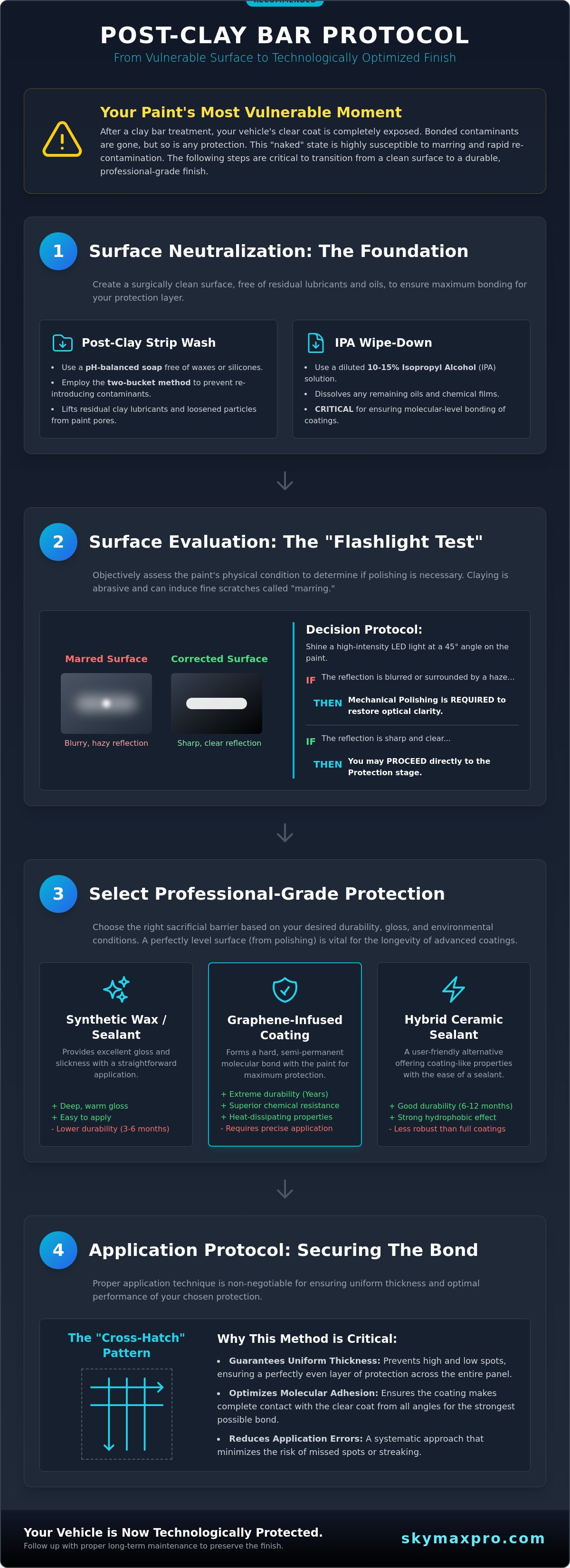
Mechanical decontamination via claying is a destructive cleaning process by design. While using a high-grade tool like Final Touch I PRO Detailing Clay effectively shears off bonded industrial fallout and brake dust, it leaves the paint in a chemically "naked" state. At this stage, the clear coat lacks any sacrificial barrier, making it highly reactive and susceptible to rapid environmental bonding. If you don't take immediate action, microscopic airborne pollutants can re-attach to the exposed surface almost instantly.
A critical part of what to do after clay bar treatment involves addressing the residue left behind by the process itself. Most clay lubricants contain surfactants or gloss enhancers that remain on the paint. These substances create a barrier that prevents ceramic coatings or sealants from achieving a true molecular bond. Additionally, the friction involved in claying can induce "clay marring," which appears as a slight dullness or fine hazing. This is why the transition from mechanical cleaning to surface refinement is the most sensitive phase of the detailing protocol.
The Post-Clay Chemical Strip Wash
The first step in stabilizing the surface is a thorough strip wash. You must use a pH-balanced soap that is free of waxes or silicone-based gloss agents. This ensures you aren't adding new layers of contamination while trying to remove the old ones. Utilizing the two-bucket method is mandatory here; one bucket for the wash solution and one for rinsing the mitt helps prevent secondary scratching from any particles loosened during the claying phase. Surfactants in the cleaning solution encapsulate residual clay lubricants and loosened microscopic particles, lifting them from the paint pores for safe rinsing. This step resets the surface tension and prepares the panels for a deep technical inspection.
The IPA Wipe-Down: Ensuring a Pure Surface
Even after a wash, trace amounts of oils and surfactants can persist. A professional Isopropyl Alcohol (IPA) wipe-down is the industry standard for ensuring a surgically clean surface. This process dissolves any remaining chemical films that a standard wash might miss. It's vital to use a properly diluted solution, typically between 10% and 15% IPA, to avoid softening the clear coat or causing flash-drying streaks.
Preparing the surface with an IPA solution ensures that the next layer of protection, such as a Ceramic Graphene Shield Coating, can bond directly to the clear coat at a molecular level. Without this step, the longevity of your protection is compromised from the start. Once the IPA has evaporated, the paint is ready for the "Flashlight Test" to evaluate if mechanical polishing is required to fix the marring induced during the decontamination phase.
Evaluating the Surface: Is Polishing Mandatory After Claying?
Once the paint is chemically stripped, you must assess its physical integrity. While many guides suggest machine polishing is an unavoidable requirement, a more precise engineering approach is to evaluate the specific finish state. Clay bars are abrasive; they encapsulate particles that, while being removed, can cause microscopic scratches known as marring. This is why the most critical phase of deciding what to do after clay bar treatment is the visual diagnostic.
The "Flashlight Test" provides an objective measurement of surface clarity. By using a high-intensity LED light at a 45-degree angle to the panel, you can identify if the claying process has induced a dull haze. If the light's reflection remains sharp with no surrounding diffraction patterns, you may proceed directly to protection. However, if the reflection appears blurred, mechanical refinement is necessary to restore the paint's planarity. Distinguishing between deep scratches and light surface haze is essential; clay bar marring is typically superficial and requires only light finishing rather than heavy correction.
Mechanical Refinement vs. Chemical Filling
Machine polishing is the superior method for achieving long-term results because it physically levels the clear coat. By removing the "peaks" of the micro-marring, you create a flat plane that allows light to reflect perfectly, maximizing gloss. This level of surface smoothness is vital for the longevity of advanced coatings. A perfectly level surface allows for a more uniform application of a Ceramic Graphene Shield Coating, extending its functional lifespan by ensuring maximum molecular adhesion. If you lack the equipment for machine correction, using a high-quality Ceramic Deep Wet Mirror Shine Wax Sealant can act as a temporary alternative by filling minor imperfections with synthetic polymers to improve visual clarity.
Hand Polishing for the DIY Enthusiast
Hand polishing is a viable option for those without a dual-action polisher, though it requires significant physical effort and precision. When polishing by hand, it's best to work in small, 12x12 inch sections to maintain consistent pressure and heat. You should select a fine-grade finishing compound that is designed for manual application to minimize the risk of uneven results. It's important to manage expectations; while hand polishing can effectively remove light clay haze and restore depth, it won't fix deep scratches or severe oxidation. For enthusiasts, this step ensures that the paint is sufficiently prepared to receive a protective layer without locking in visible defects.
Selecting Professional-Grade Protection: Wax vs. Sealant vs. Graphene
The transition from a decontaminated surface to a protected one represents the most significant shift in the professional detailing workflow. Historically, paint protection relied on natural oils like carnauba wax. While these organic compounds provide a warm aesthetic glow, they lack the structural stability required for modern environmental challenges. Natural carnauba wax typically begins to degrade at temperatures around 180°F, a threshold easily reached on dark-colored panels during summer exposure or through engine heat transfer. For enthusiasts determining what to do after clay bar treatment, relying on outdated organic barriers often leads to protection failure within weeks, leaving the naked paint vulnerable once more.
Synthetic polymer sealants and nanotechnology-based coatings offer a superior alternative by creating a semi-permanent bond with the clear coat. These engineered solutions provide high UV resistance, chemical stability, and hydrophobic properties that organic waxes cannot replicate. The selection process must account for your local climate and maintenance capabilities. If your vehicle is a daily driver exposed to road salts, industrial fallout, or high heat, a more resilient nanotechnology barrier is the logical engineering choice. This ensures that the labor-intensive decontamination process you just completed is preserved through a durable sacrificial layer. Similar to how professional stylists use advanced smoothing systems to maintain hair integrity, you can learn more about Hair Bar NYC Professional to see how high-performance products deliver salon-grade results in other specialized fields.
Ceramic and Graphene: The Nanotechnology Edge
Graphene-infused coatings represent the current pinnacle of surface protection technology. By integrating a two-dimensional lattice of carbon atoms, these coatings provide exceptional thermal conductivity. This property actively reduces the formation of water spots by dissipating surface heat more efficiently than traditional SiO2 ceramic coatings. The chemical bond formed is not merely a surface layer; it is a covalent attachment to the paint substrate. Implementing a Ceramic Graphene Shield Coating provides aerospace-grade durability that resists mechanical abrasion and chemical etching for years rather than months. This level of protection is essential for maintaining the clarity achieved during the claying phase.
Sealants and Spray Coatings for Efficiency
For those prioritizing application speed without sacrificing significant performance, spray-on ceramic technology offers a high-efficiency solution. These products utilize specialized carriers to deliver siloxane polymers that bond quickly to the surface. You can maintain the "just clayed" feel and enhance surface slickness by using a PRO Ceramic Graphene Spray Coating. This approach is ideal for maintaining existing coatings or providing a standalone barrier that lasts several months. Regarding layering strategies, you can stack spray coatings over base ceramic layers to boost hydrophobicity. However, you should never apply a traditional wax under a ceramic coating. The wax will prevent proper molecular adhesion, causing the coating to fail prematurely. Decisions on what to do after clay bar treatment should always prioritize establishing the strongest bond first.
The Application Protocol: Securing the Molecular Bond
Applying a high-performance barrier is a precision operation that requires controlled environmental variables. Surface temperature should ideally remain between 50°F and 80°F to ensure the solvent carriers evaporate at a predictable rate. High humidity can accelerate the curing process prematurely, which makes leveling difficult and increases the risk of streaks. When you're determining what to do after clay bar treatment, the application technique itself is as vital as the product selected. Precision here ensures the molecular bond is uniform across every panel.
Professionals utilize a "cross-hatch" pattern to guarantee 100% surface coverage. This involves applying the product in vertical overlapping lines followed by horizontal ones. This systematic approach eliminates thin spots that could lead to uneven protection or premature failure. You should work in manageable 2x2 foot sections to maintain control over the product's reaction time. Moving too fast or covering too large an area often results in the coating drying before it can be properly leveled.
Step-by-Step Coating Application
Priming the applicator pad is the first technical requirement. You must apply enough product to the pad to ensure it glides across the paint without friction, which prevents any dry-rubbing that could re-introduce marring to the refined surface. In the context of ceramic coating solvents, flashing refers to the rapid evaporation of the carrier liquids, signaled by a rainbow-like appearance on the surface, indicating the solids are beginning to bond. Once this visual cue appears, the product is ready for the leveling phase. To ensure you have the right equipment for this transition, consider utilizing a professional Exterior Detailing Kit designed for high-precision application.
The Final Inspection and Buffing
The buffing phase requires at least two high-GSM microfiber towels. The first towel removes the bulk of the excess product, while the second performs the final leveling to ensure a streak-free, mirror-like finish. You must use a multi-angled light source to check for "high spots," which are areas where excess coating has begun to harden unevenly. If you don't address these spots immediately, they become permanent once the coating cures and will require abrasive polishing to remove. The 24-hour rule is non-negotiable; the vehicle must remain in a dry, covered environment to allow the molecular matrix to reach its initial hardness. Total chemical cross-linking usually takes up to seven days, during which you should avoid any contact with water or high-pH detergents.
Long-Term Maintenance: Preserving the Decontaminated Finish
The final phase of the professional protocol involves protecting the integrity of the newly established barrier. Many enthusiasts mistakenly believe that high-end coatings are maintenance-free; however, from an engineering standpoint, every sacrificial layer requires systematic care to prevent premature degradation. Using pH-neutral soaps is mandatory. Highly alkaline or acidic detergents can weaken the chemical bonds of your coating, reducing its functional lifespan. When considering what to do after clay bar treatment, your primary objective shifts from restoration to preservation of the surface planarity you've achieved.
Avoiding automatic friction car washes is essential for maintaining a defect-free finish. The abrasive brushes used in these facilities introduce mechanical stress that can micro-mar the clear coat and strip away the protection you've just applied. Instead, utilize a touchless method or a two-bucket hand wash to ensure the surface remains pristine. Recognizing when protection is failing is straightforward: look for a decrease in water beading or a change in surface slickness. If the hydrophobicity drops, it's time to apply a "topper" or a high-gloss quick detailer to rejuvenate the sacrificial layer and restore the surface tension.
The Ceramic Maintenance Wash
For light dust removal or finishing after a standard wash, specialized solutions are required to maintain the coating's performance. Utilizing a Ceramic Waterless Car Wash allows you to lift contaminants safely while simultaneously depositing trace amounts of SiO2 or graphene to reinforce the base layer. You should always use non-abrasive drying techniques, such as high-velocity air blowers or ultra-soft drying towels, to minimize physical contact with the paint. For a comprehensive overview of long-term care, refer to the Professional Auto Detailing Master Checklist to ensure your vehicle maintains aerospace-grade results throughout the year.
Periodic Decontamination: When to Clay Again
Even with superior protection, environmental pollutants will eventually bond to the surface. You can use the "Baggie Test" to determine if a new round of decontamination is necessary. Place your hand inside a thin plastic sandwich bag and lightly run it over the clean, dry paint. If you feel bumps or grit, contaminants have bypassed the coating's surface tension and bonded to the substrate. A well-protected car requires mechanical claying less frequently because the coating prevents deep bonding. In many cases, using a chemical iron remover can dissolve metallic fallout without the need for abrasive clay work, extending the life of your original treatment. Understanding these nuances is the final step in mastering what to do after clay bar treatment for long-term vehicle preservation.
Advancing Beyond Decontamination: The Path to Permanent Surface Integrity
Mastering the technical requirements of surface decontamination is only the initial phase of professional paint care. You've successfully cleared the clear coat of industrial fallout, but the final outcome depends entirely on how you stabilize that reactive, naked surface. By implementing a structured protocol of chemical stripping, visual diagnostics, and precision application, you ensure that the smooth finish you've achieved isn't lost to immediate environmental re-bonding. Understanding exactly what to do after clay bar treatment is what separates a standard maintenance wash from an aerospace-grade restoration.
The engineering behind your protection layer determines the functional lifespan of your results. Choosing a barrier that utilizes covalent bonding and heat-dissipating graphene lattices provides a level of durability that traditional organic waxes cannot match. You've performed the essential mechanical work; now it's time to secure that investment with the most advanced surface technology available.
Upgrade to Aerospace-Grade Protection with SKY MAXPRO Graphene Coatings. Our professional-grade solutions are manufactured in the USA using aerospace-approved nanotechnology formulations. We offer eco-friendly, VOC-free solutions that deliver measurable efficiency and a mirror-like finish. Secure your vehicle's future today.
Frequently Asked Questions
Do I need to wash my car again after using a clay bar?
Yes, a secondary wash is mandatory to neutralize the surfactants and polymers found in most clay lubricants. These residues create a barrier that prevents proper molecular adhesion of your chosen sealant or coating. A pH-balanced strip wash effectively lifts these contaminants without adding new waxes to the surface. This step ensures the substrate is chemically ready for the next phase of the professional protocol.
Can I wax my car immediately after claying?
You shouldn't apply wax until the surface has been chemically stripped and wiped with an Isopropyl Alcohol (IPA) solution. Residual lubricants interfere with the bonding process, leading to premature protection failure. Once the surface is surgically clean, applying a high-performance barrier is the logical next step in what to do after clay bar treatment. This sequence ensures the wax or sealant attaches directly to the clear coat for maximum durability.
Is it normal for the paint to look dull after clay bar treatment?
Visual dullness, often called clay marring, is a common result of the mechanical decontamination process. Because clay bars are abrasive, they can leave microscopic scratches or haze on the clear coat while shearing off bonded contaminants. This loss of clarity indicates that a light mechanical refinement or polishing stage is necessary. Polishing levels these micro-imperfections to restore the paint's planarity and light-reflective properties.
How long does a ceramic coating last after a proper clay bar prep?
The longevity of a coating depends on the quality of the preparation and the specific technology used. A professional ceramic application typically lasts between 5 and 7 years when applied to a properly decontaminated surface. Advanced graphene-infused formulations can extend this protection significantly, with some next-generation coatings engineered to last up to 15 years. Consistent maintenance with pH-neutral soaps is required to achieve these maximum service lives.
What happens if I don’t put anything on the paint after claying?
Leaving paint unprotected after claying leaves the clear coat in a vulnerable, naked state. Without a sacrificial barrier, the exposed substrate is highly susceptible to rapid oxidation and chemical etching from UV rays and acid rain. Environmental contaminants will bond to the paint pores more aggressively than before. Immediate protection is the most critical part of what to do after clay bar treatment to prevent accelerated surface degradation.
Can I use a clay bar on a car that already has a ceramic coating?
Using a clay bar on a ceramic coating should be a last resort. The abrasive nature of the clay can physically wear down the coating's thickness and compromise its hydrophobic properties. You should first attempt chemical decontamination using iron removers or specialized water spot removers. If the Baggie Test still reveals bonded grit, use the finest grade of clay with heavy lubrication to minimize coating abrasion.
Do I need to polish my car every time I use a clay bar?
Polishing isn't mandatory every time, but it's technically beneficial for surface clarity. You should perform a visual inspection using a high-intensity light source to check for marring after the claying process. If the paint shows a visible haze or diffraction patterns, mechanical refinement is required to achieve a mirror-like finish. If the surface remains sharp and clear, you may proceed directly to the application of a nanotechnology-based shield.
How do I remove clay bar residue if it gets stuck to the paint?
To remove stuck clay residue, you should re-apply a generous amount of clay lubricant to the affected area. Use a fresh, clean piece of clay to gently lift the stuck particles through re-encapsulation. If the residue persists, a diluted Isopropyl Alcohol (IPA) solution can help dissolve the clay's binding agents. Never attempt to scrape the residue off with a dry towel, as this will introduce deep scratches into the clear coat.