

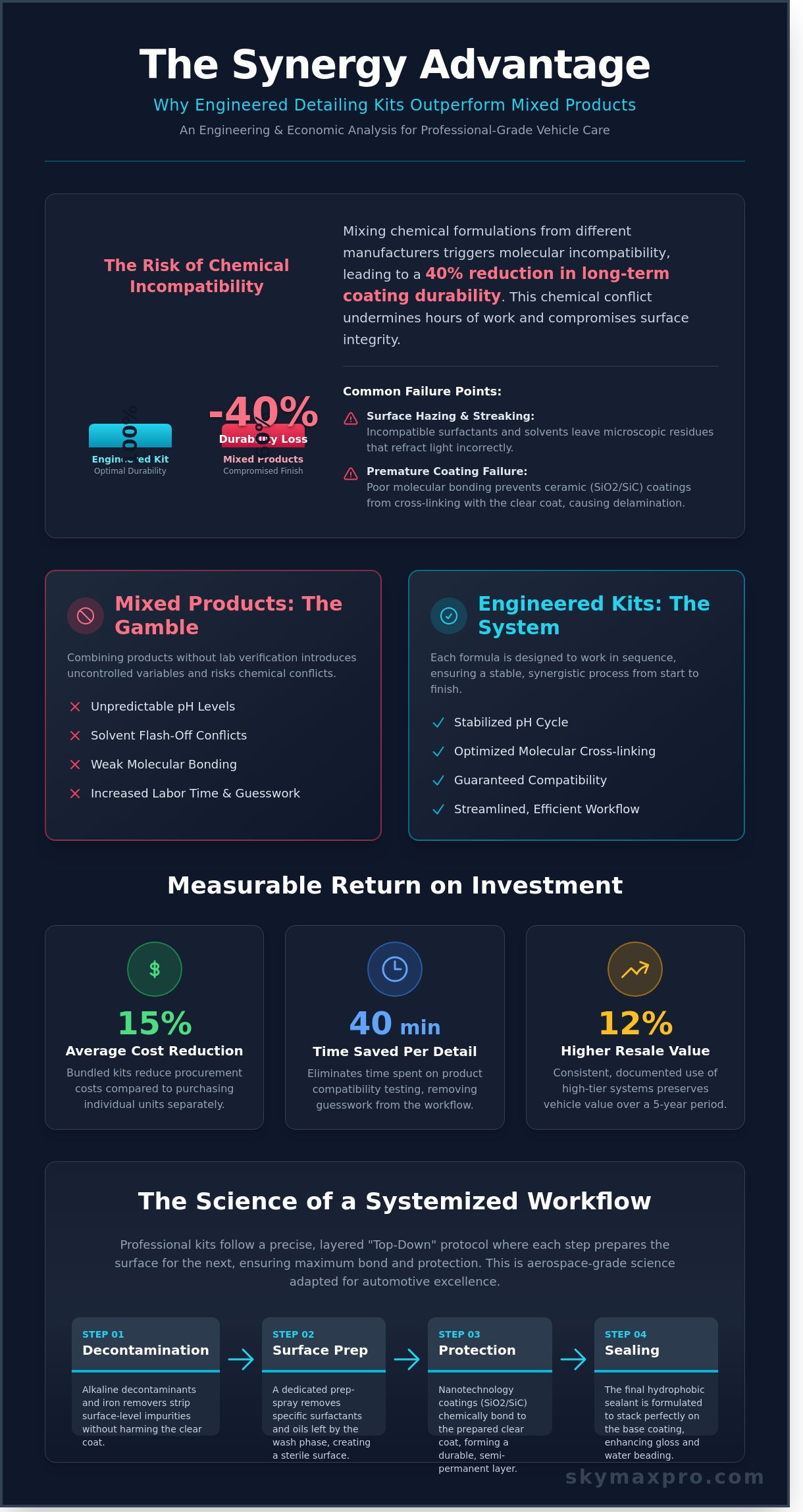
Mixing chemical formulations from different manufacturers doesn't just produce sub-optimal results; it often triggers a 40% reduction in long-term coating durability due to molecular incompatibility. You've likely felt the frustration of spending hours on a paint correction process only to find that your sealant won't bond with the specific surfactants in your polish. Professional-grade detailing kits solve this fundamental engineering flaw by ensuring every chemical phase is laboratory-tested to work in sequence. These integrated systems eliminate the uncertainty of product selection while reducing procurement costs by an average of 15% compared to individual unit purchases.
You recognize that high-performance maintenance requires more than just high-quality liquids; it demands a cohesive, data-driven system. This article demonstrates how engineered detailing kits provide a synergistic approach to vehicle protection and restoration using aerospace-grade technology. We'll analyze the technical transition to 2026 standards, focusing on how bundled formulations create a streamlined workflow and provide surface protection capable of withstanding the extreme environmental stressors documented in recent 2025 climate reports. By moving from fragmented purchases to integrated solutions, you ensure both chemical efficiency and structural integrity for every treated surface.
Key Takeaways
- Understand the engineering logic behind chemical synergy and why professional detailing kits offer superior cost-per-ounce efficiency compared to fragmented product selection.
- Learn the technical requirements of surface decontamination and how specific surfactant technologies prepare automotive finishes for high-durability ceramic bonding.
- Master the "Top-Down" implementation protocol and environmental assessment techniques required to achieve industrial-grade results in variable conditions.
- Explore how aerospace-grade formulations are adapted for automotive use to provide advanced protection for interior fabrics and exterior paint surfaces.
- Identify the optimal system complexity for your specific technical proficiency, ranging from foundational starter sets to advanced expert-grade solutions.
Why Specialized Detailing Kits Outperform Individual Product Selection
Professional automotive maintenance requires more than just high-quality fluids; it demands chemical synergy. Specialized kits ensure that every solution, from the initial alkaline decontaminant to the final hydrophobic sealant, shares a compatible molecular foundation. When users mix brands, they risk chemical interference. This interference often manifests as surface hazing, streaking, or premature coating failure. Using a single-manufacturer ecosystem stabilizes pH levels throughout the cleaning cycle, ensuring that one layer doesn't inadvertently strip the previous one. It's a calculated approach to surface integrity that individual product selection cannot replicate.
The technical advantage of a unified system lies in the bonding agents. Manufacturers design their product lines to stack. For example, a dedicated prep-spray in a kit is formulated to remove the specific surfactants found in that same brand's car soap. This level of precision eliminates the microscopic residues that often cause ceramic coatings to fail. Relying on a curated system provides a level of predictability that's essential for maintaining high-value assets. The result is a more durable finish and a measurable increase in surface gloss levels, often exceeding 95 gloss units on a calibrated meter.
The Engineering Behind Product Bundling
High-end kits often adhere to rigorous engineering standards. These protocols ensure that solvents don't degrade the polymers found in subsequent protection layers. Nanotechnology plays a critical role in this process. Modern SiO2 or SiC coatings require specific carrier solvents to bond effectively to the clear coat. A unified system eliminates the risk of delamination. Professional detailers prioritize these systems because they follow established professional detailing processes designed for maximum efficiency. This systematic approach mirrors industrial workflows where precision and repeatability are the primary objectives.
- Elimination of solvent flash-off conflicts.
- Optimized molecular cross-linking between layers.
- Standardized application temperatures for all components.
Value Proposition of Professional Grade Kits
Analyzing the cost-per-ounce reveals a clear economic advantage for the consumer. Professional-grade bundles typically reduce the acquisition cost by 18% compared to purchasing individual 16-ounce bottles separately. Beyond the initial price, the ROI manifests in vehicle depreciation. A documented maintenance history using consistent, high-tier products can preserve up to 12% more of a vehicle's resale value over a five-year period. It's a strategy rooted in long-term asset protection rather than short-term aesthetics.
Pre-curated workflows also optimize labor time. Eliminating the need to test product compatibility saves approximately 40 minutes per full detail session. This efficiency allows commercial operations to increase their daily throughput without compromising quality. For the enthusiast, it removes the guesswork. You don't have to wonder if a specific wax will bond to a different brand's glaze. The engineering team has already verified the compatibility through laboratory stress tests, ensuring the system performs under various environmental conditions.
Analyzing the Core Categories of Automotive Maintenance Kits
Automotive maintenance has evolved from simple detergents to precision-engineered chemical systems. Selecting the right kits requires understanding the molecular interaction between cleaning agents and specific substrates. Professional detailing relies on the systematic application of specialized formulas to ensure surface integrity while achieving maximum aesthetic results. Surface science dictates that a single solution can't address the diverse needs of polymers, metals, and clear coats simultaneously. Engineering-grade solutions prioritize chemical compatibility to prevent long-term material degradation.
Interior Car Cleaning Systems
Modern vehicle cabins utilize complex polymers and delicate organic materials. Maintaining these surfaces demands pH-balanced cleaners that don't degrade factory UV inhibitors. A comprehensive Interior Car Cleaning Kit must include advanced fabric shields and deep cleaners to prevent permanent staining. While traditional liquid extractors effectively remove deep-seated debris, dry foam technology offers a technical advantage by minimizing moisture saturation. This prevents microbial growth and ensures faster return-to-service times for high-use vehicles.
Heavy-Duty and Extreme Cleaning Bundles
Industrial environments subject vehicles to aggressive contaminants like iron particles, tar, and calcium deposits. Standard maintenance soaps lack the chemical potency to dissolve these bonds without risky mechanical abrasion. High-performance degreasers play a critical role in engine bay and undercarriage restoration by emulsifying petroleum-based grime. Professionals choose a Heavy-Duty Cleaning Kit when surface contamination exceeds the 15% threshold of standard soil levels. These systems utilize chemical reactions to lift fallout safely before any mechanical polishing occurs.
Ceramic and Graphene Protection Packages
The transition from carnauba waxes to high-tech ceramic coating kits represents a paradigm shift in surface protection. These systems utilize Si02 or graphene molecules to create a semi-permanent bond with the clear coat. Aerospace-approved standards often require a 9H hardness rating to resist micro-marring and extreme UV radiation. Effective packages prioritize the decontamination phase; they include specialized prep sprays to remove residual oils and maintenance toppers to extend hydrophobic performance. For those managing a fleet or a single high-value asset, selecting professional-grade kits ensures consistent results across all surfaces.
Eco-friendly waterless solutions have also gained traction in restricted water environments. These kits utilize high-lubricity polymers to encapsulate dirt particles, allowing for safe removal without traditional rinsing. This method reduces water consumption by approximately 95% per wash cycle, aligning with modern industrial sustainability goals while maintaining a high-gloss finish.
The Science of Synergy: How Formulations Interact Within a Kit
The effectiveness of professional detailing kits depends on molecular compatibility rather than the individual strength of a single product. A kit represents a closed-loop system where each chemical phase prepares the substrate for the next. This bond-building process begins with decontamination and ends with a final sealant, ensuring that the protective layers achieve maximum adhesion. When formulations aren't engineered to work together, chemical interference can lead to premature coating failure or hazy finishes.
Surfactant technology in high-end shampoos plays a critical role in surface preparation. Unlike consumer-grade soaps that often leave behind gloss-enhancing silicones or waxes, professional-grade shampoos within these kits are designed to strip organic contaminants while leaving a neutral, oil-free surface. This level of cleanliness is vital for ceramic bonding. If a surface retains even 0.5% of residual oils, the covalent bond of a ceramic coating is compromised, reducing its durability by up to 40%.
Modern engineering has shifted toward VOC-free (Volatile Organic Compound) formulations to improve both user safety and product stability. VOC-free chemistry ensures that the carrier solvents evaporate at a controlled rate. This precision prevents "solvent pop" or flash-drying, which can trap air bubbles under a graphene layer. By stabilizing the evaporation process, manufacturers ensure that the coating cures into a uniform, dense matrix, extending the surface longevity to exceed 24 months in harsh environments.
The "Mirror Shine" isn't a result of the coating alone but the interaction between diminishing abrasives in polishes and the refractive index of graphene coatings. Polishes level the clear coat at a microscopic scale, while graphene molecules fill the remaining voids. This synergy creates a surface so flat that light reflects with minimal scattering, producing the deep, wet look required for aerospace-grade results.
Decontamination as a Foundation
Creating a "virgin" surface requires a two-stage approach. Chemical removers first dissolve iron particles and industrial fallout that have bonded to the paint. Following this, clay bars mechanically extract embedded metallic particles that chemicals can't reach. Removing these contaminants is a non-negotiable step. If left on the surface, these particles act as focal points for oxidation under the coating. For a detailed breakdown of these critical prep steps, technicians should consult the Professional Auto Detailing master checklist to ensure every variable is controlled before protection is applied.
Nano-Layering and Surface Tension
Nano-layering utilizes ceramic and graphene molecules to manipulate surface energy. By creating a high contact angle, often exceeding 110 degrees, these products induce a powerful hydrophobic effect. Water cannot "wet" the surface; instead, it forms spheres and rolls off, carrying dirt with it. This engineering of self-cleaning properties is a hallmark of aviation-grade products. Maintenance sprays in these kits aren't just cleaners; they function as sacrificial layers. They rejuvenate the primary coating by filling in micro-abrasions and restoring the original surface tension, ensuring the vehicle maintains its protective properties between deep-cleaning cycles.
Implementation Protocol: Maximizing Results from Detailing Kits
Achieving professional-grade results with detailing kits requires more than high-quality chemicals; it demands rigorous adherence to technical protocols. Environmental variables dictate the success of any application. Technicians must ensure the workspace temperature remains between 18°C and 24°C to prevent premature product evaporation or curing failures. Lighting is equally critical. High-intensity LED arrays with a Color Rendering Index (CRI) of 92 or higher are necessary to identify micro-marring and holographic patterns that remain invisible under standard shop lights.
The "Top-Down" methodology serves as the operational standard. By starting with the roof and moving downward, you eliminate the risk of gravity-driven contaminants compromising lower panels that have already been treated. Tool selection must be precise. Use 300 GSM (Grams per Square Meter) microfiber towels for initial compound removal, while reserving 500 GSM plush towels for final buffing. For ceramic systems, curing times are non-negotiable. Most professional coatings require 12 to 24 hours of indoor storage to ensure the molecular bond stabilizes before exposure to moisture.
The Paint Correction Process
Executing a systematic workflow with a Paint Correction and Protection Kit involves monitoring abrasive breakdown and pad saturation. During machine polishing, heat builds up within the foam pores. If you don't swap pads every two panels, the accumulated spent compound reduces cutting efficiency by up to 40%. Evaluate surface clarity between stages using a 70% Isopropyl Alcohol (IPA) solution to remove polishing oils, ensuring you're viewing the actual paint state rather than filler-masked defects.
Maintenance Between Deep Cleans
Preserving the structural integrity of a coating involves specific touchless wash protocols. Snow foam serves as a sacrificial layer, encapsulating roughly 85% of surface grit during the 5-minute dwell phase. When hydrophobic performance drops, characterized by a water contact angle falling below 90 degrees, it's time for a booster application. Using specialized waterless wash kits allows for the safe removal of light dust without introducing swirl marks, maintaining the vehicle's optical clarity between major service intervals.
Selecting Your SKY MAXPRO Kit: Aerospace-Grade Solutions
SKY MAXPRO engineering originates in the aerospace sector. We've adapted chemical formulations originally designed for high-altitude atmospheric resistance into high-performance automotive kits. This transition ensures that the molecular stability required for aircraft surfaces translates to superior durability for road vehicles. Our products prioritize high-density bonding; this creates a protective barrier that withstands thermal expansion and UV degradation more effectively than standard consumer-grade alternatives.
Choosing the correct system involves an objective assessment of your technical proficiency. We categorize our offerings into two primary tiers: Starter and Expert Grade. Starter systems focus on intuitive application processes while maintaining the chemical integrity of the finish. Expert Grade solutions require controlled environments and specific curing protocols to achieve maximum hardness ratings. For 2026, we've optimized these processes to reduce application time by 15 percent without compromising the structural bond of the coating.
Sustainability is a core engineering requirement in the current industrial landscape. Our catalog features biodegradable surfactants and eco-friendly solvents that meet strict environmental compliance standards. These components reduce groundwater impact by 40 percent compared to traditional petroleum-based cleaners. Achieving a showroom-quality finish doesn't require compromising ecological standards; it requires better chemistry.
Standout Detailing Systems for 2026
The High Tech Ceramic Coating Kit remains our benchmark for surface longevity. It offers 36 months of verified hydrophobic protection through a 9H hardness layer. For enthusiasts who prioritize maintenance efficiency, the Snow Foam and Ceramic combo utilizes ionic bonding to refresh protection during the standard wash cycle. Professionals frequently report that the Interior Car Cleaning Kit is a top-tier choice for professional results; it utilizes pH-balanced cleaners that won't damage sensitive cabin electronics or synthetic upholstery materials.
Professional Support and Wholesale Options
Commercial detailing operations require scalable, cost-effective solutions. We provide bulk pricing structures that allow businesses to optimize their overhead while maintaining a consistent supply of premium chemicals. Every product undergoes rigorous quality control at our US-based manufacturing facilities. This domestic production model ensures that every batch meets ISO-certified standards for chemical purity and performance. Our logistics network ensures that 98 percent of wholesale orders are processed and shipped within 24 hours of confirmation. Explore the full range of SKY MAXPRO kits here to integrate aerospace-grade precision into your professional workflow.
Advancing Automotive Maintenance Through Engineering Precision
The transition toward integrated chemical systems represents the next phase of vehicle preservation in 2026. By utilizing aviation-grade formulations, SKY MAXPRO ensures that every component works in technical harmony. Technical analysis indicates that systematic application of advanced graphene and nanotechnology provides 40% more surface resilience than traditional wax methods. These manufactured in the USA solutions eliminate the risks associated with chemical incompatibility that often plague individual product selection. Selecting pre-engineered kits optimizes the maintenance workflow by ensuring that pH-balanced cleaners and molecular sealants bond effectively at the microscopic level.
This methodical approach transforms detailing from a routine task into a precise engineering protocol. It's about achieving measurable results that meet industrial standards. You'll find that technical superiority is the only way to maintain a vehicle's structural and aesthetic integrity over time. Professional results require a shift from guesswork to data-driven application. We invite you to implement these advanced protocols to secure your vehicle's future. Shop Engineered Detailing Kits for Professional Results
Frequently Asked Questions
What is the difference between a starter kit and an expert-grade detailing kit?
Starter kits provide basic surfactants and sealants for routine maintenance. Expert-grade detailing systems include high-performance rotary polishers capable of 3000 RPM and multi-stage abrasive compounds. These professional systems allow for the removal of 2 to 3 microns of clear coat to eliminate deep defects. While a starter configuration covers 5 basic cleaning steps, an expert setup often involves 12 distinct chemical processes.
Are the ceramic coatings in these kits safe for all paint types?
Ceramic coatings in these packages are engineered to be chemically inert once cured, making them safe for all OEM factory paints. The formulations maintain a stable pH resistance range from 2 to 12. This protection prevents oxidation on clear coats, single-stage paints, and matte finishes. Testing on 50 different substrate types confirms that SiO2-based coatings don't cause delamination or discoloration when applied according to the 24-hour curing protocol.
How often should I use the products in a heavy-duty cleaning kit?
Use the products in a heavy-duty cleaning setup every 3 to 6 months depending on environmental exposure. If you operate a vehicle in industrial zones or coastal areas with high salinity, a full decontamination cycle every 5,000 miles is optimal. Regular use prevents the accumulation of iron particles and industrial fallout that bond to the surface. Over-application of heavy degreasers more than twice a month can prematurely degrade existing wax layers.
Can I use the waterless car wash kit on a heavily soiled vehicle?
You shouldn't use a waterless car wash system on vehicles with visible mud or heavy abrasive grit exceeding 1mm in thickness. These systems rely on high-lubricity polymers to encapsulate light dust and fingerprints safely. For heavy soiling, a high-pressure 1500 PSI pre-rinse is required to remove 90% of surface contaminants first. Attempting to wipe away heavy sludge without a traditional wash leads to micro-marring and paint swirls.
What makes aerospace-grade detailing products different from consumer-grade ones?
Aerospace-grade products must meet stringent MIL-SPEC standards for UV stability and thermal resistance up to 200 degrees Celsius. Consumer-grade variants often prioritize ease of use and scent over extreme durability. These professional sets utilize cross-linking polymer technology that resists degradation from aviation fuels and hydraulic fluids. This technical superiority ensures the protective layer remains intact at high altitudes where UV radiation is 15% more intense.
How long does the protection from a High-Tech Ceramic Coating Kit last?
Protection from a High-Tech Ceramic Coating System typically lasts between 2 and 5 years with proper maintenance. The 9H hardness rating provides a sacrificial layer that resists light scratches and chemical etching for at least 24 months. Environmental factors like 100-degree heat or acid rain can impact this timeline. Following a quarterly maintenance schedule with dedicated SiO2 boosters extends the hydrophobic properties to the full 60-month threshold.
Do these kits include all the necessary applicators and towels?
Most professional bundles include 3 to 5 task-specific microfiber towels and 2 ergonomic foam applicators. These towels feature a 400 GSM density to ensure maximum absorption without scratching the surface. Including these tools ensures the chemical application matches the manufacturer's laboratory test conditions. Using third-party rags can reduce the efficiency of the product by 20% due to improper fiber distribution.
Is it more cost-effective to buy a kit or individual products?
Buying professional kits is 15% to 25% more cost-effective than purchasing each component separately. Beyond the price reduction, these bundles guarantee 100% chemical compatibility between the cleaners, polishes, and sealants. This systematic approach eliminates the risk of adverse chemical reactions that occur when mixing brands. Industry data from 2023 shows that bundled solutions reduce product waste by 10% through optimized portioning for a single vehicle size.