

A true mirror finish isn't achieved through "elbow grease" or expensive marketing; it's a result of engineering a perfectly level surface at the nanoscopic level to maximize light refraction. You've likely spent hours trying to figure out how to get a mirror shine on car paint, only to be frustrated by persistent swirl marks or holograms that ruin the clarity. It's a common struggle when conflicting advice on wax versus ceramic coatings leads to inconsistent results and a lack of depth in the clear coat.
We understand that achieving professional-grade results requires a shift from traditional detailing to a technical, data-driven approach. This guide provides the methodology to master surface correction and light management for a deep, wet-look gloss. You'll learn how to implement a multi-stage leveling process and utilize advanced protective layers, such as Ceramic Graphene Shield Coating, which represents the current peak of surface durability. We'll cover the transition from initial decontamination to the application of coatings designed to maintain structural integrity and high reflectivity, ensuring your correction work is preserved for the long term.
Key Takeaways
- Understand the physics of specular reflection and how eliminating microscopic surface irregularities like orange peel is essential for achieving optical clarity.
- Execute a precise multi-stage decontamination process to ensure the clear coat is free of bonded contaminants before mechanical leveling begins.
- Master the engineering principles behind how to get a mirror shine on car paint by differentiating between defect removal and gloss enhancement stages.
- Apply advanced nanostructured protection, such as Ceramic Graphene Shield Coating, to fill surface pores and achieve a durable, high-refraction finish.
- Implement post-correction maintenance protocols, including contactless washing and high-GSM microfiber techniques, to preserve the structural integrity of the mirror finish.
The Physics of Reflection: Why Surface Leveling Creates a Mirror Shine
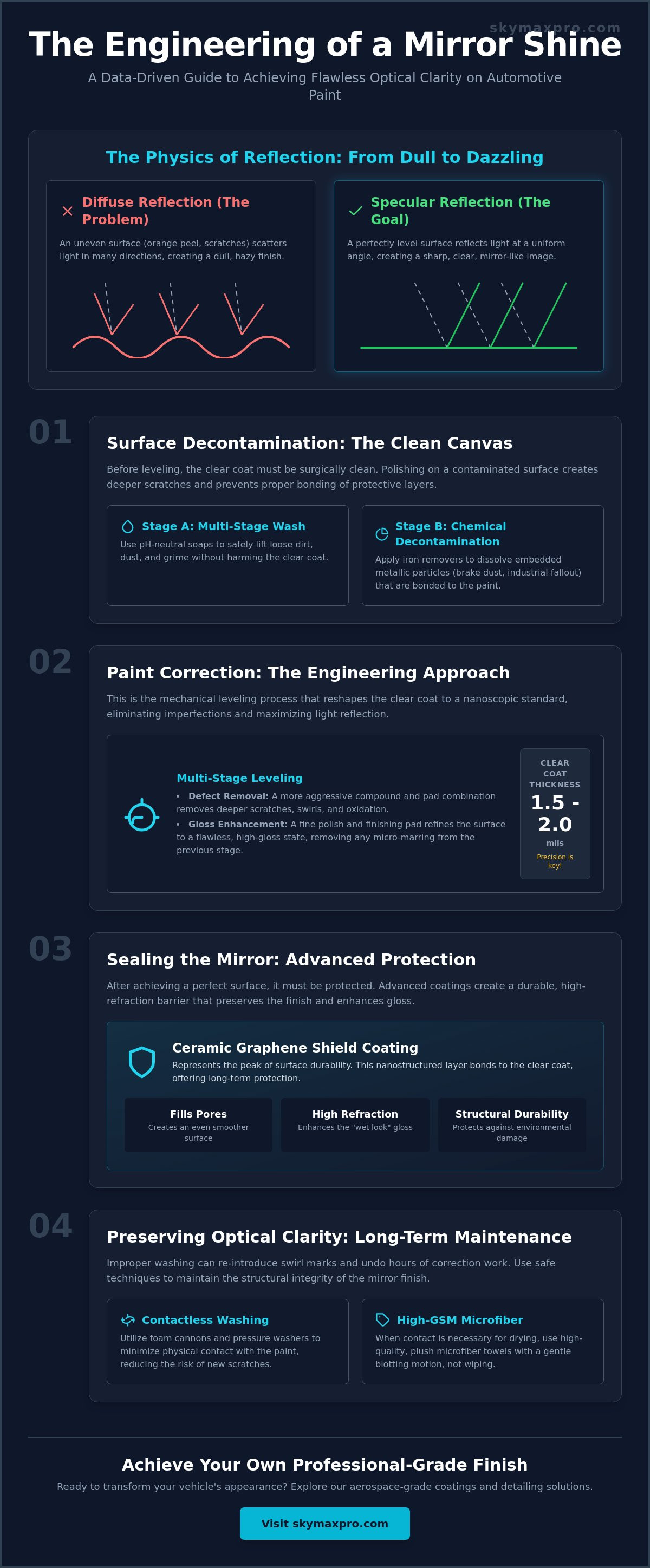
Achieving a true mirror finish is an exercise in optical engineering rather than simple cleaning. Most car owners focus on the chemical properties of waxes, but the actual visual result depends entirely on how the paint surface manages incident light. To understand how to get a mirror shine on car paint, you must first analyze the clear coat's topography. At a microscopic level, even a clean car can have a surface resembling a mountain range. These peaks and valleys, often referred to as "orange peel," cause diffuse reflection where light scatters in multiple directions. This scattering reduces the intensity of the reflection and creates a dull, hazy appearance that lacks definition.
According to The Physics of Reflection, a surface only appears mirror-like when it facilitates specular reflection. In this state, light waves strike a perfectly level plane and bounce off at a uniform angle. When the clear coat is textured or contaminated, it forces light into a diffuse pattern. This is why mechanical leveling is the only path to a professional finish; you're literally reshaping the clear coat to ensure photons travel in a predictable, synchronized path. The goal is to eliminate any deviation in the surface plane that might disrupt this light return.
The Role of the Clear Coat in Optical Depth
Modern automotive clear coats are surprisingly thin, typically measuring between 1.5 and 2 mils in thickness. This layer acts as a transparent window to the color coat below. Maintaining its structural integrity is vital because it determines the paint's refractive index. When the surface oxidizes, it develops a "fogged" appearance. This isn't just surface dirt; it's a breakdown of the polymer chain that traps light within the clear coat rather than reflecting it back to the viewer. Protecting this thickness while removing defects is the primary challenge of professional paint correction.
Specular Reflection and Light Refraction
A perfectly flat surface allows light to bounce at a uniform angle, creating the high-contrast "pop" associated with showroom finishes. Even minor imperfections, known as micro-marring, can ruin this effect. These tiny scratches act as prisms, refracting light away from the eye and washing out the paint's true color. By leveling the clear coat to a nanoscopic standard, you ensure that light enters and exits the clear coat with minimal interference. Specular reflection is the primary driver of the mirror effect, occurring when light waves reflect off a surface at a consistent, predictable angle.
Surface Decontamination: Prepping the Canvas for Maximum Clarity
Before mechanical leveling can begin, the clear coat must be surgically clean. Polishing a surface that still holds bonded contaminants is counterproductive; the machine's orbital motion turns microscopic grit into an abrasive slurry that induces deep scratches. This stage is critical for anyone mastering how to get a mirror shine on car paint because it ensures the polisher only interacts with the clear coat itself. A "stripped" surface, free of old waxes and environmental pollutants, is the only foundation that allows for true optical clarity and proper bonding of final protective layers.
The process begins with a multi-stage wash using pH-neutral car soaps. This step safely lifts loose debris without etching the surface. However, a standard wash is insufficient for professional results. You must remove topographical contaminants that have physically bonded to the clear coat polymer. Research into testing clearcoat scratch resistance confirms that these coatings are vulnerable to physical degradation, meaning any debris left behind during the polishing phase will compromise the finish's structural integrity.
Chemical Decontamination and Iron Removal
Industrial fallout and brake dust consist of jagged metallic particles that embed themselves into the paint's pores. These cannot be washed away. Using a dedicated iron remover triggers a chemical reaction that liquifies these particles, turning them into a water-soluble solution. This chemical approach is safer than aggressive mechanical scrubbing, as it minimizes the risk of introducing new swirls. To ensure the paint is completely "stripped," use a Heavy Duty Red Power Degreaser to dissolve old waxes, silicones, and road oils. This ensures that your polishing pads don't become clogged with spent product, which would otherwise reduce the efficiency of the leveling process.
Mechanical Decontamination with Detailing Clay
Even after chemical treatment, some stubborn contaminants may remain. Mechanical decontamination using Final Touch I PRO Detailing Clay is necessary to shear away these remaining protrusions. Always use high-lubricity fluids during this stage to prevent clay marring. You can verify the surface readiness by using the "baggie test." Place your hand inside a thin plastic sandwich bag and lightly run it over the dry paint. If you feel any bumps or grit, the surface isn't level yet. For those looking to streamline this preparation, a comprehensive Exterior Detailing Kit provides the specialized tools needed to reach this state of industrial cleanliness. Once the surface feels as smooth as glass through the baggie, the paint is ready for the correction phase.
Paint Correction: The Engineering Approach to Leveling
Paint correction is the foundational mechanical stage in determining how to get a mirror shine on car paint. While decontamination prepares the surface, correction actively reshapes the clear coat polymer to eliminate light-scattering defects. This process requires a systematic approach to removing a microscopic layer of the clear coat, typically between 0.1 to 0.3 mils, to reach the bottom of scratches and swirl marks. Using a Dual Action (DA) polisher is the industry standard for this task. Unlike high-heat rotary buffers that risk burning through the finish, DA polishers utilize an orbital motion that minimizes localized thermal buildup while ensuring uniform material removal across the panel.
The efficiency of this stage depends on the science of diminishing abrasives found in modern compounds. These engineered particles are designed to break down under the heat and pressure of the polishing cycle. They begin as aggressive, jagged structures that "cut" through deep defects and gradually fracture into smaller, rounded spheres that "polish" the surface. This transition ensures that the aggressive cutting phase leads directly into a refinement phase, reducing the total number of steps required to achieve optical clarity. Success is verified through high-CRI (Color Rendering Index) inspection lamps, which reveal microscopic holograms that are invisible under standard garage lighting.
Pad selection must be calibrated to the specific hardness of the vehicle's clear coat. Industry professionals typically categorize pads by their material density and "cut" capability:
- Microfiber and Wool Pads: These provide high surface area contact and are utilized for heavy defect removal on harder European clear coats.
- Firm Foam Pads: These offer a balance of cutting and finishing, ideal for moderate swirl marks.
- Soft Finishing Foam: These have a low-density cell structure designed to maximize gloss without removing significant material.
Compounding to Remove Deep Defects
Heavy compounding is necessary when the clear coat exhibits severe oxidation or deep scratches that disrupt the plane of reflection. During this cutting phase, managing the physics of heat generation is vital. As the pad oscillates, the friction causes the clear coat to expand slightly. Consistent machine movement and moderate pressure are required to prevent "pigtails" or uneven leveling. If the surface temperature exceeds safe thresholds, the clear coat can become gummy, leading to pad loading and a decrease in cutting efficiency. A methodical overlapping pass technique ensures that the entire section is leveled to a consistent depth.
The Finishing Polish for Optical Clarity
The finishing stage is where the "haze" left by heavy compounding is removed to reach the highest possible refractive state. Fine-cut polishes utilize non-diminishing micro-abrasives to smooth out the surface at a nanoscopic level. This refinement allows light to pass through the clear coat and reflect off the color coat with zero diffusion. Before finalizing this stage, you must perform a thorough IPA (isopropyl alcohol) wipe. This removes residual polishing oils that might "fill" remaining scratches, providing a true view of the surface. Only when the paint is completely bare and defect-free can it be considered ready for a long-term protective seal.
Sealing the Mirror: Aerospace-Grade Protection and Enhancement
Once mechanical leveling is complete, the surface exhibits high specular reflection, but the clear coat remains chemically vulnerable. Nanotechnology coatings serve as the final engineering stage in how to get a mirror shine on car paint. Unlike traditional carnauba waxes that merely sit on top of the paint, nanostructured coatings penetrate and fill the remaining microscopic pores of the clear coat. This creates a cross-linked bond that effectively turns the surface into a non-porous, hydrophobic shield. While carnauba wax provides a temporary organic glow, graphene coatings offer superior durability and a significantly higher refractive index. This technological shift ensures the mirror finish remains stable under environmental stress rather than degrading within weeks.
The primary technical advantage of modern coatings is their ability to resist UV radiation. UV rays trigger photo-oxidation, which breaks down the polymer chains in the clear coat and leads to a loss of clarity over time. By applying a high-solids Ceramic Graphene Shield Coating, you introduce a sacrificial layer that absorbs this radiation. This protects the underlying correction work and maintains the "wet" look indefinitely. Graphene doesn't just protect; it transforms the clear coat's interaction with light by providing a perfectly uniform surface tension across the entire vehicle body.
The Graphene Advantage in Reflectivity
Graphene's molecular structure, a single layer of carbon atoms arranged in a hexagonal honeycomb lattice, provides exceptional surface tension. This high contact angle causes water and contaminants to bead and roll off before they can bond to the finish. One of the biggest challenges in maintaining a mirror shine is water spotting, which occurs when mineral-heavy water evaporates and etches the surface. Graphene's thermal conductivity helps dissipate heat, which is a key factor in how to get a mirror shine on car paint that lasts through seasonal transitions. For a streak-free application, using the PRO Ceramic Graphene Spray Coating allows for rapid bonding without the complexity of traditional ceramic application. You should ensure the panel is cool to the touch and apply the product in a cross-hatch pattern for uniform coverage.
Layering for Depth: The Wet Look Sealant
While a ceramic or graphene base provides structural protection, layering can further enhance the visual depth of the finish. Utilizing a Ceramic Deep Wet Mirror Shine Wax Sealant over a cured ceramic base creates a multi-dimensional effect. The hard ceramic base provides the level plane, while the specialized sealant adds a high-gloss top layer that increases the perceived "wetness" of the paint. This synergy between different chemical structures maximizes light refraction. Curing times are critical during this phase. Most professional coatings require 12 to 24 hours of environmental stability to achieve full cross-linking. You must avoid moisture exposure during this window to ensure the bond reaches its maximum theoretical hardness.
To achieve professional results with guaranteed chemical compatibility, we recommend utilizing the Ceramic Coating Kit for your final protection stages.
Post-Correction Maintenance: Preserving the Optical Clarity
Achieving a flawless finish is only half the battle. If you don't implement a rigorous maintenance protocol, the specular reflection you've engineered will quickly degrade due to mechanical abrasion and environmental contaminants. Understanding how to get a mirror shine on car paint is a hollow victory if you introduce swirl marks during the very first wash. To prevent this, professional detailers utilize "contactless" or low-friction washing methods. These techniques focus on chemical encapsulation of dirt particles before any physical contact occurs, ensuring that the clear coat's level plane remains undisturbed.
The primary tool for physical contact is the high-GSM (Grams per Square Meter) microfiber towel. Standard towels have a low pile that traps grit against the paint, acting like sandpaper. In contrast, high-GSM towels possess deep fibers that pull contaminants away from the surface. Between full washes, maintaining the hydrophobic layer is essential. Using a Quick Detailer Spray with Ceramic High Gloss Finish provides a lubricated barrier that safely removes light dust while depositing a sacrificial layer of SiO2 or graphene. For a structured long-term approach, following a Professional Auto Detailing Master Checklist ensures that no component of the protection system fails prematurely.
Safe Washing Techniques to Prevent Marring
The most common cause of gloss reduction is improper washing. The two-bucket method, which uses one bucket for soap and one for rinsing the wash mitt, is the minimum standard. However, combining this with a foam cannon application provides superior safety. The foam dwells on the surface, breaking the bond between road film and the clear coat. You should never engage in "dry washing" or use towels that have touched the ground. For scenarios where a full water-based wash isn't feasible, a Ceramic Waterless Car Wash offers a high-lubricity alternative that encapsulates light soil, allowing for safe removal without inducing micro-marring.
Periodic Decontamination and Toppers
Over time, even the most advanced coatings can become "clogged" with environmental pollutants. You'll identify this when the hydrophobic properties begin to degrade, characterized by water sheeting rather than tight beading. Periodic chemical decontamination using a pH-neutral iron remover can clear these pores. Following this with a "topper" spray rejuvenates the top layer of the ceramic or graphene matrix, restoring the original refractive index. Consistent maintenance is significantly more cost-effective than performing a full mechanical re-correction of the clear coat every year.
Mastering the Science of Optical Perfection
Achieving a showroom finish requires a transition from traditional labor to technical precision. We've analyzed how mechanical leveling establishes specular reflection and how nanostructured coatings preserve that clarity against environmental degradation. By following a structured protocol of decontamination and multi-stage correction, you transform the clear coat from a diffuse surface into a high-refraction plane. This engineering approach is the definitive method for how to get a mirror shine on car paint that survives beyond the first wash.
To implement these professional standards, utilize tools engineered for industrial-grade results. Elevate your car’s finish to a professional standard with the SKY MAXPRO Exterior Detailing Kit. Our systems leverage aerospace-grade formulations and advanced Graphene and Ceramic nanotechnology, making them the trusted choice for professional detailers nationwide. With the right technical framework and high-performance chemistry, achieving aerospace-grade results is a predictable outcome.
Frequently Asked Questions
Can I get a mirror shine on a car with bad paint or fading clear coat?
A mirror shine is not achievable on paint with a failing clear coat. Once the clear coat delaminates or reaches a state of severe oxidation, the structural integrity of the polymer is compromised. There's no longer a level surface to reflect light. In these cases, the paint requires a professional respray rather than a correction process. Attempting to level failing clear coat often leads to total paint failure.
How long does a professional mirror shine finish last?
A professional mirror finish typically lasts between 2 and 5 years depending on the protective coating applied. While traditional waxes degrade within 60 days, modern graphene and ceramic coatings provide a cross-linked bond that resists environmental abrasion. Maintaining the finish with pH-neutral soaps and periodic toppers is essential. Next-generation coatings emerging in 2026 even claim durability of up to 15 years under optimal conditions.
Is it better to use a machine polisher or apply polish by hand for a mirror finish?
A machine polisher, specifically a Dual Action (DA) polisher, is essential for a true mirror finish. Hand polishing lacks the consistent speed and pressure required to level the clear coat at a nanoscopic level. Machines provide thousands of oscillations per minute. This is necessary to break down diminishing abrasives and remove defects uniformly. Hand application is only suitable for applying non-abrasive waxes or glazes.
Will a ceramic coating hide existing swirl marks and scratches?
Ceramic coatings won't hide existing swirl marks or scratches. Since these coatings are optically clear, they actually magnify the surface condition underneath. If you apply a coating over uncorrected paint, the defects will be locked in and more visible. This is why the paint correction stage is the most critical step in how to get a mirror shine on car paint; the surface must be perfect before sealing.
How often should I clay bar my car to maintain its reflectivity?
You should only clay bar your vehicle when the "baggie test" indicates the presence of bonded contaminants. For most daily-driven vehicles, this occurs once or twice per year. Mechanical decontamination is an abrasive process that can introduce micro-marring, so it shouldn't be performed as a routine maintenance step. Only use detailing clay when you plan to follow up with at least a light finishing polish.
What is the difference between a high-gloss finish and a mirror finish?
The difference lies in optical clarity and the type of reflection produced. A high-gloss finish simply reflects a large amount of light, but a mirror finish achieves specular reflection with zero diffusion. In a mirror finish, the edges of reflected objects are sharp and undistorted. This requires a perfectly level clear coat surface, whereas high gloss can still exist on a surface with significant orange peel or minor defects.
Does the color of the car affect how the mirror shine appears?
The color of the vehicle significantly impacts the perceived depth of a mirror shine. Darker colors, particularly black and deep blue, act as a better backdrop for reflections because they absorb more light. This creates higher contrast with the reflected images. Lighter colors like white or silver are highly reflective but often mask the fine details of a mirror finish due to their high light scattering properties.
Can I apply a mirror shine wax over a ceramic graphene coating?
You can apply a specialized sealant or wax over a graphene coating to enhance the "wet look" of the paint. However, you must ensure chemical compatibility. Using a product like Ceramic Deep Wet Mirror Shine Wax Sealant is a reliable way how to get a mirror shine on car paint with added aesthetic depth. The wax adds a layer of gloss while the underlying graphene layer maintains the structural protection and hydrophobic properties.