

Did you know that interior detailing products account for 45% of the $13.7 billion global detailing market, yet many operators still struggle with the fundamental physics of decontamination? When cleaning heavily soiled car upholstery, the standard "scrub and wipe" method is a fundamental failure of methodology. It typically redistributes surfactants across the surface while trapping organic matter deep within the fabric matrix. You've likely experienced the frustration of persistent odors returning or witnessed delicate fibers fraying under the stress of unscientific agitation.
It's common to feel that professional-grade restoration is out of reach without risking the textile's integrity. This guide provides a technical protocol for restoring neglected interiors using advanced chemistry and precise mechanical extraction. We'll analyze how to match specific chemical agents to the molecular structure of contaminants and implement the ANSI/IICRC S300 standards for fabric restoration. You'll learn the engineering required to achieve a laboratory-clean environment that stays fresh long after the upholstery dries.
Key Takeaways
- Understand the physics of capillary action and how it drives contaminants deep into seat foam, necessitating a multi-layer restoration strategy.
- Master the technical protocol for cleaning heavily soiled car upholstery by matching specific chemical surfactants to the molecular structure of the soil.
- Evaluate the engineering advantages of hot water extraction and steam cleaning over manual agitation for neutralizing deep-seated bio-contaminants.
- Implement a precise step-by-step restoration workflow that begins with high-efficiency dry vacuuming to prevent debris from liquefying during the wet phase.
- Learn to engineer a microscopic hydrophobic barrier that prevents future fiber saturation and protects the integrity of the textile matrix.
The Science of Heavy Soiling: Why Standard Cleaning Fails
Heavy soiling isn't merely an aesthetic issue; it's a structural failure of the fabric's protective barrier. Within the $13.7 billion global detailing market, the most significant technical challenge remains the restoration of saturated textiles. In the context of cleaning heavily soiled car upholstery, we define this condition as deep-layer fiber saturation where contaminants have migrated beyond the surface pile into the underlying foam. Standard cleaning often fails because it addresses only the visible fraction of the problem.
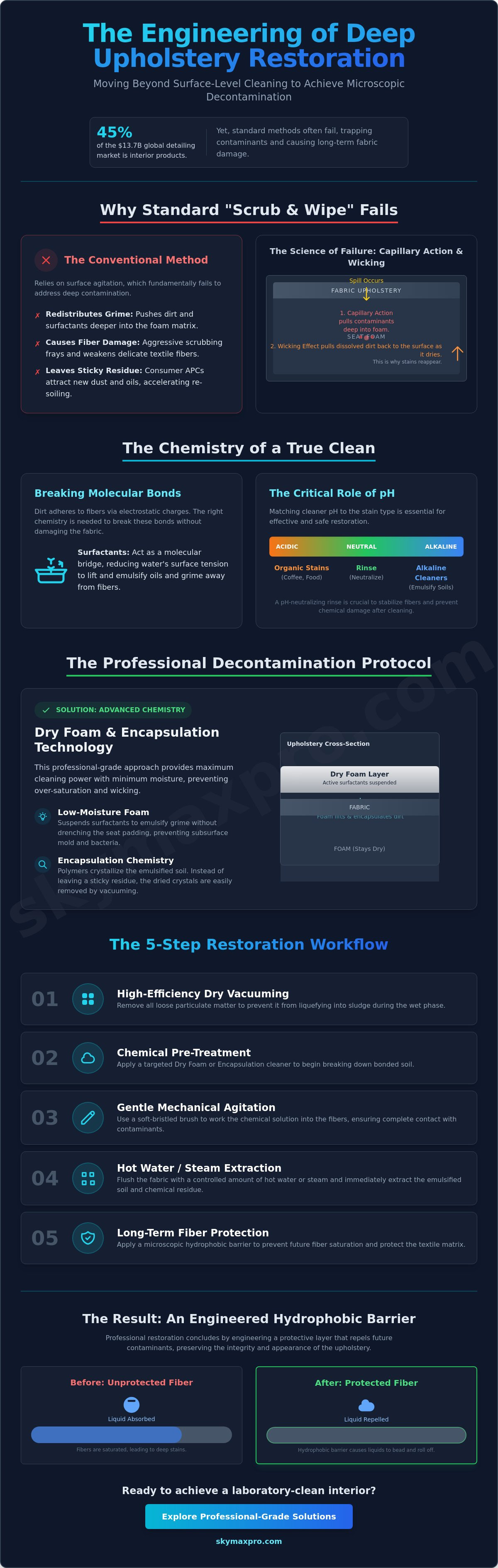
The primary driver of this failure is capillary action. When liquid contaminants like coffee, soda, or biological fluids hit the seat, the porous nature of the foam draws the moisture downward. As the seat dries, the "wicking effect" occurs; the evaporating moisture pulls dissolved dirt back to the surface. This cycle explains why stains often reappear 24 to 48 hours after a superficial cleaning. Professional Auto detailing requires a methodology that breaks this cycle through deep-layer extraction rather than surface-level agitation.
Consumer-grade "all-purpose" cleaners (APCs) lack the specific chemical versatility needed for this level of restoration. They're designed as jacks-of-all-trades, often relying on high-suds surfactants that leave behind a sticky residue. This residue actually accelerates future soiling by acting as a magnet for new dust and oils, leading to a rapid degradation of the fabric matrix. Mastering the process of cleaning heavily soiled car upholstery requires moving beyond these generic solutions toward targeted chemical engineering.
Understanding Molecular Bonding in Fabric Fibers
Dirt particles don't just sit on the fabric; they adhere to fibers through electrostatic charges. Synthetic materials like polyester often create a tight molecular bond with inorganic contaminants like grease and motor oil. If you attempt to remove these through mechanical scrubbing alone, you risk permanent fiber fraying. Without chemical assistance to break these bonds, the friction required for removal exceeds the tensile strength of the textile. Organic contaminants, such as protein-based stains, require an entirely different approach to decouple them from the fiber's surface.
The Role of pH in Upholstery Restoration
Successful restoration depends on understanding the pH scale. Most organic stains are acidic and require an alkaline cleaner to break them down. However, high-pH chemicals can be aggressive. If they aren't neutralized, they can weaken the fabric's structural integrity or cause chemical burns on skin contact. Precision involves using the correct alkaline surfactant to emulsify the soil, followed by a pH-neutralizing rinse to stabilize the fibers and prevent the fabric from becoming brittle or discolored.
The Professional Decontamination Protocol: Chemistry and Surfactants
Surfactants serve as the molecular bridge between water and non-polar contaminants. When cleaning heavily soiled car upholstery, the primary objective is to reduce the surface tension of water, allowing the cleaning solution to penetrate the microscopic crevices of the fabric fibers. This mechanical-chemical synergy ensures that contaminants aren't just pushed around but are actively detached from the substrate. By utilizing advanced surfactant technology, you can emulsify stubborn lipids and proteins that standard cleaners fail to affect.
Standard liquid cleaners often lead to over-saturation, which triggers the capillary wicking discussed in the previous section. To mitigate this risk, professional protocols utilize a Carpet, Fabric & Upholstery Dry Foam Tech Shampoo Cleaner. This technology suspends the active surfactants in a low-moisture foam, providing sufficient dwell time to emulsify grime without drenching the underlying seat padding. This approach is critical for maintaining the structural integrity of the foam and preventing the growth of subsurface bacteria. Integrating a high-performance dry foam shampoo into your workflow ensures professional-grade results with minimal dry time.
Encapsulation chemistry represents the next evolution in this process. Encapsulation is the process of crystallizing soil for vacuum removal. Instead of leaving a sticky surfactant residue that attracts new dirt, the polymers in the solution surround the emulsified soil. As the foam dries, it forms a brittle crystal that you can simply vacuum away. This prevents re-soiling and ensures that the "clean" feel of the fabric is a result of actual soil removal rather than chemical masking.
Adhering to safety standards is equally important. Current 2026 regulations, such as those from the California Air Resources Board (CARB), mandate strict limits on Volatile Organic Compounds (VOCs) in automotive cleaners. Using VOC-free formulations ensures that the vehicle's interior remains safe for occupants long after the detailing session. Before full application, always perform a colorfastness test on an inconspicuous area to ensure the dye's stability. While a professional interior cleaning requires high-performance agents, safety protocols prevent irreversible damage to sensitive textiles.
Surfactant Mechanics: Lifting vs. Dissolving
Surfactants work through a process called micelle formation. The hydrophobic tails of the surfactant molecules attach to oil and grease, while the hydrophilic heads face outward toward the water. This effectively surrounds oil molecules to make them water-soluble, allowing them to be lifted from the fiber surface. Dry foam technology is particularly effective here because it keeps the chemical reaction concentrated on the fiber pile rather than the padding, which prevents deep-layer saturation.
De-greasing Heavily Impacted Areas
Certain zones, such as driver-side bolsters and floor mats, often exhibit lipid-based saturation that standard shampoos cannot resolve. In these scenarios, a targeted application of a heavy-duty degreaser is necessary to break the bond between the oil and the fiber. When cleaning heavily soiled car upholstery in these high-traffic areas, precise dilution ratios are vital. A 10:1 or 4:1 ratio, depending on soil density, provides the necessary chemical force to break down industrial-grade oils without compromising the textile's color or texture.
Mechanical Extraction vs. Manual Agitation: Selecting Methodology
Choosing between mechanical extraction and manual agitation isn't a matter of preference; it's a technical decision based on contaminant density. When cleaning heavily soiled car upholstery, manual agitation serves as the preparatory stage to break molecular bonds, while extraction acts as the final flushing mechanism. Hot water extraction is particularly efficient for deep-seated bio-contaminants because it utilizes thermal energy to increase the kinetic activity of surfactants. This process aligns with the ANSI/IICRC S300 Standard for Professional Upholstery Cleaning (2025 edition), which emphasizes the removal of soil rather than its suspension.
Steam cleaning offers a different utility. It's highly effective for breaking down heat-sensitive waxes and sanitizing surfaces without excessive moisture. However, precision is required. Modern synthetic blends can suffer from "heat set" or fiber melting if temperatures exceed 212°F (100°C). You must monitor the thermal output to ensure you're sanitizing the textile without compromising its structural integrity. The fundamental chemistry of cleaning dictates that heat accelerates chemical reactions, but excessive heat can catalyze permanent damage to delicate automotive polymers.
The Extraction Process: Flushing the Fibers
Professional extractors operate by injecting a pressurized cleaning solution into the pile and immediately recovering it via high-lift vacuum motors. This rapid recovery is essential to prevent moisture from lingering in the seat foam, which could otherwise lead to mold growth or the wicking issues mentioned previously. A critical yet often overlooked step is the final rinse. If you leave chemical residue behind, the fabric will exhibit a high surface energy that attracts dirt. Optimal temperatures vary by material: nylon and polyester can handle up to 160°F, whereas Alcantara requires a much cooler approach, typically not exceeding 100°F, to prevent pilling.
Agitation Tools and Techniques
Agitation must be measured. For durable carpeting, nylon-bristled drill brushes are effective, provided you maintain an RPM limit of 600 to 800. Excessive speed generates friction heat that can fuse synthetic fibers together. For delicate seating surfaces, horsehair brushes provide the necessary friction without the risk of abrasion. Implementing a "cross-hatch" brushing pattern ensures that the surfactant reaches all 360 degrees of the fiber. When performing the final wipe-down, use high-GSM microfiber towels (at least 350-400 GSM). These towels have a higher loop density, which increases their surface area for absorbing emulsified grime and excess moisture.
Recognizing the point of no return is a hallmark of professional expertise. If the fabric has suffered from "dry rot" due to UV exposure or if the foam backing has begun to disintegrate, cleaning is no longer a viable restoration path. In these cases, the structural failure of the material means that even the most advanced cleaning heavily soiled car upholstery protocol cannot restore the interior to a safe or aesthetic state.
Step-by-Step Restoration for Severely Impacted Interiors
Systematic restoration for cleaning heavily soiled car upholstery requires strict adherence to a multi-phase workflow. The process begins with high-efficiency dry vacuuming to remove loose particulate matter, which often constitutes up to 80% of the total soil load. Skipping this phase leads to "mudding," a condition where dry dust liquefies upon contact with cleaning agents, driving contaminants deeper into the fiber matrix. By removing these solids while they are dry, you reduce the chemical demand and mechanical stress required in subsequent stages.
Once the dry load is mitigated, the focus shifts to chemical intervention. Strategic pre-treatment of stubborn spots using a Deep Clean Interior Cleaner allows for the targeted emulsification of lipids and proteins. This isn't a spray-and-wipe operation; it requires calculated dwell time to allow the surfactants to penetrate the fiber core. For a professional result, integrate these specialized solutions into your process by utilizing a comprehensive Interior Cleaning Kit designed for technical decontamination.
Pre-Treatment: Breaking the Bond
Chemical dwell time is non-negotiable. Allowing the solution to sit for three to five minutes facilitates the breakdown of complex molecular bonds without the need for aggressive scrubbing. Use a soft-bristled brush to work the cleaner into the fiber base using circular motions, ensuring even distribution. This phase is critical for addressing localized issues like ink, organic tannins from coffee, or protein-based pet accidents that require specific surfactant reactions to release from the textile matrix.
The primary cleaning phase involves controlled moisture application followed by extraction. Whether using a dedicated hot water extractor or a manual blotting technique with high-GSM microfiber towels, the goal remains the removal of suspended contaminants. You must recover the moisture as quickly as it's applied to protect the seat's internal electronics and foam layers. This ensures that the soil is physically removed from the vehicle rather than simply being redistributed within the cushion.
Drying and Ventilation Protocols
Accelerated drying is the final safeguard against the "musty" odor caused by lingering moisture. Position industrial air movers to create cross-ventilation, ideally in a low-humidity environment. This rapid evaporation prevents the wicking effect where deep-seated stains migrate back to the surface pile during the drying process. Conduct a final inspection under high-intensity lighting to check for "ghosting," which are the faint shadows of previous stains that may require a second, more targeted chemical pass. Once the fabric is dry, groom the pile with a soft brush to restore the factory-original texture and appearance.
Long-Term Fiber Protection: Engineering a Barrier
The final phase of the engineering protocol isn't the removal of contaminants, but the stabilization of the textile's surface energy. After cleaning heavily soiled car upholstery, the fibers are left in an "open" and vulnerable state. Without a protective barrier, the fabric acts as a desiccant, rapidly absorbing moisture and atmospheric pollutants. To prevent this, we implement a hydrophobic barrier that operates on a microscopic level, fundamentally altering how the fabric interacts with external matter. This stage transitions the process from simple cleaning to a full-scale fabric restoration.
By applying PRO Shield for Fabric, Carpet, Upholstery & Floor Mats, you create an invisible tension barrier. This aerospace-grade technology utilizes advanced polymers to coat individual fibers rather than sealing the gaps between them. This distinction is vital for maintaining the material's functional properties. When liquids contact the treated surface, the low surface energy causes them to bead and roll off rather than saturating the pile. This proactive approach ensures that the labor-intensive process of cleaning heavily soiled car upholstery doesn't need to be repeated frequently, as contaminants remain on the surface where they can be easily neutralized.
The Benefits of Fabric Ceramic Protection
The primary advantage of ceramic-based protection is its ability to block UV radiation, which is the leading cause of fiber degradation and color fading in automotive interiors. Beyond solar protection, these coatings provide a dual-action resistance against both water-based spills and lipid-based oils. Ceramic fabric protection does not change the texture or breathability of the material. It preserves the factory-original hand-feel while providing a high-performance shield that standard consumer products cannot replicate. This ensures the structural integrity of the textile matrix remains intact over the vehicle's operational lifespan.
Implementing a Maintenance Schedule
For high-use vehicles or fleet operations, we recommend a re-application of the protective barrier every 6 to 12 months. This frequency depends on the mechanical abrasion the seats experience. Maintenance of protected surfaces is significantly simplified; most surface-level dust can be removed using a simple damp microfiber towel without the need for aggressive surfactants. Integrating this step into a broader auto detailing routine ensures that the vehicle remains in a state of constant readiness. By following this technical protocol, you move from reactive cleaning to a sophisticated maintenance strategy that preserves both value and hygiene.
Advancing Your Interior Restoration Standards
Restoring an automotive interior to factory standards requires more than just effort; it demands a technical protocol rooted in chemical engineering. You've seen how mastering the wicking effect and utilizing encapsulation technology transforms the process of cleaning heavily soiled car upholstery from a temporary fix into a permanent restoration. By matching specific surfactants to soil types and implementing a hydrophobic barrier, you ensure the textile matrix remains protected against future degradation and UV-induced fading.
Achieving these results consistently requires professional-grade instrumentation and chemistry. Our solutions are manufactured in the USA using aerospace-approved formulations that are both VOC-free and eco-friendly. This commitment to safety and measurable efficiency allows you to maintain the highest standards of interior hygiene without compromising material integrity. It's time to move beyond surface-level cleaning toward a methodology based on structural restoration.
Ready to implement these engineering principles in your own workflow? Shop the SKY MAXPRO Interior Cleaning Kit for Professional Results and experience the difference of precision-engineered car care. Your vehicle deserves a restoration process that is as sophisticated as its original design.
Frequently Asked Questions
Can I use a steam cleaner on all types of car upholstery?
No, steam cleaning is not universally compatible with all automotive textiles. While durable polyester blends can withstand temperatures near 212°F, delicate materials like Alcantara or certain synthetic suedes can suffer from permanent fiber melting or pilling. You must monitor the thermal output to ensure you remain within the material's safe operational range. For heat-sensitive polymers, a low-moisture foam approach is a safer alternative for effective decontamination.
What is the best way to remove set-in coffee stains from car seats?
The most effective method involves utilizing a tannin-specific surfactant to break the molecular bond between the organic pigment and the fiber. After applying a pre-treatment, you must allow for sufficient dwell time to emulsify the stain. Following this, hot water extraction is used to flush the contaminants from the deep layers of the fabric. This process ensures that cleaning heavily soiled car upholstery results in a complete removal rather than surface-level fading.
How do I stop stains from wicking back up after the seat dries?
To prevent the wicking effect, you must achieve deep-layer soil recovery through high-lift mechanical extraction. Wicking occurs when moisture trapped in the seat foam pulls dissolved contaminants to the surface during evaporation. Implementing a thorough dry vacuuming phase before wetting the fabric reduces the total soil load. Using industrial air movers to accelerate the drying process also minimizes the time window in which capillary action can occur.
Is it safe to use a drill brush on delicate car fabrics?
Drill brushes are generally reserved for durable carpeting and should be used with caution on seating surfaces. If you choose this method, maintain a low RPM range between 600 and 800 to prevent friction-induced heat damage. For delicate textiles, a manual horsehair brush is the preferred engineering choice. It provides sufficient agitation to work the surfactants into the fiber pile without risking the structural integrity or causing the material to fray.
How long does it take for car upholstery to dry after a deep clean?
Drying times typically range from two to six hours, depending on ambient humidity and the volume of air movement. Utilizing professional extraction equipment significantly reduces this window by recovering the majority of the applied moisture. To ensure a factory-grade finish and prevent musty odors, you should always employ industrial air movers. This rapid evaporation is critical for stabilizing the fabric and preventing any remaining sub-surface contaminants from migrating.
What is the difference between a fabric protector and a standard cleaner?
A standard cleaner is a surfactant-based solution designed to emulsify and remove existing contaminants. In contrast, a fabric protector is a ceramic or polymer-based coating that engineers a hydrophobic barrier on a microscopic level. While cleaners address current soil, protectors lower the surface energy of the fibers to prevent future saturation. This makes the surface resistant to both water-based and oil-based spills, simplifying long-term maintenance detailing.
Can heavily soiled upholstery ever truly be restored to factory condition?
Yes, heavily soiled upholstery can often be restored to a factory-like state through a precise decontamination protocol. Success depends on the structural integrity of the material; if the fibers haven't suffered UV-induced rot or mechanical disintegration, molecular cleaning can remove deep-seated grime. By cleaning heavily soiled car upholstery with professional surfactants and mechanical extraction, you can eliminate both visible stains and the microscopic bio-contaminants that cause persistent odors.
How do I remove persistent odors like smoke or pet smells from car seats?
Removing persistent odors requires the physical extraction of the organic or chemical particles trapped within the fabric and foam. Surface-level deodorizers only mask the issue temporarily. You must use a deep-cleaning surfactant to emulsify the odor-causing molecules, followed by hot water extraction to flush them out of the textile matrix entirely. For severe cases, a secondary chemical neutralization step may be necessary to ensure the environment remains laboratory-clean.