

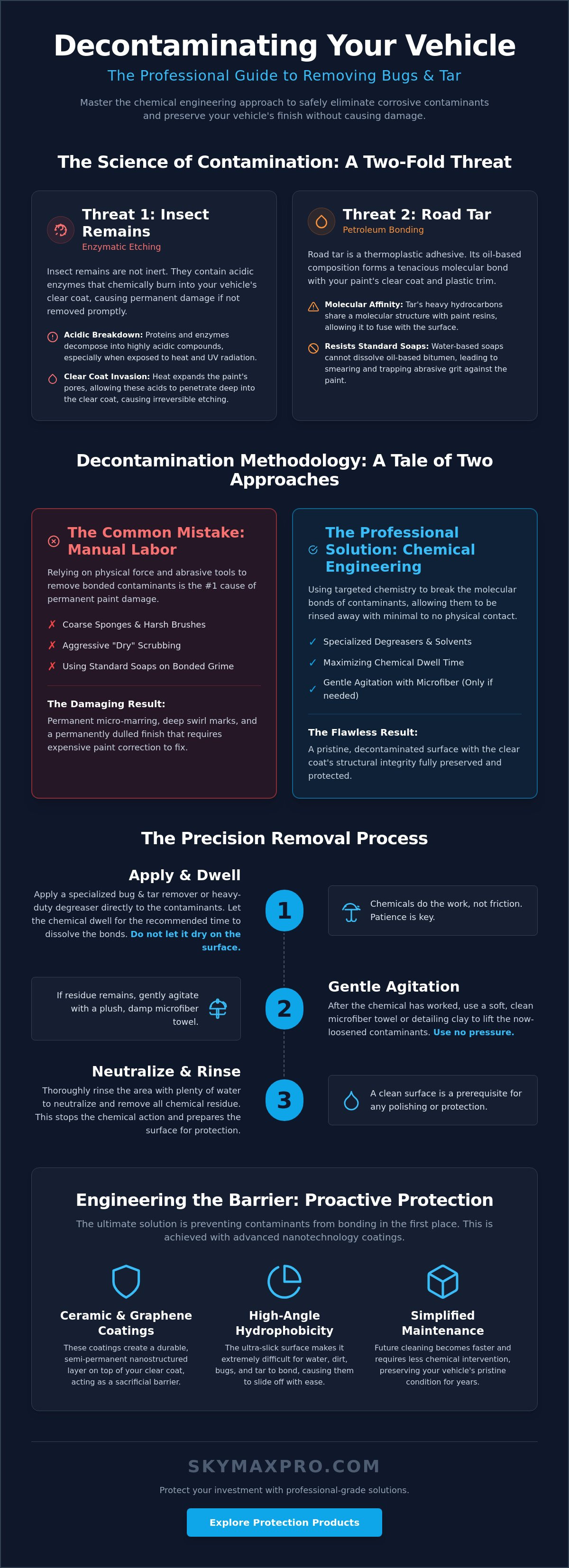
The most common mistake in automotive maintenance isn't leaving debris on the paint; it's the physical force used to remove it. When you're struggling with how to remove bugs and tar from front bumper surfaces, reaching for a coarse sponge often results in microscopic marring that permanently dulls your finish. In the world of high-end detailing, we treat decontamination as a chemical engineering challenge rather than a manual labor task. With the global car care market projected to reach $12.1 billion by late 2026, the shift toward sophisticated, non-contact solutions has become the industry standard for preserving vehicle integrity.
You've likely spent hours scrubbing at sun-baked organic acids and road bitumen, only to find that standard soaps barely make a dent. This guide will teach you to master the technical methodology for decontaminating your vehicle's front fascia using aerospace-grade chemistry and precision detailing techniques. We'll analyze the molecular breakdown of contaminants, the role of VOC-compliant solvents, and how to utilize advanced ceramic coatings to prevent future bonding altogether. By the end of this article, you'll possess the technical knowledge to achieve a pristine finish while minimizing physical contact and protecting your clear coat from acidic etching.
Key Takeaways
- Understand the biochemical impact of enzymatic acidity and why immediate decontamination prevents permanent clear coat etching.
- Discover the professional methodology for how to remove bugs and tar from front bumper panels using chemical dwell time instead of abrasive scrubbing.
- Learn to differentiate between surface-level contaminants and permanent "ghosting" to apply the correct restoration protocols for mineral deposits.
- Identify the specific role of heavy-duty degreasers in breaking down organic proteins and thermoplastic road tar at a molecular level.
- Explore how ceramic and graphene nanotechnology creates a high-angle hydrophobic barrier that prevents future debris from bonding to the surface.
The Science of Contamination: Why Bugs and Tar Destroy Paint
The front fascia of a vehicle serves as the primary impact zone for atmospheric and organic contaminants. Understanding the physics of these interactions is essential for anyone researching how to remove bugs and tar from front bumper surfaces without compromising the clear coat. Modern automotive paint composition relies on a multi-layer system where the clear coat provides the final barrier against environmental stressors. However, this layer is highly susceptible to chemical invasion when organic matter or petroleum-based debris is allowed to dwell. Unlike standard surface dust, bugs and tar create semi-permanent bonds that require a targeted chemical response rather than mechanical friction.
Enzymatic Etching: The Hidden Threat
Insect remains aren't inert. They contain complex proteins and enzymes that begin a process of decomposition immediately upon impact. When exposed to UV radiation and ambient heat, these organic materials break down into highly acidic compounds. This triggers a "heat cycle" effect. As the sun warms the bumper, the paint's microscopic pores expand, allowing these acids to migrate deeper into the clear coat. If you don't neutralize these acids quickly, the result is permanent etching. This is a physical depression in the paint that won't wash away. Understanding this chemical timeline is why learning how to remove bugs and tar from front bumper panels is a race against structural degradation.
Petroleum Bonding: Why Tar Defies Standard Wash Cycles
Road tar presents a different engineering challenge due to its thermoplastic nature. Composed primarily of heavy hydrocarbons, tar shares a molecular affinity with the resins found in automotive plastics and clear coats. This similarity allows it to form a tenacious bond that standard water-based surfactants can't penetrate. Standard car soaps are designed to encapsulate loose dirt, but they lack the solvency to dissolve oil-based bitumen. Attempting to scrub these deposits often leads to "smearing," where the tar is simply spread across a larger surface area. Worse, "dry scrubbing" can trap abrasive road grit against the modern water-based finish, leading to deep swirl marks.
It's also critical to distinguish between these surface-level deposits and embedded industrial fallout. While bugs and tar are topical, they often trap metallic particles against the paint. A professional engineering approach prioritizes chemical dissolution to break these molecular bonds before any physical contact occurs. This ensures the structural integrity of the clear coat remains intact while efficiently removing stubborn debris that standard maintenance routines often miss.
Selecting the Professional Chemical Arsenal for Decontamination
Effective decontamination requires a shift from mechanical friction to chemical dissolution. While many amateur enthusiasts rely on aggressive scrubbing, a professional engineering approach prioritizes breaking molecular bonds. This is the most efficient way to address how to remove bugs and tar from front bumper surfaces without inducing micro-marring or clear coat failure. Standard pH-neutral shampoos are excellent for maintenance, but they lack the alkaline strength required to emulsify organic proteins and petroleum-based bitumen. Using the wrong chemistry leads to surface-level smearing rather than true decontamination.
The Power of Heavy-Duty Degreasers
Organic contaminants like insect remains require a high-performance alkaline solution to break down protein structures. Utilizing a specialized product like Heavy Duty Red Power Degreaser facilitates the emulsification process, turning stubborn, dried-on debris into a water-soluble state. This chemistry is particularly effective at penetrating road film that standard surfactants leave behind. When applying these concentrated solutions to modern bumper assemblies, precision is vital. Many vehicles now feature sensitive ADAS sensors and textured plastics that require specific dilution ratios to prevent chemical staining or surface oxidation. For those seeking a comprehensive removal guide, understanding the balance between chemical potency and surface safety is the first step toward a pristine finish.
Mechanical Support: Detailing Clay and Lubricants
Chemical sprays perform the bulk of the work, but microscopic particles often remain embedded in the paint's pores. This is when we transition to mechanical decontamination using Final Touch I PRO Detailing Clay. Unlike abrasive pads, detailing clay works by encapsulating these minute contaminants and lifting them away from the surface. This step is only safe when paired with high-slickness lubricants that provide a protective layer between the clay and the paint. Without sufficient lubrication, the risk of micro-marring increases significantly, especially on softer, water-based clear coats. Professional results depend on this layer of protection to maintain surface integrity during the final lift.
The goal is a surface that is chemically and physically pure. By selecting an exterior detailing kit designed for industrial-grade results, you ensure that every tool in your arsenal works in synergy to protect the vehicle's structural integrity. This methodical selection of chemistry ensures that the front-end remains free of "ghosting" or mineral deposits that often plague less rigorous cleaning processes. Precision in your chemical choice isn't just about aesthetics; it's about the long-term preservation of the vehicle's engineering standards.
The Precision Removal Process: A Step-by-Step Engineering Guide
Executing a professional decontamination protocol requires a disciplined workflow that prioritizes the structural integrity of the clear coat. Mastering how to remove bugs and tar from front bumper assemblies is not about the speed of the wash, but the precision of the chemical interaction. Before any product application, the surface temperature must be normalized. Working on a hot bumper causes rapid solvent evaporation, which leads to chemical spotting and reduced effectiveness. A thorough pre-rinse using a high-pressure stream is the first critical step to displace loose abrasive grit and mineral deposits that could cause scratching during the agitation phase.
Once the surface is cool and free of loose debris, the systematic removal process follows these engineering stages:
- Targeted Application: Apply the Heavy Duty Red Power Degreaser directly to the affected areas, ensuring complete saturation of the organic remains.
- Managed Dwell Time: Allow the chemistry to penetrate the contaminant for 2 to 5 minutes, depending on ambient humidity.
- Controlled Agitation: Use an ultra-soft microfiber towel or a specialized detailing sponge to gently lift the emulsified debris.
- Secondary Neutralization: Perform a full contact wash with a pH-balanced shampoo to remove residual solvents and surfactants.
- Technical Inspection: Use a high-output LED inspection lamp to identify any remaining "ghosting" or etched textures that require further correction.
Mastering the Dwell Time
The "active window" is the period where the degreaser breaks the molecular bonds of the bug proteins or tar bitumen without drying on the paint. If the solution begins to flash or dry, it can leave surfactant marks that are difficult to remove. In high-temperature environments, you can extend this window by misting the surface with a fine water spray to keep the chemistry active. You'll know the process is working when the organic matter begins to liquefy and "bleed" down the fascia. This visual cue indicates that the bond has been successfully emulsified, making it safe to proceed with the agitation phase of how to remove bugs and tar from front bumper panels.
Agitation without Abrasion
The most common cause of front-end swirl marks is circular scrubbing. In a professional engineering approach, we utilize a "no-pressure" rule. The chemistry has already done the heavy lifting; your role is simply to provide a path for the debris to transfer from the paint to the microfiber. Use a cross-hatch wiping pattern (horizontal followed by vertical strokes) to ensure total coverage. This linear movement mimics industrial finishing processes and prevents the localized heat buildup associated with circular friction. If a contaminant doesn't lift with a light pass, don't increase pressure. Instead, reapply the chemical agent and repeat the dwell cycle to further soften the bond.
Post-Removal Restoration: Addressing Etching and Water Spots
Decontamination is rarely completed after the physical removal of debris. Once the bulk of the matter is gone, technical inspection often reveals secondary defects known as "ghosting" or enzymatic etching. Identifying the difference between a topical surface stain and a permanent etch is a critical skill in mastering how to remove bugs and tar from front bumper panels. While a stain sits on top of the clear coat, an etch is a physical crater caused by the acidic decomposition of insect remains. These defects require specific chemical neutralization or mechanical leveling to restore the surface to its original engineering specifications.
Neutralizing Mineral Deposits
Stubborn rings often persist even after the organic material is removed. These are frequently the result of "hard water" minerals like calcium and magnesium interacting with the high-alkalinity bug remains. This combination creates a crystalline bond that standard soaps cannot dissolve. Utilizing a specialized Water Spot Remover is the most efficient way to break these mineral bonds through controlled acidic neutralization. This process targets the alkaline buildup without compromising the integrity of the underlying paint layers. After application, rigorous rinsing protocols are essential to ensure no acidic residue remains trapped within the paint's microscopic pores, which could lead to secondary oxidation if left unaddressed.
Surface Prep for Final Protection
The restoration phase concludes with preparing the substrate for a new protective barrier. A "squeaky clean" surface is non-negotiable for maximum bonding of modern sealants. If any residual oils or surfactants remain, the subsequent protective layer will fail prematurely. Utilizing a Quick Detailer Spray with Ceramic High Gloss Finish provides an immediate increase in surface slickness while serving as a final inspection agent. This step ensures that every square centimeter of the front fascia is free of streaks and microscopic films. When executing the final wipe-down, use a high-GSM microfiber towel and a linear technique to achieve aerospace-grade results that reflect the vehicle's structural quality.
Restoring the clarity of your front end requires tools that meet industrial standards. To achieve a professional-grade finish, you can order a specialized exterior detailing kit that includes the high-performance chemistry needed to neutralize mineral deposits and prepare your paint for long-term resilience. Precision in the restoration phase ensures that the previous steps of how to remove bugs and tar from front bumper surfaces result in a factory-fresh aesthetic rather than just a clean one. By addressing the molecular remnants of contamination, you prevent the long-term degradation that often follows a standard, non-technical wash.
Engineering the Barrier: Preventing Future Bug and Tar Adhesion
Traditional carnauba waxes are inadequate for high-impact zones like the front fascia. These organic coatings have low melting points, often softening under direct sunlight or engine heat. When road tar impacts a softened wax layer, it becomes physically embedded, making the question of how to remove bugs and tar from front bumper surfaces a recurring struggle. In contrast, modern nanotechnology utilizes inorganic bonds that remain stable at much higher temperatures. By creating a high-angle hydrophobic surface, you ensure that contaminants cannot achieve a molecular grip on the substrate. This "self-cleaning" property allows water and debris to bead and roll off rather than spreading and bonding.
The Graphene Advantage
Graphene integration represents the current apex of automotive surface engineering. A Ceramic Graphene Shield Coating provides a semi-permanent sacrificial layer with several key technical benefits over standard sealants. The unique honeycomb lattice of graphene is highly thermally conductive, which helps dissipate surface heat and prevents road tar from "baking" into the finish during long drives. This material also increases the surface hardness of the clear coat, providing a measurable defense against micro-pitting caused by high-velocity insect impacts. Furthermore, graphene's innate chemical resilience protects the underlying paint from the high-pH alkaline cleaners and acidic enzymes found in bug splatter, ensuring the structural integrity of the fascia remains uncompromised.
Maintenance and Quick Refresh Techniques
Maintaining this barrier requires a disciplined schedule to ensure the hydrophobic properties remain optimal. For "on-the-go" decontamination between full wash cycles, utilizing a Ceramic Waterless Car Wash allows for the safe removal of fresh debris without the need for a full pressure rinse. This product encapsulates organic particles in a high-lubricity polymer, preventing the scratching issues discussed in the agitation phase of our guide. To extend the life of the primary coating, a regular application of PRO Ceramic Graphene Spray Coating serves as a technical "top-up" layer that restores the contact angle and surface slickness.
- Monthly Maintenance: Use a ceramic-infused shampoo to reinforce the hydrophobic lattice.
- Quarterly Boosting: Apply a graphene spray to maintain the sacrificial layer's thickness.
- Immediate Response: Remove large insect deposits within 24 hours to prevent even the coating from being stressed by high acidity.
A professional ceramic barrier reduces cleaning time by up to 70% by preventing the physical bonding of road grime. This proactive approach changes the fundamental nature of vehicle maintenance. Instead of researching how to remove bugs and tar from front bumper panels through aggressive chemical cycles, you transition to a simple maintenance rinse. This not only preserves the aesthetic quality of the vehicle but also maintains the structural integrity of the factory finish over the long term.
Maintaining Peak Structural and Aesthetic Integrity
Transitioning from reactive maintenance to proactive surface engineering is the hallmark of professional vehicle care. You now understand that successful decontamination relies on chemical emulsification rather than destructive mechanical friction. By neutralizing enzymatic acids and petroleum bonds immediately, you protect the clear coat substrate from permanent structural failure. Mastering how to remove bugs and tar from front bumper panels ensures your vehicle meets its original engineering specifications while maintaining a factory-fresh finish.
The final step in any technical protocol is the establishment of a durable sacrificial layer. Protect your finish with SKY MAXPRO Aerospace-Grade Detailing Supplies. Our formulations were originally approved for the aerospace industry and utilize advanced nanotechnology for superior surface protection. Every solution is proudly manufactured in the United States to ensure consistent industrial-grade quality for every application. Start treating your vehicle's exterior with the precision it deserves and enjoy a finish that repels contaminants before they can bond.
Frequently Asked Questions
Is it safe to use a pressure washer to remove bugs from my front bumper?
Pressure washers are safe only when used with technical precision regarding nozzle distance and pressure settings. You should maintain a minimum distance of 12 to 18 inches from the surface to prevent the high-velocity water from lifting paint edges or damaging sensitive ADAS sensors. While high pressure helps displace loose grit, it rarely dissolves the molecular bond of sun-baked insect remains without the assistance of a chemical pre-treatment.
Can I use household dish soap to dissolve road tar?
Household dish soaps are unsuitable for automotive decontamination because they are formulated to strip oils indiscriminately. While they might remove topical grease, they lack the specific petroleum-based solvents required to break down the thermoplastic bonds of road tar. Additionally, these soaps strip away existing waxes and sealants, leaving your clear coat vulnerable to immediate oxidation and acidic etching from future contaminants.
Will bug remains permanently damage my car's paint if left for a week?
Bug remains can cause permanent clear coat etching in as little as 48 hours depending on UV exposure and ambient temperature. As organic proteins decompose, they release acidic enzymes that migrate into the paint's microscopic pores during heat cycles. Learning how to remove bugs and tar from front bumper surfaces quickly is essential to prevent these "ghosting" marks, which often require mechanical compounding to repair once the etching has occurred.
How often should I apply a ceramic coating to my front bumper for maximum protection?
Application frequency depends on the specific durability of the nanotechnology utilized in your protection plan. A semi-permanent solution like Ceramic Graphene Shield Coating can provide structural protection for years when maintained correctly. However, we recommend applying a sacrificial booster, such as a PRO Ceramic Graphene Spray Coating, every three to four months to maintain the high-angle hydrophobic properties that make decontamination easier.
What is the difference between a bug remover and a heavy-duty degreaser?
The primary difference lies in the breadth of the chemical solvency and the target contaminant. Specialized bug removers are often enzyme-based to target organic proteins, whereas a Heavy Duty Red Power Degreaser offers a more robust alkaline formula designed to emulsify both organic matter and petroleum-based road film. For professional-grade results, a degreaser provides the versatility needed to address the complex mixture of debris found on high-impact fascia panels.
Can detailing clay remove tar spots that chemicals won't touch?
Detailing clay is highly effective for removing stubborn tar spots, but it should only be used as a secondary mechanical step. Utilizing Final Touch I PRO Detailing Clay allows you to lift particles that have physically bonded to the clear coat after chemical solvents have softened them. You must always use a high-slickness lubricant during this process to prevent the clay from inducing micro-marring on the paint's surface.
Why does my bumper feel rough even after I've washed off all the visible bugs?
Surface roughness typically indicates that microscopic mineral deposits or industrial fallout remain embedded in the clear coat. Even when you've mastered how to remove bugs and tar from front bumper panels, these invisible contaminants can persist. This "sandpaper" texture requires a combination of chemical decontamination with a water spot remover and mechanical leveling with a clay bar to restore the substrate to a factory-smooth finish.
Does a ceramic coating make it impossible for bugs to stick to the car?
A ceramic coating does not make the surface "bug-proof" but it significantly reduces the surface energy of the paint. This high-angle hydrophobic barrier prevents contaminants from forming a permanent molecular bond with the clear coat. While bugs will still impact the bumper during travel, the lack of adhesion ensures they can be rinsed away with minimal friction, protecting the paint from the mechanical damage of aggressive scrubbing.