

A true mirror finish is not achieved through labor alone, but through the systematic reduction of surface roughness to a sub-micron level. Many professionals and enthusiasts find themselves trapped in a cycle of temporary results, where gray oxidation and deep pitting reappear shortly after a standard buffing session. If your wheels lack the crisp, aerospace-grade depth you expect, it’s because the underlying metal structure hasn't been properly stabilized. Learning how to polish aluminum wheels to a mirror finish requires a technical shift from simple cleaning to precise surface engineering.
This guide provides the professional framework needed to transform dull surfaces into flawless reflections that last. We'll walk through the exact sequence of mechanical leveling, chemical decontamination, and the application of advanced molecular sealants like Ceramic Graphene Shield Coating. You'll learn to navigate OSHA-compliant safety standards for aluminum dust while mastering a multi-stage abrasive progression. By the end of this article, you'll have the technical knowledge to achieve a durable, high-gloss finish that resists environmental degradation and maintains its clarity through rigorous use.
Key Takeaways
- Understand the molecular physics of light diffusion and why heavy-duty chemical decontamination is a prerequisite for a scratch-free finish.
- Learn the precise cross-hatch sanding technique and grit progression required for how to polish aluminum wheels to a mirror finish without leaving surface haze.
- Identify the specific mechanical buffing pad sequences, transitioning from Sisal to Flannel, to achieve maximum optical clarity.
- Discover why traditional waxes fail under high-heat wheel conditions and how molecular sealing with graphene technology prevents the recurrence of oxidation.
- Master the professional workflow that reduces labor time while ensuring aerospace-grade durability and long-term surface stability.
The Science of Surface Reflection: Why Aluminum Loses Its Shine
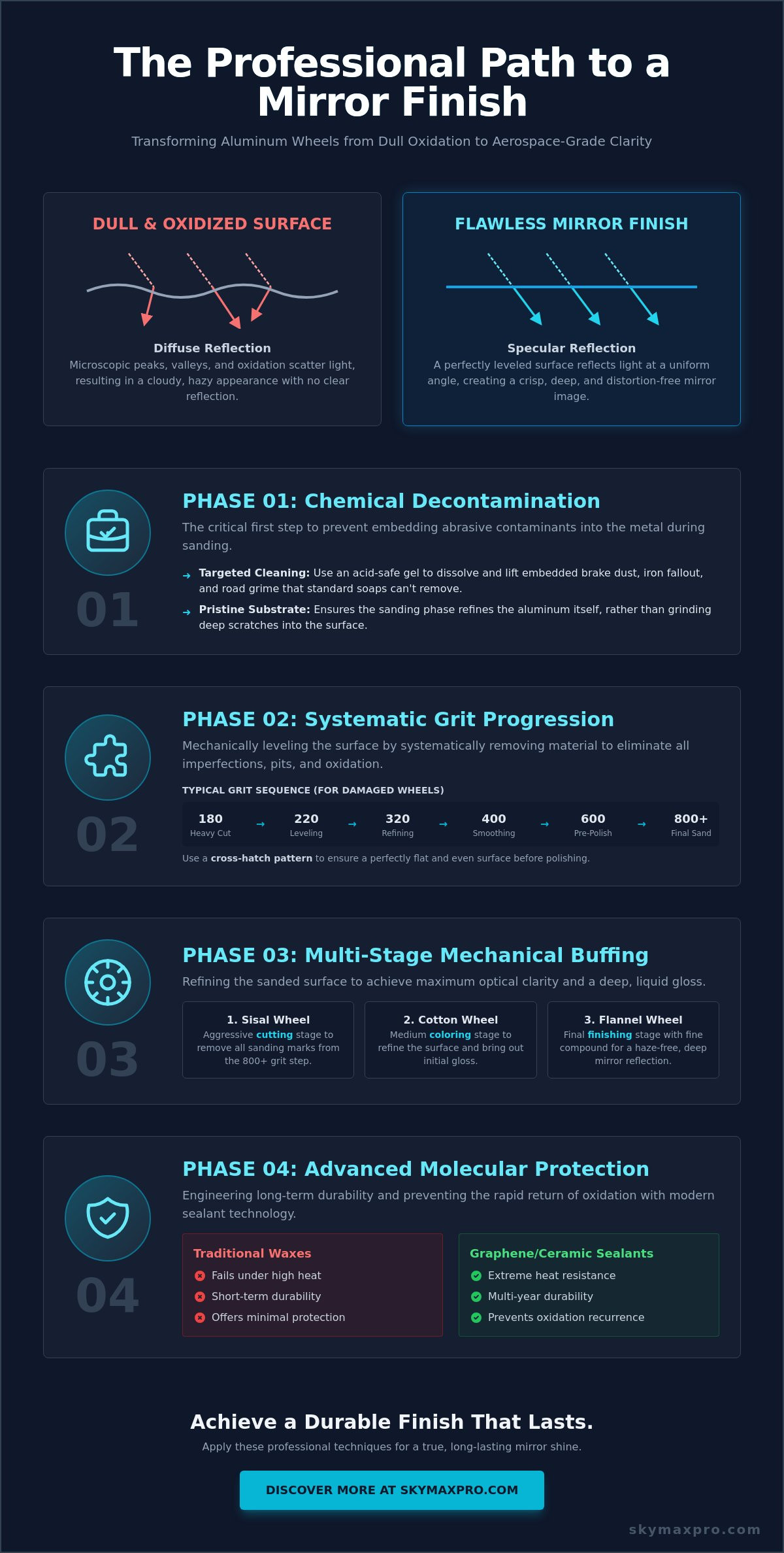
A mirror finish is defined by its ability to achieve specular reflection, where light rays bounce off a surface at a consistent angle with near-zero diffusion. In engineering terms, this requires a surface topography so level that microscopic irregularities don't interfere with the light's path. When you're researching how to polish aluminum wheels to a mirror finish, you're essentially learning how to perform surface refinement at a sub-micron scale. Standard aluminum wheels often appear cloudy because their surfaces are covered in microscopic peaks and valleys that scatter light in multiple directions, a phenomenon known as diffuse reflection.
The primary culprit behind this loss of clarity is aluminum oxide (Al2O3). Aluminum is a highly reactive base metal; when it's exposed to oxygen, it instantly forms a thin, hard, and transparent-to-gray ceramic layer. While this oxide layer protects the underlying metal from deep corrosion, it's chemically dull and non-reflective. To achieve a true mirror reflection, this layer must be mechanically removed and the underlying metal leveled before a new, controlled protective barrier can be applied. Understanding The Science of Metal Polishing is critical here, as it distinguishes between simple cleaning and the actual leveling of the metal's grain structure.
Understanding Light Diffusion and Surface Topography
The "cloudiness" seen on older wheels is a direct result of surface roughness. Even if a wheel feels smooth to the touch, it may still be riddled with microscopic abrasions. The goal of professional polishing is to reduce the "Ra" (Roughness Average) value of the metal. Different manufacturing processes affect this differently. Cast aluminum wheels are generally more porous and contain internal voids that can become visible during heavy sanding. Forged and billet aluminum wheels, however, possess a much denser molecular structure. This density allows them to accept a higher level of refinement, eventually resulting in a deeper, more "liquid" mirror reflection once the surface is leveled to a sub-micron state.
The Role of Environmental Oxidation
Environmental factors accelerate the degradation of the aluminum alloy's surface. Road salts, industrial fallout, and hot brake dust create a volatile environment for bare metal. Brake dust is particularly damaging because it consists of hot metallic shards that can embed themselves into the porous surface of the aluminum, leading to deep structural pitting. Unlike surface oxidation, which is a uniform layer of "cloudiness," pitting represents localized galvanic corrosion that has eaten into the metal's structure. If your wheels are factory-coated, the first step in how to polish aluminum wheels to a mirror finish involves the complete chemical removal of the failing clear coat, as you cannot refine the metal topography through a layer of degraded plastic or acrylic.
Phase 1: Chemical Decontamination and Surface Preparation
Skipping the decontamination phase is the most common failure point in professional metal restoration. When you begin mechanical sanding on a surface contaminated with road grit, oils, or brake dust, you're essentially grinding abrasive contaminants into the alloy. This creates deep, permanent gouges that are significantly more difficult to remove than the original oxidation. Adhering to Industry Standards in Metal Finishing requires a pristine substrate before any abrasive media touches the metal. Proper preparation ensures that the subsequent sanding steps refine the metal rather than damaging it further.
Removing Embedded Brake Dust and Iron
Metallic particles from brake pads are often fused to the aluminum surface through high-heat cycles, creating a bond that standard detergents cannot break. These inorganic salts require specialized chemistry to lift. For deep decontamination, it's necessary to use an acid-safe gel that targets iron deposits. Applying PRO Safe ACID Gel Wheel & Rim Cleaner allows the formula to penetrate the oxidized layer and suspend iron particles for safe removal. A dwell time of three to five minutes is usually sufficient, provided the product doesn't dry on the surface. Agitate the solution with soft-bristle brushes to reach the wheel barrels and intricate spoke designs. This chemical lifting is the secret to how to polish aluminum wheels to a mirror finish without fighting phantom scratches later in the process.
Degreasing for a Clean Mechanical Start
Once the metallic contaminants are neutralized, you must address organic oils, tire dressings, and road films. A professional-grade, VOC-free degreaser is essential to strip away grease without etching the sensitive aluminum alloy. If the wheels have a failing factory clear coat, this is the stage to use a dedicated chemical stripper. Chemical stripping is far superior to mechanical scraping because it preserves the integrity of the base metal. After the stripper has done its work, the surface must be neutralized with a thorough rinse. To ensure a professional result, consider using a Heavy Duty Red Power Degreaser to remove any remaining stubborn residues.
The final step in preparation is a rigorous drying protocol. Water spots contain minerals that can interfere with the sanding process and cause uneven leveling. Use compressed air or a clean microfiber towel to ensure the wheel is completely dry, especially in the lug nut pockets and around the valve stem. A dry, chemically clean surface allows you to see the true state of the metal, making it easier to identify areas of deep pitting that will require extra attention during the sanding phase. This disciplined approach to preparation sets the foundation for a flawless, high-optical-clarity finish.
Phase 2: Systematic Grit Progression for Surface Leveling
Surface leveling is an exercise in topographic precision. To master how to polish aluminum wheels to a mirror finish, you must move beyond the idea of "sanding" and adopt the mindset of "leveling." The objective is to replace random, deep pits and oxidation with a uniform, microscopic scratch pattern that becomes progressively finer. Most DIY attempts fail because they lack the patience for a complete grit sequence, leading to an inconsistent finish that lacks depth and clarity.
The "Cross-Hatch" technique is the professional standard for verifying surface uniformity when learning how to polish aluminum wheels to a mirror finish. By alternating the sanding direction 90 degrees with every grit change, you create a visual fail-safe. If you're using 600 grit horizontally, you don't move to 800 grit until every vertical mark from the 400 grit stage is completely gone. This systematic approach eliminates "ghost scratches," which are deep lines that remain hidden under a satin sheen only to ruin the final mirror reflection during the mechanical buffing stage.
Wet Sanding Protocols
Wet sanding is superior for aluminum alloys because water serves a dual purpose: it cools the metal and acts as a lubricant to prevent "pilling." Pilling occurs when removed aluminum particles clump together and get trapped between the abrasive paper and the wheel, creating deep, unintended gouges. To maintain a clean cutting surface, you should follow these protocols:
- Use a spray bottle to keep the surface and the abrasive paper saturated at all times.
- Rinse the wheel frequently to clear spent abrasive material and metallic slurry that can clog the paper.
- Employ a sanding block on flat spokes to maintain geometric precision and prevent "waves" in the final reflection.
The Transition to Finishing Grits
The progression from 1000 to 3000 grit represents the bridge between mechanical leveling and optical polishing. At 1000 grit, the wheel should exhibit a perfectly consistent matte appearance. By the time you reach 3000 grit, the surface will begin to show a hazy satin sheen. This stage requires extreme vigilance. Any deep scratch left behind by a 400 grit paper will be magnified once the metal reaches a high gloss. If you detect an inconsistent pattern, it's more efficient to drop back two grit levels and re-level the area immediately. You're not just sanding; you're preparing a molecularly smooth foundation for the final polish.
Phase 3: Mechanical Buffing and Final Metal Polishing
Mechanical buffing represents the final stage of physical surface refinement. While the previous sanding phases created a level foundation, buffing uses high-speed rotational energy and specialized abrasive compounds to eliminate the microscopic 3000-grit scratch pattern. This process relies on precise thermal management and the sequential use of varying pad densities to achieve maximum specular reflection. Understanding how to polish aluminum wheels to a mirror finish at this stage requires a calculated balance between rotational speed and downward pressure to avoid surface deformation or "burning" the alloy.
The transition through pad types is a critical engineering requirement. Professionals typically progress through three distinct stages:
- Sisal Pads: Used for heavy cutting if the sanding phase was cut short, though rarely needed after 3000-grit refinement.
- Spiral Sewn Cotton: The standard for medium-cut compounding, providing the rigidity needed to generate the necessary heat for metal flow.
- Loose Flannel: The final finishing pad designed to remove micro-haze and produce a deep, liquid reflection.
Compound Selection and Application
The chemistry of your polishing media determines the final optical depth. Professional compounds utilize diminishing abrasive technology, where particles break down under heat and friction to transition from a cutting phase to a high-luster finishing phase. It's essential to match the compound’s aggressive "cut" to the pad density; using a high-cut compound on a loose flannel pad will lead to an inconsistent finish. For the final refinement stage, applying Chrome & Metal Polish ensures that any remaining micro-haze is chemically and mechanically eliminated. Adhere to the "less is more" rule to prevent compound buildup, which can cause friction-induced streaking and obscure your progress.
High-Speed Buffing Techniques
Mastering machine control is the most technical aspect of how to polish aluminum wheels to a mirror finish. For aluminum alloys, maintaining a range between 2,000 and 3,000 RPM provides enough thermal energy to "flow" the metal surface slightly without causing localized warping. Don't allow the pad to become loaded with spent metal and dried compound; use a pad spur to clean the surface mid-process. After each machine pass, wipe the area with a clean microfiber towel to inspect the reflection clarity. This allows you to identify any remaining "tails" or haze before moving to the next pad. To achieve the legendary "Blue" depth—a reflection so dark it appears ink-like—finish with a professional-grade Chrome & Metal Polish to finalize the optical clarity before the sealing phase.
Phase 4: Engineering Longevity with Molecular Protection
Achieving a flawless reflection is a significant technical milestone, but the process of how to polish aluminum wheels to a mirror finish remains incomplete without molecular stabilization. Bare aluminum is inherently unstable. It begins to develop a fresh oxide layer the moment it's exposed to the atmosphere. While many enthusiasts rely on traditional carnauba waxes, these organic compounds fail under the thermal stress of high-performance braking systems. Carnauba wax typically begins to degrade at approximately 180°F, a temperature easily exceeded during standard driving conditions. This thermal failure leaves the refined surface vulnerable to immediate atmospheric oxidation and the embedment of hot brake dust particles.
Modern surface engineering provides a more durable solution through the use of graphene and ceramic technologies. These materials offer a much higher melting point and chemical resistance than organic waxes. By creating a hydrophobic barrier, you don't just protect the shine; you also simplify the cleaning process by preventing contaminants from bonding to the metal at a microscopic level. This final phase is what separates a temporary "detail" from a professional, aerospace-grade restoration.
Applying Aerospace-Grade Ceramic Coatings
To ensure long-term surface stability, you must transition from temporary waxes to high-heat resistant molecular barriers. Utilizing a Ceramic Graphene Shield Coating represents the current engineering standard for wheel protection. Unlike wax, which sits on top of the metal, these coatings form a covalent bond with the aluminum substrate through a cross-linking chemical reaction. This creates a 9H hardness barrier that is significantly more resistant to micro-marring and chemical etching. The graphene infusion provides enhanced thermal dissipation, ensuring the protective layer remains intact even during aggressive heat cycles. This level of protection is the only way to ensure your efforts in how to polish aluminum wheels to a mirror finish aren't wasted after a single week of driving.
Maintaining the Mirror Shine
Proper maintenance is essential to preserve the optical clarity of the finish. Once the wheels are coated, you should never return to the harsh acid cleaners used in the initial decontamination phase. Instead, use a pH-neutral automotive cleanser for routine washing to remove surface dust without stripping the protective layer. For periodic gloss enhancement and to maintain the hydrophobic properties of the coating, applying a Quick Detailer Spray with Ceramic High Gloss Finish will reinforce the barrier. This maintenance protocol ensures that the labor-intensive results of your restoration are preserved for months. Stick to clean, dedicated microfibers and avoid automated car washes to prevent the introduction of new swirl marks into your mirror-perfect surface.
Advancing Beyond the Surface: Achieving Long-Term Optical Stability
Mastering the technical sequence of surface refinement is the only way to move from a temporary shine to permanent optical clarity. By prioritizing chemical decontamination and following a disciplined grit progression, you eliminate the microscopic defects that cause light diffusion. The final transition to mechanical buffing and molecular sealing ensures that the metal's grain structure remains protected against the intense heat cycles of the road. Understanding how to polish aluminum wheels to a mirror finish is a professional skill that ensures your efforts aren't wasted when paired with the right engineering solutions.
To maintain this level of precision, you need chemistry that matches your labor. Our professional systems utilize aerospace-approved nanotechnology and are manufactured in the USA to meet the highest performance standards. These Graphene-Ceramic hybrid formulations provide over five years of durability, ensuring your wheels remain resistant to oxidation and road grime. Shop Professional Metal Polishing and Ceramic Protection Kits to secure your investment. Transform your wheels into a lasting architectural statement through the power of precise surface engineering.
Frequently Asked Questions
Can I polish aluminum wheels without removing them from the car?
While technically possible, polishing wheels while they are mounted on the vehicle is not recommended for professional results. You cannot achieve full access to the wheel barrels or intricate spoke edges, and the high-speed rotation of buffing pads risks damaging brake calipers or suspension components. Removing the wheels ensures a 360-degree workspace, allowing for the comprehensive surface leveling required for a flawless finish.
How long does it take to polish a set of four aluminum wheels to a mirror finish?
The time required depends heavily on the initial state of the alloy and the equipment used. For a manual, multi-stage restoration involving grit progression from 400 to 3000, expect to spend 4 to 8 hours per wheel. However, professional automated rim polishing systems can reduce this duration to approximately 30 to 60 minutes per unit. This variance highlights why systematic preparation is critical to operational efficiency.
What is the difference between polished aluminum and chrome?
Chrome is a multi-layered electroplated finish consisting of copper, nickel, and chromium applied over a base metal, whereas polished aluminum is the raw alloy itself refined to a high luster. Chrome offers a blue-tinted, hard reflection but can flake or peel if the bond fails. Polished aluminum provides a warmer, liquid depth that can be restored indefinitely, though it requires molecular sealing to prevent oxidation.
Will polishing my wheels remove deep curb rash or pitting?
Standard polishing won't remove structural damage, but the systematic sanding phases described in this guide will eliminate most surface-level pitting and light curb rash. Deep gouges require mechanical leveling with lower grit abrasives to remove enough material to reach the bottom of the defect. If pitting has compromised the structural integrity of the rim flange, a professional metallurgical inspection is required before proceeding.
How often do I need to re-polish my aluminum wheels once they are coated?
Once you have mastered how to polish aluminum wheels to a mirror finish and applied a graphene-ceramic barrier, you shouldn't need to re-polish for several years. High-quality coatings like Ceramic Graphene Shield provide a covalent bond that resists oxidation and environmental etching. Maintenance is reduced to simple pH-neutral washing, as the hydrophobic surface prevents brake dust from fusing to the refined alloy.
Is it better to polish aluminum wheels by hand or with a machine?
Machine polishing is significantly more effective than hand application because it generates the consistent thermal energy required for metal flow. High-speed rotation allows the polishing compounds to break down properly and refine the surface topography at a sub-micron level. Hand polishing is only suitable for tight recesses where machine pads cannot reach or for very light maintenance on already-perfect surfaces.
What should I do if my wheels have a factory clear coat that is peeling?
Peeling factory clear coats must be completely removed using a dedicated chemical stripper before you begin the polishing process. Attempting to polish over failing plastic or acrylic coatings will result in an uneven, cloudy appearance. Once the chemical stripper has exposed the bare alloy, the surface must be neutralized and decontaminated before you proceed with the mechanical leveling and grit progression phases.
Can I use steel wool to polish aluminum wheels?
You should never use steel wool on aluminum wheels because it introduces a risk of galvanic corrosion. Steel wool leaves behind microscopic iron filaments that become embedded in the softer aluminum alloy. When exposed to moisture, these iron particles rust and trigger localized corrosion, leading to deep pitting. Always use dedicated aluminum-oxide abrasives and non-metallic buffing pads to maintain the purity of the alloy.