

Most "deep cleaning" attempts are actually just surface-level surfactant applications that push contaminants deeper into the seat foam. You've likely experienced the frustration of persistent odors returning or the fear that over-saturating your seats will lead to sub-surface mold growth. Mastering how to deep clean car upholstery requires moving beyond basic scrubbing and adopting a methodology rooted in chemical engineering and moisture management.
This guide provides a professional framework for restoring your interior using aerospace-approved formulations and precision extraction. We'll show you how to utilize dry foam technology to neutralize stubborn protein and oil-based stains while avoiding the risks associated with traditional wet methods. You'll learn to achieve a factory-new appearance and apply nanotechnology-based protection that seals fibers against future spills. We're moving from simple maintenance to a technical restoration that eliminates deep-seated allergens and ensures long-term cabin hygiene. By following these industrial standards, you can achieve a sterile, protected environment that exceeds standard detailing results.
Key Takeaways
- Learn how surfactant molecules isolate and break the bond between sub-surface contaminants and fabric fibers for a scientifically superior clean.
- Master the precise 4-step engineering protocol on how to deep clean car upholstery using controlled mechanical agitation and specialized dry foam technology.
- Identify and neutralize stubborn protein or oil-based stains by applying a targeted hierarchy of chemical interventions rather than aggressive scrubbing.
- Discover the importance of restoring factory-grade protection with hydrophobic shields to prevent future spills from penetrating the upholstery structure.
- Understand the operational advantages of using VOC-free, aerospace-approved detailing systems to ensure a safe and sterile cabin environment.
Understanding Upholstery Contamination and the Science of Extraction
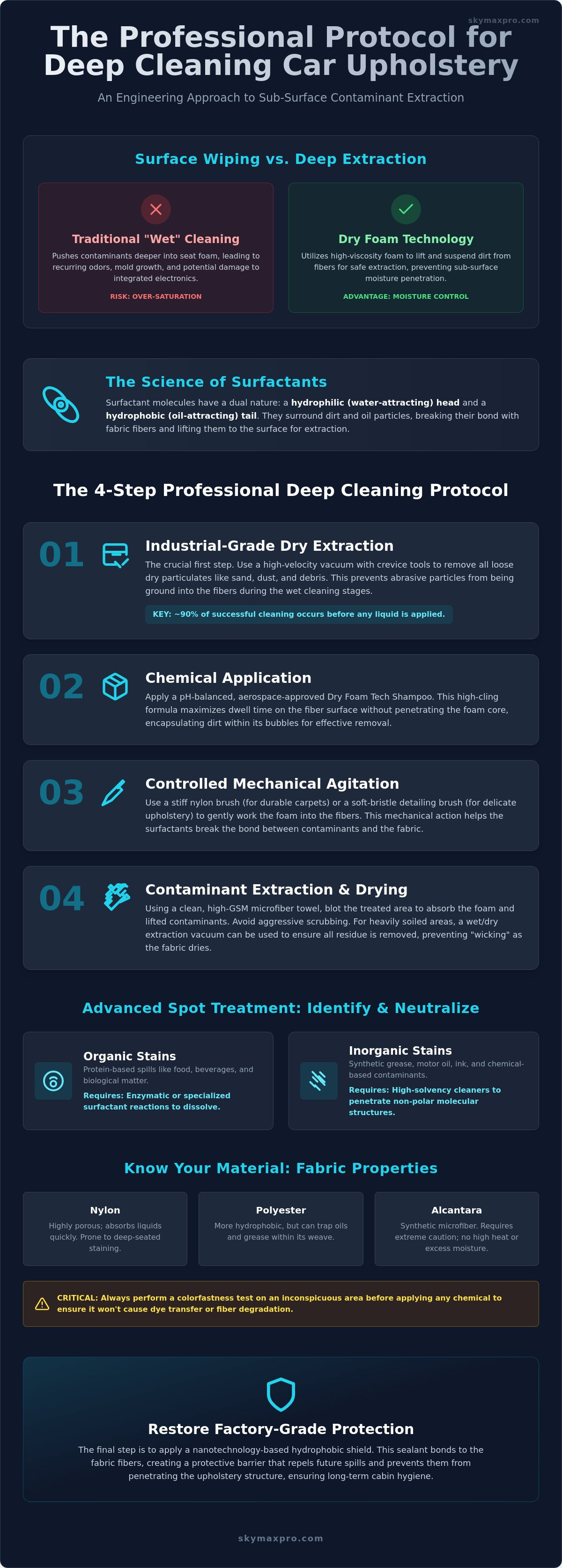
Professional deep cleaning is defined by the extraction of sub-surface contaminants trapped within the microscopic pores of fabric fibers. Surface-level wiping merely redistributes dirt. True restoration requires a chemical process that breaks the bond between the contaminant and the material. In the context of professional Auto detailing, this process relies on surfactants. These molecules possess a dual nature: a hydrophilic head that attracts water and a hydrophobic tail that attaches to oils and dirt. When applied correctly, surfactants surround the soil particles, lifting them to the surface where they can be mechanically removed without damaging the fabric's structural integrity.
Understanding the difference between organic and inorganic contaminants is vital for successful extraction. Organic stains, such as protein-based food spills or biological matter, require specific enzymatic or surfactant reactions to dissolve. Inorganic stains, including synthetic greases, motor oils, or ink, demand high-solvency cleaners that can penetrate non-polar molecular structures. Identifying these variables is the first step in learning how to deep clean car upholstery with engineering precision. Failure to differentiate these stains often leads to permanent setting of the contaminant within the fiber matrix.
The primary engineering challenge in modern vehicle interiors involves the seat core. Most automotive seats utilize multi-layered polyurethane foam integrated with sensitive occupancy sensors and heating elements. Traditional "wet" cleaning methods pose a significant risk of over-saturation. If moisture penetrates the foam core, it creates an environment for anaerobic bacteria and mold growth, which results in persistent odors. Controlling the moisture-to-chemistry ratio is essential for maintaining the safety and longevity of the vehicle's electronic components.
The Chemistry of Foam Technology
Using a specialized Carpet, Fabric & Upholstery Dry Foam Tech Shampoo Cleaner is the most effective way to manage moisture. Dry foam technology produces a high-cling consistency that maximizes dwell time on the fiber surface without gravity-fed saturation into the seat base. This high-viscosity foam suspends dirt within its bubbles for easier extraction. Because the formula is pH-balanced, it preserves the original fabric dyes and prevents the "crunchy" residue often left by high-alkaline household cleaners. It's a safer, more controlled alternative to traditional liquid scrubbing.
Identifying Fabric Types: Nylon vs. Polyester vs. Alcantara
Different materials exhibit varying absorbency rates. Nylon is highly porous and absorbs liquids quickly, making it prone to deep-seated staining if not treated with high-dwell surfactants. Polyester is more hydrophobic but can trap oils within its weave. Alcantara, a synthetic microfiber, requires extreme caution; it can't handle high heat or excessive moisture without losing its soft texture. Before you begin the process of how to deep clean car upholstery, you must perform a colorfastness test on an inconspicuous area. This ensures the chemistry won't cause dye transfer or fiber degradation during the agitation phase.
The 4-Step Professional Deep Cleaning Protocol
A systematic workflow is the difference between a superficial wipe-down and a technical restoration. When determining how to deep clean car upholstery, professionals prioritize a sequence that maximizes chemical efficiency while minimizing moisture exposure. This protocol relies on a balance of mechanical energy (agitation) and chemical potential (dwell time). By adhering to a rigorous four-step process, you eliminate the risk of wicking, where deep-seated dirt rises to the surface during the drying phase. Following a structured engineering approach ensures that every square centimeter of fabric receives a consistent level of decontamination.
Professional-grade materials required for this protocol include:
- High-velocity vacuum with specialized crevice attachments
- Stiff nylon brush and soft-bristle detailing brush
- Clean, high-GSM microfiber towels
- pH-balanced dry foam shampoo
- Nitrile gloves for chemical safety
Step 1: Industrial-Grade Dry Extraction
Approximately 90% of successful deep cleaning occurs before any liquid touches the fabric. Dry particulates like abrasive silica (sand) and dust act as sandpaper on fabric fibers, causing premature wear and structural degradation. Use high-velocity air or a stiff nylon brush to "open" the fabric weave, vibrating trapped debris to the surface for vacuuming. Focus specifically on the seams and crevices where these particles aggregate. Skipping this step turns dry dust into mud once a cleaner is applied, which complicates the extraction process and increases the risk of permanent staining.
Step 2: Chemical Application and Agitation
Apply a uniform layer of Carpet, Fabric & Upholstery Dry Foam Tech Shampoo Cleaner across the target area. Before application, consult the manufacturer's upholstery cleaning codes to verify the material's tolerance for water-based surfactants. Use a soft-bristle detailing brush in controlled circular motions to lift contaminants. This mechanical agitation breaks the surface tension of the stain, allowing the foam to encapsulate the debris. Maintain a dwell time of two to three minutes; this allows the chemistry to work without allowing the product to dehydrate on the surface.
Step 3: Moisture Control and Blotting
The extraction phase requires clean, high-GSM microfiber towels to pull the foam and suspended dirt out of the fabric. Use a "twist and lift" technique rather than a heavy scrubbing motion. Scrubbing can push the suspended contaminants deeper into the cushion's foam core, leading to sub-surface mold. Monitor towel saturation constantly. Once a towel face is soiled, flip to a fresh section to prevent cross-contamination. This phase is critical in the process of how to deep clean car upholstery, as it ensures the moisture is removed before it can penetrate sensitive seat sensors. For the best results, keeping a dedicated Interior Cleaning Kit on hand ensures you have the right tools for immediate moisture management.
Advanced Spot Treatment: Decoding Chemical Reactions for Stubborn Stains
Professional spot removal is a targeted chemical intervention designed to isolate and neutralize specific molecular bonds. When vehicle owners investigate how to deep clean car upholstery, they often overlook the hierarchy of stain removal. You must always initiate the process with the least aggressive chemical method to preserve fiber integrity. Using high-pH cleaners or aggressive solvents as a first resort can cause irreversible dye migration or fiber fraying. A professional approach involves identifying the stain's origin before selecting a reactive agent, ensuring the treatment matches the contaminant's molecular structure.
One common error in detailing is the misuse of heat. While steam is effective for many applications, it acts as a catalyst that permanently sets protein-based stains like milk, coffee with cream, or biological matter. High temperatures coagulate the proteins, bonding them to the fabric at a molecular level. To prevent the "clean ring" or tide line effect, professionals use a "feathering" technique. This involves working from the center of the stain outward, gradually decreasing chemical concentration and agitation as you reach the unaffected areas. This ensures a seamless visual transition and prevents concentrated surfactant residues from attracting new dirt.
Removing Oil and Grease Contaminants
Petroleum-based contaminants require solvent-based surfactants to break down non-polar molecular chains. Using Deep Clean Interior Cleaner provides the necessary solvency to lift industrial greases and skin oils that standard shampoos cannot reach. When working in high-traffic areas like armrests or seat bolsters, ensure you use safety protocols to protect adjacent interior plastics. High-solvency cleaners can cause stress cracking or discoloration on unpainted polymers if allowed to dwell on surfaces they weren't engineered for. Always apply the cleaner to a microfiber towel first rather than spraying the surface directly near sensitive trim.
Eliminating Organic Odors at the Molecular Level
True odor elimination occurs through molecular encapsulation, not masking. Fragrance-heavy retail products merely overlay scents on top of volatile organic compounds. Bacteria thrive in the damp, dark environments of under-seat upholstery foam, producing metabolic byproducts that cause persistent smells. Neutralizing these requires an enzymatic approach that breaks down the organic matter providing the food source for the bacteria. Advanced nanotechnology-based formulas surround these odor molecules, altering their structure so they no longer trigger human olfactory receptors. This ensures the cabin environment remains sterile and professional, effectively addressing one of the most difficult aspects of how to deep clean car upholstery.
Fiber Restoration and the Importance of Post-Cleaning Sealants
The final phase in mastering how to deep clean car upholstery isn't the extraction itself, but the restoration of the fiber's chemical defense system. Deep cleaning is a necessary but aggressive process that successfully removes contaminants; however, it also strips away factory-applied protective oils and fluoropolymer coatings. This leaves the fabric "naked" and highly susceptible to immediate re-soiling. Without a post-cleaning sealant, the porous fibers act as a vacuum for new spills, often leading to deeper stains than those originally removed. True professional restoration requires the application of a hydrophobic shield to re-establish this lost barrier.
The engineering behind modern fabric sealants utilizes nanotechnology to create a high-tension barrier on each individual fiber. Instead of a thick, suffocating film, these nano-scale particles bond to the material to prevent liquids from "wetting out." When a liquid hits a treated surface, the surface tension causes the fluid to bead and roll off rather than penetrating the weave. This technology doesn't just protect against aesthetics; it provides a significant long-term ROI by doubling the interval between required deep cleans and preserving the structural integrity of the textile. Understanding how to deep clean car upholstery must include this re-stabilization of the fabric surface to ensure the results endure daily operational wear.
Applying Aerospace-Grade Protection
Applying PRO Shield for Fabric, Carpet, Upholstery & Floor Mats requires a methodical approach to ensure 100% surface saturation. We recommend a "cross-hatch" spraying pattern, which involves applying the product in horizontal overlapping passes followed by vertical ones. This technique guarantees that the sealant reaches the sides of the fiber twists, not just the top. Patience is critical during the curing phase. The polymer bond requires a stabilization period, typically several hours, to fully cross-link with the fabric. Avoid any mechanical stress or moisture exposure during this time to ensure the shield's maximum durability. To achieve these industrial-standard results, you can find the necessary professional formulas in our Interior Cleaning Kit.
Maintaining the Softness and Hand-Feel
A common failure point in detailing is the loss of the material's original texture, often resulting in a "crunchy" feel. This is usually caused by the over-application of protectants or failing to reset the fabric nap. Once the protector has reached its initial dry state but before it fully cures, use a clean, dry detailing brush to gently agitate the surface. This mechanical action separates any fibers that may have bonded together during the drying process, restoring the original hand-feel. Monitor the health of your protection by observing the "beading" effect during routine maintenance. If water no longer beads on the surface, it indicates the tension barrier has been compromised and requires a technical re-application.
Optimizing Results with Professional-Grade Detailing Systems
Achieving a factory-new interior requires more than just high-quality chemicals; it demands an integrated system where each formula complements the next. Mismatched products often lead to chemical interference. For example, residues from a low-grade shampoo can prevent a high-tech sealant from bonding correctly to the fiber. By utilizing a unified system, you ensure that the surfactant's ionic charge is compatible with the protector's molecular structure. This synergy is the final pillar in learning how to deep clean car upholstery to professional standards. Using VOC-free and biodegradable chemistry is also a non-negotiable safety requirement for enclosed vehicle cabins. This prevents the inhalation of toxic solvents often found in low-cost industrial degreasers.
A professional maintenance kit should include a dedicated dry foam shampoo, a hydrophobic fabric shield, and high-GSM microfiber towels. Consistency in these tools prevents cross-contamination and ensures that chemical reactions remain predictable during every session. When you understand how to deep clean car upholstery as a technical process, you realize that the tools are just as critical as the chemistry. High-performance detailing is about reducing variables to ensure a repeatable, high-quality outcome every time you service the vehicle.
The final verification step involves a methodical inspection using specialized high-CRI detailing lights. These lights reveal streaks, uneven chemical distribution, or residual contamination that normal cabin lighting obscures. Hold the light at an acute angle to the fabric surface to check for "wicking," where dirt has traveled back up the fiber during the drying phase. If wicking occurs, it indicates that the initial extraction was insufficient. A professional finish must be dry to the touch, scent-neutral, and visually uniform across all panels.
The Professional Interior Maintenance Schedule
Establishing a rigorous maintenance schedule prevents the accumulation of abrasive silica that degrades fabric over time. For vehicles used in commercial or high-traffic environments, a quarterly extraction schedule is recommended. For private passenger vehicles, an annual deep clean combined with monthly vacuuming is usually sufficient to maintain the material's structural integrity. Immediate spot-cleaning for emergency spills is vital to prevent permanent fiber staining before the contaminant can bond. For a full breakdown of vehicle care beyond upholstery, refer to our Professional Auto Detailing Master Checklist.
Why SKY MAXPRO Engineering Matters
SKY MAXPRO engineering bridges the gap between aerospace surface protection and automotive detailing excellence. Our formulas are made in the USA and trusted by professionals for their measurable efficiency, safety, and technological superiority. We focus on providing solutions that offer long-term protection rather than temporary aesthetic fixes. By choosing aerospace-approved chemistry, you're investing in the longevity of your vehicle's interior. Explore our full Interior Cleaning Kit for a comprehensive restoration and protection system that delivers professional-grade results.
Achieving Industrial-Standard Interior Restoration
Mastering how to deep clean car upholstery transforms a routine chore into a technical maintenance program that preserves the structural integrity of your vehicle's cabin. By prioritizing dry extraction and utilizing aerospace-approved nanotechnology, you move beyond surface-level cleaning to achieve a sterile, factory-new environment. The key to lasting success lies in the balance between precise chemical agitation and the application of hydrophobic shields that prevent future contaminants from bonding to the fibers. Professional-grade results are no longer reserved for industrial shops; they're attainable for every enthusiast who follows a data-driven protocol.
Our 100% biodegradable and VOC-free formulas ensure that your cleaning process is as safe for the environment as it is for your passengers. Whether you're neutralizing stubborn organic odors or establishing a long-term protective barrier, using an integrated system is the most efficient path to excellence. Don't settle for retail-grade compromises when you can utilize the same precision engineering used in aerospace maintenance. Upgrade to Aerospace-Grade Interior Care with SKY MAXPRO today and experience the difference of a professionally restored interior. You now have the methodology and the technical insight to maintain your vehicle at the highest possible standard.
Frequently Asked Questions
Can I use a steam cleaner on my car upholstery?
Steam cleaning is effective for synthetic materials but requires precise temperature control to avoid fiber damage. You must avoid using steam on protein-based stains like blood or milk; high heat coagulates these proteins and bonds them to the fibers permanently. Additionally, excessive steam can over-saturate the foam core, leading to mold growth or damage to integrated seat sensors. Always prioritize dry foam technology for a safer, moisture-controlled deep clean.
How long does it take for car seats to dry after a deep clean?
Drying times typically range from 2 to 6 hours when using professional dry foam methods in a well-ventilated environment. If you utilize traditional wet extraction, the drying process can extend up to 24 hours. Factors such as ambient humidity, temperature, and the absorbency of the fabric influence this duration. Using high-velocity air movers or keeping windows slightly open accelerates the evaporation process, ensuring the seat core remains dry and sterile.
Will deep cleaning remove cigarette or pet odors permanently?
Permanent odor removal requires neutralizing volatile organic compounds at a molecular level rather than masking them with fragrances. While surface cleaning improves air quality, deep-seated odors from cigarette smoke or pets often reside in the sub-surface foam core. Using enzymatic cleaners or nanotechnology-based formulas encapsulates these molecules, altering their structure so they no longer emit a scent. This technical approach ensures the odor is eliminated from the cabin environment permanently.
Is it safe to use a drill brush on delicate car fabrics?
Drill brushes provide high mechanical energy but can cause irreversible fiber fraying or "pilling" on delicate materials. Alcantara and high-thread-count polyesters require soft-bristle manual detailing brushes to maintain their original factory texture. If you choose to use a drill brush on durable nylon carpeting, always select the softest attachment and maintain a low RPM. Testing an inconspicuous area is a mandatory safety protocol to verify the fiber's resilience before proceeding.
How do I prevent "water rings" when spot-cleaning my seats?
Water rings occur when concentrated surfactants and minerals dry in a distinct line at the edge of a damp spot. To prevent this, you must clean the entire panel or utilize a feathering technique. Work from the center of the stain outward, gradually decreasing the moisture and chemical concentration as you reach the dry areas. This ensures a seamless visual transition and prevents the accumulation of soil-attracting residues at the edges of the treated area.
What is the difference between a fabric cleaner and a fabric protector?
A fabric cleaner utilizes surfactants to break the bond between dirt and fibers for mechanical extraction. In contrast, a fabric protector is a post-cleaning sealant that uses nanotechnology to create a high-tension barrier on the fiber surface. This shield prevents liquids from "wetting out" the material, causing them to bead on the surface instead. Mastering how to deep clean car upholstery requires using both systems in a specific sequence to ensure long-term material protection.
How often should I deep clean my car interior?
Maintenance frequency depends on vehicle utilization and environmental exposure levels. High-traffic commercial vehicles or those carrying pets require quarterly deep cleaning to prevent the accumulation of abrasive silica. For standard passenger vehicles, an annual deep clean combined with monthly dry extraction is sufficient. Regular maintenance prevents contaminants from penetrating the sub-surface foam, which simplifies the cleaning process and protects the vehicle's long-term resale value and cabin hygiene.
Can I use laundry detergent to clean my car upholstery?
Laundry detergents are engineered for high-volume water rinsing and leave heavy residues when used in automotive interiors. These chemicals contain high-alkaline builders and optical brighteners that are difficult to extract from seat foam, resulting in a "crunchy" texture that attracts dirt rapidly. Using the correct chemistry is vital when learning how to deep clean car upholstery, as pH-balanced automotive shampoos preserve the fabric's soft hand-feel and prevent chemical degradation of the material.