

Traditional carnauba wax is no longer a viable solution for the rigorous environmental stressors of 2026. You're likely exhausted by the inefficient cycle of frequent reapplication and the daunting complexity associated with professional ceramic coating protocols. It's a common frustration to watch a deep paint finish degrade under industrial pollutants despite hours of labor. This lack of durability isn't just a maintenance hurdle; it's a failure of outdated chemical engineering.
This guide demonstrates how a modern ceramic wax sealant transforms standard paint protection into a high-performance barrier through aerospace-grade molecular engineering. We'll analyze the transition from aesthetic detailing to technical surface management, focusing on how Sky Maxpro utilizes nanotechnology to achieve molecular leveling. You'll discover the mechanisms behind long-lasting hydrophobicity and the "wet mirror shine" that defines professional-grade results. We will preview the latest application protocols that align with ISO 2026 standards, ensuring your vehicle maintains a deep gloss while significantly simplifying your long-term maintenance routine. It's time to move beyond temporary waxes and embrace a solution engineered for measurable efficiency and superior surface security.
Key Takeaways
- Analyze the evolution from organic carnauba to inorganic SiO2 technology and its impact on 2026 surface protection standards.
- Understand the molecular cross-linking process that enables a ceramic wax sealant to form a durable, high-performance barrier against environmental degradation.
- Compare the durability, gloss depth, and cost-per-application of hybrid ceramic formulations against traditional synthetic and natural waxes.
- Identify the essential stages of the professional application protocol, from deep decontamination to precise surface preparation for optimal bonding.
- Learn how aerospace-grade nanotechnology facilitates molecular leveling to produce a deep, mirror-like finish and simplified maintenance routine.
What is a Ceramic Wax Sealant? Defining Modern Surface Protection
A ceramic wax sealant represents a significant leap in automotive material science. It is a hybrid formulation that suspends silicon dioxide (SiO2) particles within a synthetic or natural wax matrix. This engineering synergy allows for the user-friendly application traditionally associated with carnauba wax while delivering the chemical resilience of a ceramic coating. By 2026, the industry has transitioned away from purely organic finishes toward these inorganic hybrids to meet higher durability benchmarks. In automotive surface engineering, a sacrificial layer acts as a renewable, low-energy barrier designed to weather environmental degradation so the underlying clear coat remains structurally intact.
To understand the technical foundation of these products, one must look at what sealants are in a broader industrial context: substances used to block the passage of fluids through openings in materials. In detailing, this means sealing the microscopic pores of the paint to prevent oxidation and contaminant adhesion. Sky Maxpro’s Ceramic Deep Wet Mirror Shine Wax Sealant utilizes this principle to provide professional-grade protection without the technical barriers of traditional ceramic applications.
The Evolution from Carnauba to SiO2
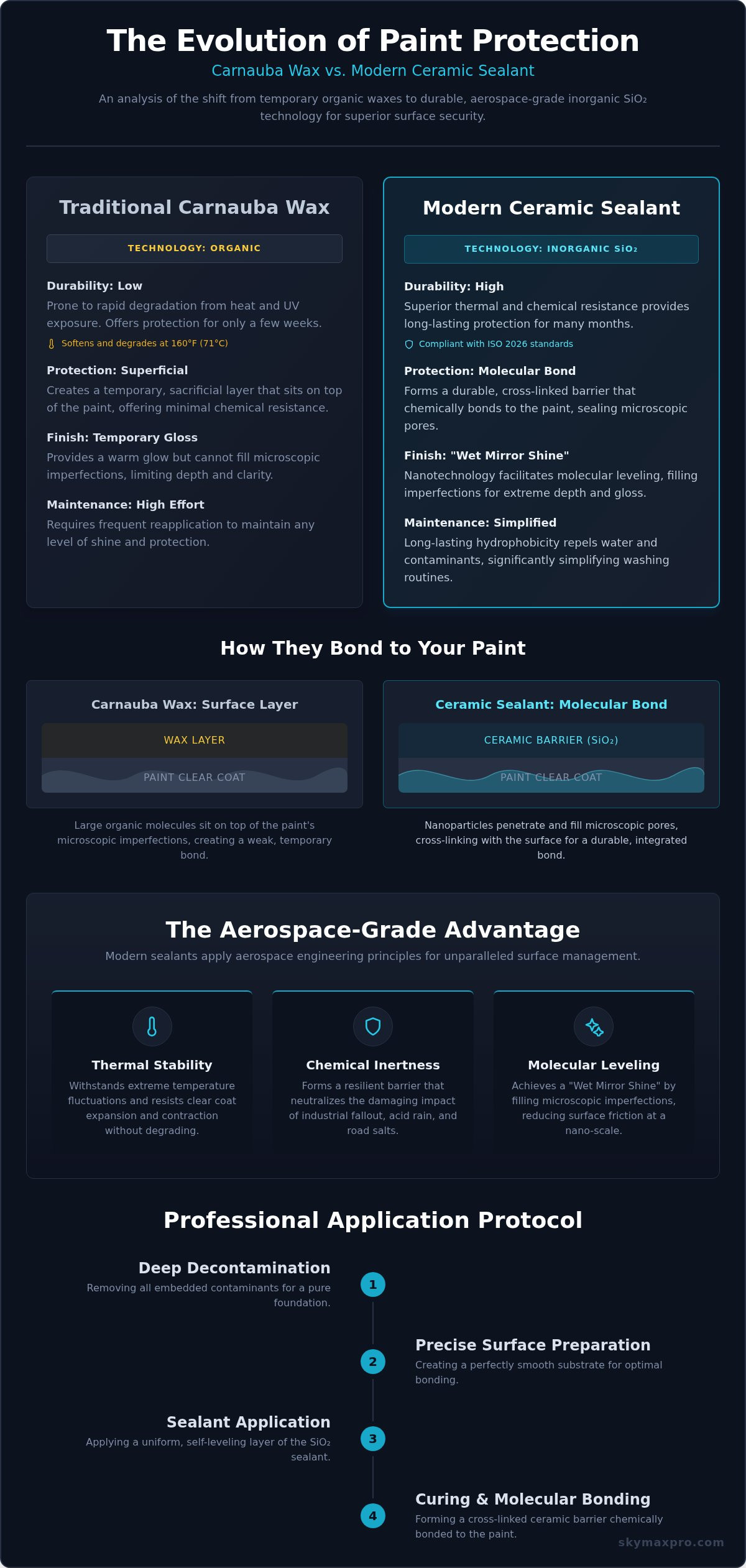
Traditional organic waxes have clear physical limitations. Carnauba begins to soften and degrade at temperatures as low as 160°F, a threshold easily reached on a dark-colored vehicle in direct sunlight. This thermal instability leads to rapid evaporation and a total loss of hydrophobic properties. In contrast, inorganic SiO2 provides superior UV and chemical resistance. Under the ISO 11997-1:2026 standards for cyclic corrosion resistance, these hybrid formulas demonstrate a significantly higher tolerance for environmental stressors. Nanotechnology plays a vital role here; it ensures a uniform surface bond that fills microscopic imperfections, creating a level of smoothness that organic molecules simply cannot achieve.
Why Aerospace-Grade Standards Matter for Your Car
Aerospace-approved formulations are designed to withstand high-speed friction and extreme temperature fluctuations that would incinerate standard detailing products. When these standards are applied to automotive care, the result is a product that maintains structural integrity under intense heat and high-pressure washing. Sky Maxpro manufactures these supplies locally in the US, ensuring that the transition from the hangar to the garage doesn't compromise formulation consistency. This engineering approach focuses on:
- Thermal Stability: Resistance to clear coat expansion and contraction.
- Chemical Inertness: Neutralizing the impact of industrial fallout and road salts.
- Molecular Leveling: Achieving a "Wet Mirror Shine" by reducing surface friction at a nano-scale.
This shift from aesthetic detailing to technical surface management ensures that your vehicle's finish is protected by a barrier that is as scientifically robust as it is visually striking. It's a move toward measurable efficiency where the goal isn't just a temporary shine, but a high-performance ceramic barrier.
The Molecular Engineering Behind Ceramic Hybrid Sealants
A ceramic wax sealant is more than a simple mixture of ingredients; it's a stable suspension of silicon dioxide (SiO2) particles within a high-performance polymer sealant matrix. This suspension ensures that the inorganic ceramic particles are distributed evenly across the vehicle's surface during application. As the product cures, a chemical reaction known as cross-linking occurs. This process creates a complex, three-dimensional network of molecules that bond both to each other and the paint substrate. Unlike industrial ceramics that may be prone to brittle fracture, automotive aerospace-grade ceramic coatings are engineered for flexibility, allowing them to expand and contract with the car's body panels.
Nanotechnology allows these ceramic particles to penetrate the microscopic pores and valleys of the clear coat. Standard waxes are too large to settle into these imperfections, but nano-scale SiO2 fills them completely. The self-leveling properties of the formula ensure that as the sealant cures, it creates a perfectly flat plane. This molecular leveling reduces surface friction and light scattering, which is the primary mechanism behind the signature "Wet Mirror Shine" effect. By creating a smoother surface at the atomic level, the sealant maximizes light reflection and depth.
SiO2 Integration and Hydrophobic Performance
The technical efficiency of a sealant is measured by its Water Contact Angle (WCA). High-performance ceramic hybrids are engineered to achieve a WCA exceeding 100 degrees. This steep angle forces water to form tight, spherical beads rather than spreading across the paint. By minimizing the contact area between the droplet and the surface, the sealant prevents mineral deposits and environmental pollutants from bonding as the water evaporates. This creates a "self-cleaning" effect where dirt particles are encapsulated by water and easily rinsed away during routine maintenance.
Chemical Bonding vs. Physical Layering
Traditional carnauba wax relies on physical adhesion, which means it simply sits on top of the paint and is easily stripped by heat or detergents. Ceramic sealants utilize covalent bonding to integrate with the clear coat at a molecular level. This bond is significantly more resistant to environmental degradation and high-pH cleaning agents. The resulting cross-linked polymer chain forms a dense, three-dimensional lattice that maintains structural stability against thermal expansion and chemical abrasion, ensuring the protective barrier remains intact through repeated cleaning cycles. Utilizing a professional-grade ceramic wax sealant ensures this bond remains stable against industrial pollutants. Maintaining this barrier requires pH-neutral cleaners to prevent the premature breakdown of the polymer matrix.
- Durability: Engineered to withstand multiple wash cycles without loss of hydrophobicity.
- Resistance: Protects against bird droppings, acid rain, and UV-induced oxidation.
- Efficiency: Reduces the time required for future maintenance by preventing contaminant adhesion.
Ceramic Wax vs. Traditional Sealants: A Performance Comparison
Selecting the appropriate surface protection requires an objective analysis of three distinct categories: organic waxes, synthetic polymer sealants, and modern ceramic wax sealant hybrids. While carnauba wax is prized for its "warm" aesthetic, its physical limitations are well documented in professional detailing. As established earlier, organic waxes fail at relatively low thermal thresholds, making them unsuitable for 2026 climate extremes. Synthetic sealants offer improved durability through man-made polymers, yet they lack the inorganic hardness and chemical resistance provided by silicon dioxide (SiO2).
A common misconception in automotive care is that applying multiple layers of product linearly increases protection. In reality, the paint substrate has a finite number of bonding sites. Once the molecular lattice is saturated, additional layers fail to bond effectively and are simply removed during the buffing process. The 2026 market has shifted toward hybrid "one-step" solutions for this reason. These formulations maximize efficiency by delivering high SiO2 concentrations in a single application, reducing labor costs while maintaining professional-grade durability. This engineering approach prioritizes measurable results over the redundant labor of traditional multi-stage waxing.
Durability and Environmental Resilience
Ceramic hybrids outperform traditional options in environmental resilience because they don't just coat the paint; they shield it. Acid rain and bird droppings contain corrosive elements that quickly penetrate the soft structure of carnauba. A ceramic wax sealant provides a high-density barrier that neutralizes these contaminants before they reach the clear coat. While traditional waxes might last 60 to 90 days, a professional-grade ceramic hybrid maintains its hydrophobic properties for 12 months or longer under standard driving conditions. This longevity is supported by the 2026 ISO 11997-1 standards for corrosion resistance, where SiO2-based products consistently outperform organic alternatives.
Visual Aesthetics: Depth vs. Clarity
The visual difference between these technologies is a matter of light physics. Carnauba wax creates a "warm" glow by filling pores with an oily residue that slightly softens light reflection. In contrast, SiO2-infused products deliver a "glassy," highly reflective finish. This is achieved through molecular leveling, which creates a perfectly flat plane on the substrate. When light hits a surface treated with Sky Maxpro’s Ceramic Deep Wet Mirror Shine Wax Sealant, it refracts with minimal scattering, resulting in a sharp, mirror-like clarity without the oily residue of old-school products. This transformation of the surface's refractive index is what creates the "Wet Mirror Shine" that defines modern technical surface management.
- Carnauba Wax: 1-3 months durability; low heat resistance; warm, deep glow.
- Synthetic Sealants: 4-6 months durability; moderate chemical resistance; plastic-like gloss.
- Ceramic Wax Sealant: 12+ months durability; high UV and acid resistance; glassy, mirror-like finish.
Professional Application Protocol for Ceramic Wax Sealants
The performance of a ceramic wax sealant is inextricably linked to the precision of its application. Unlike traditional waxes that allow for a wider margin of error, hybrid ceramic formulations require a disciplined, five-step engineering protocol to ensure the SiO2 particles achieve maximum molecular cross-linking with the paint substrate. Failure to follow these technical stages often results in diminished durability and a loss of the intended hydrophobic properties.
- Step 1: Deep Decontamination. Begin by removing embedded industrial fallout and mineral deposits that standard washing cannot reach. Using a high-quality detailing clay is essential to create a surgically smooth surface for optimal bonding.
- Step 2: Surface Preparation. Chemically strip away old oils, silicones, and residual waxes. A surface that isn't completely clean will prevent the sealant from forming a covalent bond with the clear coat.
- Step 3: Precise Application. Apply a minimal amount of product to a microfiber applicator. Work in small, controlled sections (2x2 feet) using a cross-hatch pattern to ensure 100% molecular coverage.
- Step 4: Flash and Buff Timing. Observe the "flash" point, where the solvent evaporates and the product begins to rainbow or haze. Precision matters here; buffing too early prevents bonding, while buffing too late makes removal difficult and may cause streaking.
- Step 5: Curing Requirements. Allow the treated surface to remain in a moisture-free environment for a 24-hour initial "No-Touch" period. According to 2026 professional application protocols, the coating achieves its full 9H hardness and maximum chemical resistance over a 7-day window.
The Critical Importance of Surface Prep
Applying a ceramic wax sealant over existing organic wax leads to premature failure because the SiO2 molecules cannot penetrate the oily barrier to reach the paint pores. We recommend a pre-wash using a heavy duty degreaser to remove stubborn road films and surfactants. Following this with an Isopropyl Alcohol (IPA) panel wipe ensures the surface is neutralized, providing the ideal environment for the polymer matrix to anchor securely to the substrate.
Maintenance and Boosting the Ceramic Layer
Preserving the sacrificial barrier requires an abrasive-free maintenance routine. A "contactless wash" method, utilizing high-pressure water and pH-neutral soaps, prevents the introduction of swirl marks that can degrade the mirror-like finish. To extend the life of the protection, use a quick detailer spray with ceramic properties every two to three washes. This replenishes the top layer of SiO2 and maintains peak hydrophobicity. For the highest level of surface security, integrate the Ceramic Deep Wet Mirror Shine Wax Sealant into your professional maintenance routine to ensure long-term coating stability.
The Sky Maxpro Advantage: Aerospace-Grade Surface Management
Sky Maxpro’s Ceramic Deep Wet Mirror Shine Wax Sealant represents the convergence of high-performance chemical engineering and practical automotive care. By utilizing aerospace-approved nanotechnology, this formulation achieves a level of surface security that exceeds conventional market standards. Our US-based manufacturing facility ensures total control over the production environment, allowing for a degree of formulation consistency that imported alternatives often lack. This precision is why professional detailers manage high-value assets with our technical solutions; they require a predictable, measurable outcome that preserves the structural integrity of the clear coat.
A system-based approach is fundamental to achieving these results. Rather than treating surface protection as an isolated event, Sky Maxpro advocates for a technical workflow that begins with decontamination and ends with molecular leveling. This holistic method ensures that every product, from the initial wash to the final ceramic wax sealant application, works in synergy to build a resilient, high-gloss barrier. By integrating these specialized tools into a single maintenance protocol, you eliminate the chemical conflicts often found when mixing brands, resulting in a more stable and durable finish.
Beyond the Shine: Long-Term Asset Protection
Technical surface management is ultimately about protecting the resale value of the vehicle. Superior paint preservation prevents the oxidation and clear coat failure that significantly devalues high-end automobiles. Utilizing professional-grade concentrates offers a level of cost-efficiency that benefits both high-volume detailing businesses and individual enthusiasts. Beyond economic performance, Sky Maxpro remains committed to environmental responsibility. Our formulations are engineered to be eco-friendly and biodegradable, ensuring that high-performance detailing doesn't come at the expense of ecological safety. This commitment to sustainable chemistry aligns with 2026 EPA regulations while maintaining the professional-grade durability our partners expect.
Integrating Ceramic Tech into Your Detailing Arsenal
A ceramic wax sealant is a versatile tool that can be used as a standalone protectant or as a maintenance topper for existing ceramic coating kits. This flexibility allows you to customize the level of protection based on the specific operational requirements of the vehicle. The "Final Touch" in any professional detail is achieving that show-car finish with engineering precision, a goal made attainable through our advanced SiO2 suspensions. By choosing a product engineered for the hangar and optimized for the road, you secure a finish that is as resilient as it is visually striking. Explore the Ceramic Deep Wet Mirror Shine Wax Sealant to integrate aerospace-grade technology into your next detailing project and experience the evolution of surface protection.
Advancing Your Surface Maintenance Strategy
Transitioning to a professional ceramic wax sealant is more than an aesthetic upgrade; it's a strategic move toward technical surface security. By leveraging SiO2 cross-linking and aerospace-approved nanotechnology, you establish a high-performance sacrificial barrier that withstands the complex industrial and thermal stressors of 2026. This engineering approach ensures your vehicle retains a deep, mirror-like finish while significantly reducing the labor required for future maintenance cycles. The transition from organic carnauba to inorganic hybrids represents the new standard in measurable paint protection.
Success in surface management relies on a commitment to precision, starting with thorough decontamination and ending with molecular leveling. Sky Maxpro delivers the professional-grade durability and consistency required to protect high-value assets through locally manufactured, US-based solutions. You don't have to settle for the rapid degradation of traditional organic waxes when a technologically superior alternative is available. Embracing these aerospace-grade standards ensures your vehicle remains protected against UV radiation and chemical contaminants with industrial-level efficiency.
Upgrade to Aerospace-Grade Protection with Ceramic Deep Wet Mirror Shine Wax Sealant and experience the peak of hybrid surface technology. Your vehicle's finish deserves the long-term stability and mirror-like clarity of modern material science.
Frequently Asked Questions
How long does a ceramic wax sealant typically last compared to carnauba wax?
A professional-grade ceramic wax sealant typically provides 12 months or longer of surface protection, whereas traditional carnauba wax generally fails within 30 to 90 days. The inorganic SiO2 molecules form a covalent bond with the paint that is significantly more resistant to thermal degradation and high-pH detergents. This technical stability ensures the hydrophobic barrier remains intact through repeated wash cycles and extreme environmental exposure.
Can I apply a ceramic wax sealant over an existing ceramic coating?
Yes, applying a ceramic wax sealant over an existing coating is an effective maintenance strategy to replenish the sacrificial layer. It acts as a booster that enhances the surface's hydrophobic properties and restores the "wet mirror shine" without compromising the integrity of the base coating. This system-based approach provides an additional barrier against industrial fallout and mineral deposit adhesion.
Does a ceramic wax sealant protect against scratches and rock chips?
No, these formulations are not engineered to prevent mechanical damage from rock chips or heavy abrasions. While the 9H hardness provides increased resistance to light swirl marks and chemical etching, the layer is too thin to absorb the kinetic energy of road debris. For impact resistance, a dedicated paint protection film is required, though the sealant can be applied on top of the film for UV protection.
Is it necessary to use a clay bar before applying a ceramic sealant?
Yes, deep decontamination is a mandatory stage in the professional application protocol. Using a detailing clay removes embedded metallic particles and environmental contaminants that prevent the sealant from achieving maximum molecular cross-linking. If you apply the product over a contaminated surface, the bond will be weak, leading to premature failure and a reduction in surface clarity.
How long should I let the ceramic wax cure before exposing it to rain?
You must allow at least 24 hours for the initial "No-Touch" curing period before the surface is exposed to rain or moisture. This window is critical for the polymer matrix to stabilize and anchor to the clear coat. While the surface may feel dry to the touch within an hour, the full chemical resistance and 9H hardness are only achieved after a 7-day complete curing cycle.
What happens if I apply too much ceramic wax sealant at once?
Over-application results in "high spots," which appear as hazy streaks or oily shadows on the paint finish. Because the substrate has a finite number of bonding sites, excess product cannot integrate and instead sits loosely on the surface. These spots require additional buffing with a clean microfiber or a light solvent wipe to level the layer and restore the intended optical clarity.
Can ceramic wax sealants be used on glass or plastic trim?
Yes, hybrid ceramic formulations are effective on non-porous surfaces like glass and smooth plastic trim. They provide excellent water sheeting and UV protection, though you should avoid applying them to textured or porous plastics to prevent white residue. For glass, the sealant significantly improves visibility during heavy rain by increasing the water contact angle and reducing wiper friction.
Is a ceramic wax sealant better than a spray ceramic coating?
The choice between the two depends on your specific maintenance goals rather than one being objectively superior. A ceramic wax sealant typically offers a thicker sacrificial layer and a deeper, more traditional wax-like gloss. Spray coatings prioritize application speed and are often used as maintenance toppers, while the sealant is preferred for long-term technical surface management and maximum depth of finish.